
Nvidia's $20B Groq Acquisition: Strategic Move or Misstep in the Inference Era?
The recent $20 billion licensing agreement between NvidiaNVDA-- and Groq has ignited intense debate about the future of AI inference and the sustainability of Nvidia's dominance in the semiconductor industry. This transaction, structured as a non-exclusive licensing deal and talent acquisition, grants Nvidia access to Groq's Language Processing Unit (LPU) architecture and compiler technology while allowing Groq to operate independently under new leadership. The deal reflects a pivotal moment in the AI hardware landscape, where the economics of inference-characterized by latency, power efficiency, and deterministic execution-are reshaping competitive dynamics.
Strategic Alignment: Complementing or Contradicting Nvidia's Roadmap?
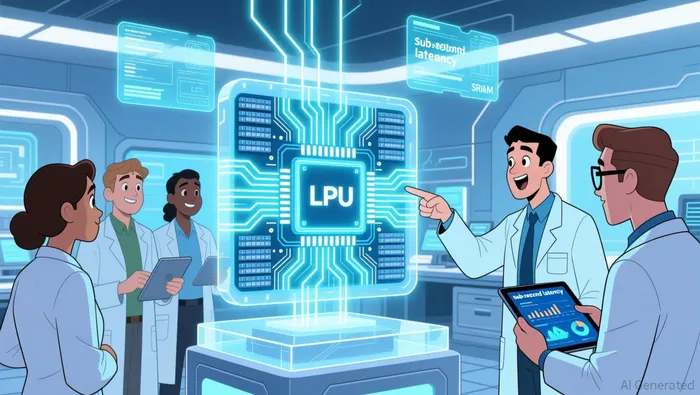
Groq's LPU architecture represents a radical departure from traditional GPU-centric models. Unlike Nvidia's H100 GPUs, which prioritize parallelism and throughput, Groq's single-core, deterministic design emphasizes low-latency execution and on-chip memory locality. This architecture, featuring massive SRAM to minimize data movement, enables sub-second latency and token-per-second performance metrics that outpace even the H100's capabilities in real-time inference tasks. For Nvidia, integrating Groq's compiler-driven execution model-optimized for static scheduling and runtime predictability-could enhance its AI Factory roadmap by addressing bottlenecks in agentic AI and edge computing applications.
However, the strategic fit is not without risks. Groq's LPU is inherently specialized for sequential processing, a niche compared to the broader applicability of GPUs. Analysts caution that this could fragment Nvidia's ecosystem, forcing customers to navigate multiple architectures for training and inference workloads. While the deal secures Groq's 90% workforce and intellectual property, the long-term scalability of LPU-based solutions for large language models remains unproven.
Competitive Implications: Consolidation or Fragmentation?
The Groq deal underscores a broader industry trend: the shift from training to inference as the primary revenue driver in AI. According to Jensen Huang, inference already accounts for 40% of AI-related revenue, with growth projected to accelerate exponentially. By preemptively absorbing Groq's technology, Nvidia aims to neutralize a potential competitor while expanding its technological breadth. This move aligns with its broader capital strategy of building a "capital moat" through strategic acquisitions and partnerships.
Yet, the inference market is becoming increasingly fragmented. Startups like Cerebras and D-Matrix, with their wafer-scale chips and Microsoft-backed architectures, are gaining traction as alternatives to both GPUs and LPUs. The Groq deal may inadvertently validate these niche players, encouraging further specialization and competition. While Nvidia's licensing structure avoids antitrust scrutiny, it also signals a shift toward modular, architecture-specific solutions-a departure from the unified ecosystem it has long championed.
Financial Margins: A Double-Edged Sword
From a financial perspective, the $20 billion investment raises critical questions about margin sustainability. Nvidia's gross margins, already among the highest in the hardware industry at over 50% in 2026, could face downward pressure as inference markets mature and competition intensifies. The integration of Groq's talent and IP, however, may offset these risks by accelerating innovation in energy-efficient inference solutions-a growing priority for cloud providers and edge developers.
Analysts remain divided. Some argue that the deal reinforces Nvidia's ability to monetize AI infrastructure, leveraging its financial strength to outpace rivals. Others warn that the focus on inference could divert resources from training, where competitors like Google's TPUs are gaining ground. The bear case for Nvidia's margins hinges on the scalability of Groq's technology and the pace of inference commoditization.
Reinvigorating NVDA's Stock: A Calculated Bet?
For investors, the Groq deal represents a high-stakes bet on the future of AI. The stock has historically thrived on its dominance in training, but inference's growing economic weight could redefine its value proposition. By securing Groq's deterministic execution model, Nvidia positions itself to capture a larger share of the inference value chain, where latency and power efficiency are critical differentiators.
However, the market's reaction will depend on execution. If Nvidia successfully integrates Groq's technology into its AI Factory ecosystem without disrupting its GPU-centric model, the deal could reinvigorate investor confidence. Conversely, if the LPU's niche appeal fails to translate into broad adoption, the $20 billion investment may be seen as a misstep in an increasingly fragmented landscape.





Comentarios
Aún no hay comentarios