
Nvidia's 2026 Growth Engine: Assessing the Rubin Platform's Market Capture Potential
The core investment thesis for NvidiaNVDA-- hinges on a staggering, near-term growth pipeline. The company has locked in $500 billion in AI demand across 2025 and 2026, a figure confirmed by CEO Jensen Huang and CFO Colette Kress. This visibility is not static; Kress noted the number has already grown since the company's GTC conference in October, with orders for the next-generation Rubin chips already coming in. This represents a massive, contracted revenue stream that provides a clear runway for scaling.
Yet the stock's recent performance tells a different story. Nvidia shares are down about 8% since hitting a record on Oct. 29, a move that reflects investor concerns about the sustainability of AI spending and the rising competitive threat. The market is pricing in a shift from pure demand optimism to a more scrutinized view of execution and competition.
This tension is visible in the financials. Last quarter, data center revenue surged 66% year-over-year, driven by Blackwell sales that are "off the charts." That explosive growth fuels the $500 billion outlook. But it also sets a high bar for the next generation. The company is already seeing orders for Rubin chips, signaling that the pipeline is being filled ahead of the next architectural leap. The challenge is to maintain this pace of scaling as competition intensifies and as the market digests the sheer magnitude of the current demand wave.
The Rubin Platform: A Scalability Play for New Market Segments
The Rubin platform is Nvidia's direct answer to the next phase of AI: the industrial era. This isn't just an incremental upgrade; it's a fundamental architectural shift designed to capture a vastly larger market by making AI operations at scale not just possible, but economical. The core promise is extreme co-design, where hardware, software, and systems are engineered as one unit rather than optimized in isolation. The result is a platform built for the new reality of "always-on AI factories" that continuously convert power and silicon into intelligence.
The numbers are striking. Rubin aims for a 10x reduction in inference token cost and a 4x reduction in the number of GPUs needed to train mixture-of-experts (MoE) models compared to the current Blackwell platform. For a growth investor, this is the ultimate scalability play. Lowering the cost per token directly expands the Total Addressable Market (TAM) by making advanced AI applications viable for a much broader set of enterprise workloads. It shifts the economics from a niche, high-cost compute problem to a utility-like service, opening doors to industries where cost efficiency is paramount.
This focus on scale and efficiency targets a specific, high-growth segment: the industrial phase of AI. As described, this moves beyond discrete training and human-facing chatbots to always-on AI factories that run complex, reasoning-driven workflows 24/7. These factories need to process vast amounts of data in real time, under strict constraints on power, reliability, and security. Rubin's rack-scale architecture, treating the entire data center as a single compute unit, is explicitly designed to meet these demands. It's a platform built for the future of agentic AI and complex reasoning, where the ability to sustain performance at scale is the key competitive moat.
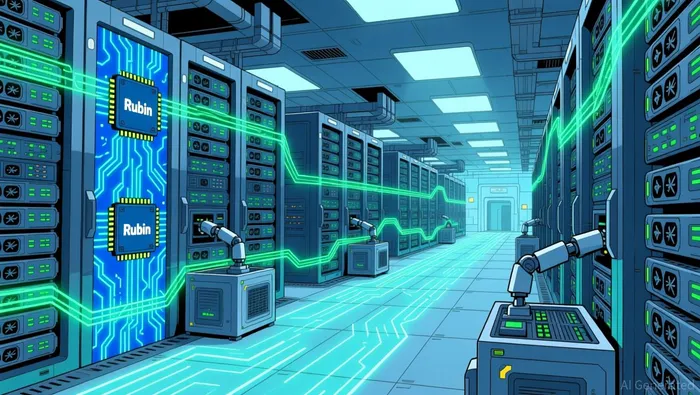
Early adoption signals from the cloud giants are a powerful validation. Microsoft is building next-generation Fairwater AI superfactories powered by Rubin, with plans to scale to hundreds of thousands of Rubin Superchips. AWS is also moving quickly, with CoreWeave among the first to offer Rubin through its Mission Control platform. This isn't speculative interest; it's major infrastructure commitment. When the world's largest cloud operators are building Rubin-powered superfactories, it confirms the platform's technical promise and its potential to become the standard for the next generation of AI deployment.
The bottom line is that Rubin represents a strategic expansion of Nvidia's TAM. By slashing operational costs and enabling unprecedented scale, it moves Nvidia from being a provider of high-performance chips to being the foundational platform for the industrialization of AI. The early partner momentum suggests the company is well-positioned to capture this new, massive market segment.
Financial Impact and Scalability Metrics
The Rubin platform's promise is not just technical; it's a direct lever for Nvidia's financial trajectory. The core metric is cost reduction. Rubin aims for a 10x reduction in inference token cost compared to Blackwell. For a growth investor, this is transformative. It dramatically lowers the barrier to entry for enterprise AI adoption, expanding Nvidia's Total Addressable Market (TAM) from high-end research labs to a vast new cohort of cost-sensitive industrial and commercial applications. This isn't just about selling more chips; it's about creating a new, massive revenue stream by making advanced AI a viable utility.
This expansion is underpinned by a formidable financial base. Nvidia's record Q3 gross margin of 73.6% provides a high-quality earnings engine to fund the Rubin transition. That margin cushion offers significant capital to invest in the platform's ramp-up, R&D, and ecosystem building without immediate pressure on profitability. However, the risk is that this margin sustainability could face headwinds. As competition intensifies and the market matures, there is a clear risk of price erosion and margin pressure, especially as Rubin's efficiency gains make AI more commoditized. The company's ability to maintain premium pricing will be a key test.
The platform's efficiency gains also accelerate capital turnover, a critical metric for scaling. Rubin promises a 4x reduction in the number of GPUs needed to train MoE models and 5x better power efficiency. For Nvidia, this means customers can deploy more AI capacity with less hardware and power, shortening their deployment cycles and accelerating their return on investment. For Nvidia itself, this creates a virtuous cycle: faster customer adoption leads to quicker revenue recognition and improved capital efficiency. The platform's rack-scale architecture, treating the data center as a single compute unit, ensures these gains hold in real-world "always-on AI factories" rather than isolated benchmarks.
The bottom line is that Rubin is a scalability play on two fronts. It expands the TAM by slashing costs, and it improves capital efficiency for both Nvidia and its customers. Combined with the current high-margin earnings base, this sets up a powerful model for sustained revenue growth. The financial impact hinges on executing this transition while navigating the competitive pressures that could challenge the premium margins that currently fund it.
Catalysts, Risks, and What to Watch
The path from Rubin's launch to sustained growth is now defined by a clear set of near-term milestones and mounting risks. The primary catalyst is the transition from promise to revenue. Nvidia is scheduled to begin first revenue recognition from Rubin NVL72 rack-scale systems in 2026. The early adopters are already committed, with Microsoft building next-generation Fairwater AI superfactories and CoreWeave among the first to offer the platform. This isn't a distant future; it's the immediate test of Rubin's scalability and market capture. Success here will validate the platform's design and provide the first concrete data on customer adoption rates and pricing power.
The most significant risk to this thesis is the acceleration of customer in-house chip development. As Nvidia's dominance fuels the AI boom, its largest clients are investing heavily to reduce dependency. The company faces the real prospect that customers such as Alphabet will rely more heavily on their in-house designed chips and buy fewer Nvidia products down the road. This trend is compounded by intense competitive pressure from AMD and a wave of specialized AI chip startups. The market is no longer a monopoly; it's a battleground where Nvidia must defend its premium position while expanding into new segments.
The key watchpoint for investors will be the health of Nvidia's financial engine. The company's record Q3 gross margin of 73.6% provides a critical cushion for the Rubin transition. However, scaling production and managing customer negotiations for this new platform will be a test of its pricing power. The risk is that as Rubin's efficiency gains make AI more commoditized, the market may demand lower prices, pressuring the ~73% margin that currently funds the company's aggressive R&D and capital expenditure. Any sustained margin erosion would directly challenge the financial model underpinning the $500 billion growth pipeline.
In short, 2026 is the year of validation. The Rubin ramp will show if Nvidia can successfully transition to the next generation of AI. But the path is fraught with the dual threats of customer defection and competitive fragmentation. The company's ability to maintain its financial strength while navigating these pressures will determine whether the growth story continues to scale or begins to plateau.







Comentarios
Aún no hay comentarios