
Nvidia's 2026 Catalyst: China Access vs. AI Bubble Fears
The new year opened with a mixed signal, setting a cautious tone for 2026. The S&P 500 rose just 0.19% on Friday, but the broader picture is one of a sputtering seasonal rally. The index is down nearly 1% over the traditional "Santa Claus rally" period, marking a third consecutive down stretch. This shaky start is critical because it tests the January Barometer, a historical indicator with an 84% accuracy rate for predicting the year's direction. A positive close for January would be a bullish signal, while a weak finish could portend a volatile year ahead.
The market's mood is one of selective optimism. While the broader indices inched higher, a clear sector rotation was underway. Chipmakers like NvidiaNVDA-- gained 2% on positive corporate developments, but AI software giants fell sharply. Microsoft, Amazon, and others dropped between 2% and 5%, reflecting a market now questioning whether their promised AI capital expenditure is being overdone. This skepticism is the new reality: investors are moving from broad tech enthusiasm to a focus on fundamentals and execution.
For Nvidia, this sets a high-stakes stage. Its near-term stock trajectory hinges on two catalysts: executing its return to the Chinese market and delivering a compelling roadmap at the upcoming CES 2026 trade show. The company's CEO, Jensen Huang, will take the stage from January 6-9, a moment where he must strike a confident tone to justify the massive spending that fueled the last bull run. The market is now differentiating between winners and losers, and Nvidia must prove it remains the leader.
Nvidia's Specific Catalysts: China and CES
The near-term catalysts for Nvidia are concrete and time-bound. The first is a potential policy shift executed through a specific timeline. The company aims to begin shipping its H200 chips to China by mid-February, using existing stock. This move follows a U.S. policy shift that gave Nvidia the green light for these sales, with the condition that it offer 25% of its China chip sales to the U.S. The execution risk is clear: China has not yet officially approved the H200's entrance, and any delay there could be problematic. Yet, the plan to ship by mid-February provides a tangible, near-term revenue catalyst if approved.
The second catalyst is a major communications event. CEO Jensen Huang will deliver a keynote at CES 2026 on January 5. Investors will be watching for clarity on the company's direction, particularly regarding AI and robotics. The event is not expected to unveil new gaming GPUs, but rather to provide a strategic update on the "next steps of AI" and Nvidia's push into physical AI and robotics. This is a chance for management to address market concerns about an AI bubble and reinforce the long-term platform shifts driving demand.
Finally, the company has significant near-term visibility. CFO Colette Kress stated on the latest earnings call that Nvidia has visibility to half a trillion dollars in Blackwell and Vera Rubin revenue from the start of this year through the end of calendar year 2026. This provides a strong forward view for the core AI business, which is critical for sustaining the current growth trajectory.
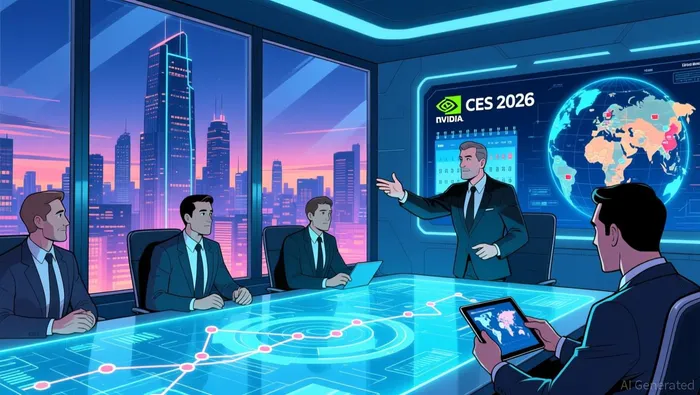
The bottom line is that these are distinct, event-driven catalysts. The China shipment is a policy-execution play with a February deadline. The CES keynote is a communications event for strategic clarity. And the $500 billion revenue visibility is a fundamental indicator of sustained demand. For investors, the setup is to watch for confirmation of the China shipment timeline and a positive strategic signal from CES, both of which would support the company's ambitious revenue forecast.
Financial Impact and Execution Risks
The financial upside from Nvidia's catalysts is massive but hinges on flawless execution. The company's fiscal Q4 revenue forecast of $65 billion represents a staggering 65% year-over-year jump, demonstrating that demand for its AI infrastructure is accelerating, not cooling. This visibility extends far into the future, with the company citing half a trillion dollars in Blackwell and Rubin revenue from now through 2026. The potential return from this growth trajectory is clear.
Yet the path to capturing that revenue is fraught with operational complexity. Nvidia must simultaneously ramp production of its H200 chips for the newly accessible China market while maintaining supply for its newer, higher-margin Blackwell platform globally. The company has reportedly asked its Taiwanese manufacturer to increase output for two million H200s for 2026, a significant logistical challenge. Any misstep in production planning or supply chain management could strain capacity and delay shipments, threatening the execution of its ambitious growth plan.
This execution pressure is mirrored in the broader AI software sector, where the market is questioning the sustainability of capital expenditure. The recent sell-off in names like Microsoft, Meta, Amazon, and Palantir reflects a sharp debate over whether these companies have over-committed to AI spending. For Nvidia, this creates a dual risk: if software providers cut back on capex, demand for its chips could soften. At the same time, the company's own aggressive production ramp for H200 in China introduces a new layer of geopolitical and regulatory uncertainty, as the market awaits official approval for the chips to enter the country.
The bottom line is a high-stakes balancing act. Nvidia's financial forecast is a powerful bullish signal, but the tangible upside depends on its ability to navigate complex production demands and a market that is now scrutinizing the durability of AI spending. The risk is not of missing a target, but of failing to meet the market's heightened expectations for flawless execution.
Catalysts and Risks: What to Watch
The near-term trajectory for Nvidia hinges on a few specific catalysts and risks that will test the strength of its AI dominance. The most concrete near-term event is the potential return to China. Nvidia has reportedly asked Taiwan Semiconductor Manufacturing to increase production for two million H200s for 2026 and aims to begin shipping them to China using existing stock by mid-February. This hinges on an official Chinese approval, which has not yet been granted. A successful, timely rollout would unlock a significant market, as sales to China represented 13% of Nvidia's overall revenue last fiscal year. Any delay or setback here would be a direct hit to near-term growth expectations.
The broader market tone for 2026 is also a key risk. The January Barometer has a strong historical track record, and the early days have been shaky. The Santa Claus rally failed, and the first trading days showed volatility. A negative start could set a bearish tone for the year, especially if combined with other headwinds. Another immediate sector risk is the sustainability of AI spending. The market is already scrutinizing whether AI software providers have overdone their pledges of AI capital expenditure. Recent moves show this skepticism in action, with giants like Microsoft and Meta seeing sharp pullbacks on the first trading day of the year. If enterprise AI capex commitments disappoint in the coming quarters, it could trigger a broader sector rotation away from tech.
Investors should watch two specific events for signals. First, CEO Jensen Huang's keynote at CES 2026, scheduled for January 5-9, will be a key moment. Beyond the usual AI hype, the focus will be on practical applications and platform shifts, particularly in emerging areas like robotics. The market is now more discerning, differentiating between winners and losers, and Huang's message will need to justify Nvidia's premium valuation. Second, the upcoming U.S. jobs report is a critical economic gauge. The December nonfarm payrolls are expected to show 65,000 jobs added. While the market has looked past some labor weakness, a significant crack in the jobs market-like a rise in the unemployment rate past 5%-could combine with any AI disappointment to create a dangerous confluence of growth and technology worries.
The bottom line is a setup defined by binary catalysts and clear risks. The H200 China shipments are a tangible, near-term event with a yes/no outcome. The January Barometer and AI capex validation are broader market forces that could set the tone. And the CES keynote and jobs report are the specific data points that will confirm or challenge the bullish narrative. For Nvidia, the path forward requires navigating these specific events with precision.







Comentarios
Aún no hay comentarios