
NVIDIA's 2026 AI Ecosystem Expansion and Its Implications for Long-Term Stock Performance
NVIDIA's strategic moves in 2026 position it as a dominant force in the AI industrial revolution, with a multi-layered approach to infrastructure dominance, supply chain resilience, and R&D innovation. By integrating Groq's AI inference technology, expanding its robotics platform, and deepening partnerships with industry leaders, NVIDIANVDA-- is not only securing its leadership in AI but also creating a self-reinforcing ecosystem that could drive sustained stock performance.
Strategic Infrastructure Dominance: The Groq Partnership
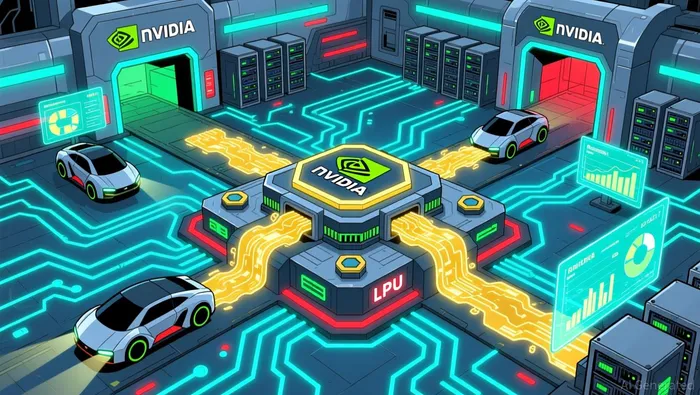
NVIDIA's $20 billion licensing agreement with Groq represents a pivotal shift in its AI strategy. By acquiring Groq's low-latency language processing units (LPUs) and hiring key personnel like Groq's founder Jonathan Ross and President Sunny Madra, NVIDIA is addressing the growing demand for efficient AI inference-a critical but historically underserved segment of the AI market. Groq's energy-efficient, high-performance LPUs complement NVIDIA's GPU-centric training dominance, enabling the company to offer a comprehensive AI stack. This move also strengthens NVIDIA's position against rivals like AMD and Intel, who are scrambling to close the gap in inference capabilities. Analysts note that the integration of Groq's technology into NVIDIA's AI factory architecture will enhance real-time workloads, from autonomous systems to enterprise applications, ensuring a first-mover advantage in the 2026 AI cycle.
Supply Chain Resilience and Robotics: The Mega Omniverse Blueprint
NVIDIA's 2026 expansion extends beyond chips to include robust supply chain solutions. The Mega Omniverse Blueprint, a collaboration with Siemens and FANUC, leverages digital twins to optimize manufacturing and logistics. Companies like Caterpillar and Toyota are already using these tools to simulate production lines, reduce downtime, and improve predictive maintenance. This initiative aligns with global efforts to decouple supply chains from geopolitical risks, a trend that could see NVIDIA's software solutions become indispensable for industrial clients.
Simultaneously, NVIDIA's three-computer architecture is revolutionizing robotics. By partnering with Agility Robotics and Figure, NVIDIA is enabling collaborative robots (cobots) to perform complex tasks such as dexterous manipulation and step recovery. These cobots, trained via millions of reinforcement learning scenarios, are poised to transform industries ranging from logistics to healthcare. The integration of AI-driven robotics into NVIDIA's ecosystem underscores its vision of a "phygital" (physical + digital) future, where software and hardware innovations converge.
AI-Driven R&D Alliances: Synopsys and the Genesis Mission
NVIDIA's R&D partnerships are accelerating its technological edge. A $2 billion investment in Synopsys has enabled faster simulation speeds and AI-driven engineering workflows, reducing design cycles for semiconductor and automotive clients. This collaboration, which combines CUDA-accelerated computing, with agentic AI, is a cornerstone of NVIDIA's strategy to dominate the next phase of AI-driven design.
In the public sector, NVIDIA's Genesis Mission with the U.S. Department of Energy is advancing AI applications in energy, manufacturing, and national security. By focusing on robotics and digital twins, this partnership aligns with broader U.S. efforts to maintain technological leadership. Meanwhile, the NVIDIA AI Factory for Government reference design-adopted by defense contractors like Lockheed and Northrop Grumman-ensures compliance with stringent security standards, opening new revenue streams in the public sector.
Institutional Confidence and Price Target Trends
The investment case for NVIDIA is further reinforced by institutional buying and bullish price targets. Institutions now own over 65% of NVIDIA's stock, with consistent purchases in 2025. Analysts project a 34% to 40% rally in 2026, with average price targets ranging from $256 to $262. More aggressive estimates, such as Tigress Financial's $350 target (84.75% upside), reflect confidence in NVIDIA's ability to monetize its AI infrastructure dominance. This optimism is driven by NVIDIA's expanding role in data centers, autonomous systems, and its strategic acquisitions like the Groq deal.
Conclusion: A Multi-Layered Engine for Sustained Growth
NVIDIA's 2026 AI ecosystem expansion is a masterclass in strategic infrastructure dominance. By securing Groq's inference technology, building resilient supply chains, and pioneering AI-driven R&D, NVIDIA is creating a self-reinforcing cycle of innovation and market capture. These initiatives, combined with strong institutional support and favorable price targets, suggest that NVIDIA's stock is well-positioned for long-term outperformance. As the AI industrial revolution accelerates, NVIDIA's ability to execute across multiple layers-hardware, software, and partnerships-will likely cement its status as the defining platform for AI in the 2020s and beyond.







Comentarios
Aún no hay comentarios