
Nvidia's $20 Billion Groq Deal: Strategic Consolidation or Overpayment for Inference Dominance?
Nvidia's $20 billion deal for Groq is not an acquisition of a startup; it is a defensive consolidation of its AI empire. The move is a direct response to a credible structural threat in the market's next phase. As the AI industry shifts from training massive models to deploying them at scale, the hardware requirements change fundamentally. Here, Groq's specialized architecture presents a clear competitive edge. Independent benchmarks show its Language Processing Unit (LPU) achieves a for Llama 2, more than double the speed of other providers. This isn't incremental improvement-it represents a step change in available speed, enabling new use cases where low latency and deterministic performance matter more than raw parallel compute power.
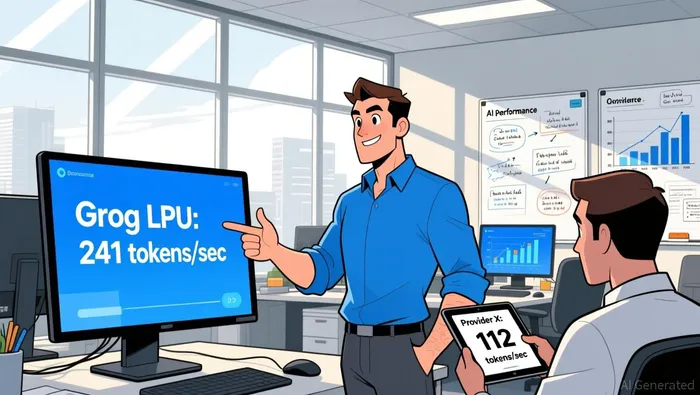
This performance advantage directly challenges Nvidia's dominance in inference workloads, where its general-purpose GPUs face a structural vulnerability. The $20 billion valuation, representing nearly a , is the price of neutralizing this threat. By securing both the technology and the team that built it-led by Jonathan Ross, the father of Google's TPU-Nvidia ensures no viable alternative can emerge to challenge its market share. The deal effectively locks down the burgeoning AI inference market, .
The strategic logic is clear. While Nvidia's GPUs have powered the AI boom, the shift to inference demands more specialized chips. Groq's pedigree, built on the same Google TPU team that Ross led, gives it a technical foundation that general-purpose hardware struggles to match. By integrating this expertise, NvidiaNVDA-- leverages its balance sheet and platform incumbency to offer more customer choice while simultaneously eliminating a potential disruptor. This is the ultimate consolidation play: a $20 billion premium paid not for a product, but for the peace of mind that comes from neutralizing a credible competitive threat before it can scale.
The Mechanics: From Licensing to De Facto Acquisition
Nvidia's deal with Groq is a masterclass in strategic acquisition-by-proxy. The structure is deliberate: a non-exclusive licensing agreement for Groq's inference technology, coupled with the onboarding of Groq's senior management team, including founder Jonathan Ross and President Sunny Madra. This creates a hybrid entity where Nvidia gains critical IP and talent while allowing Groq to continue operating as an independent company. It's a far cry from a simple purchase; it's a controlled integration that adds layers of complexity to Nvidia's future roadmap.
The comparison to the 2019 acquisition of is instructive. That deal was a classic consolidation, bringing a key technology (InfiniBand networking) fully under Nvidia's control to build its "scaling moat." The Groq deal is different. As Bank of America notes, Groq's language processing unit is a different kind of hardware from Nvidia's GPUs. This isn't about absorbing a complementary product line; it's about integrating a distinct architectural approach into a platform that already dominates training. The result is a dual-path future: Nvidia must now manage and potentially compete between its own GPU-based inference solutions and the Groq LPU technology it has licensed and is now advancing with its own team.
This dual-track strategy introduces significant friction. It will complicate Nvidia's future GPU/LPU roadmap and pricing strategies. How does the company position its own AI chips against a technology it now controls through licensing? Will the Groq LPU become a premium offering, a cost-leader, or a niche solution? The answer will shape competitive dynamics and customer choice for years. For now, the move is a defensive hedge. As BofA suggests, it's a way to potentially address competitive threats from Groq and other specialized ASIC chip manufacturers.
The bottom line is that Nvidia is leveraging its balance sheet and platform incumbency to offer more customer choice, but at the cost of internal complexity. By paying a reported for this arrangement, Nvidia is betting that its scale and ecosystem can successfully manage two inference paradigms. The success of this strategy will depend on whether it can seamlessly integrate the Groq talent and technology without fragmenting its own roadmap or cannibalizing its core GPU business. It's a high-stakes gamble on platform management, not just technology acquisition.
Financial Implications and Valuation Stretch
Nvidia's $20 billion licensing deal for Groq's technology is a strategic move of historic scale, but it comes at a steep financial and valuation cost. The cash outlay represents the company's largest acquisition to date, dwarfing its from 2019. That earlier purchase laid the groundwork for Nvidia's dominant networking "scaling moat." The Groq deal, by contrast, is a direct bet on a different kind of hardware-Groq's Language Processing Unit-that is designed for the inference phase of AI workloads. This signals a recognition that while GPUs have powered training, the future may require more specialized chips, a shift that analysts like BofA see as a necessary hedge against competition.
The premium paid for this technology is a clear market signal. The deal's size, even for a company with a , suggests the market is pricing in a high probability that Groq's LPU will become a key component of Nvidia's future inference offerings. It's a strategic insurance policy, but one that injects complexity into Nvidia's roadmap and pricing strategy. The move is seen as a defensive play to maintain its platform incumbency, allowing it to offer more customer choice while leveraging its massive scale.
This aggressive spending occurs against a backdrop of already sky-high valuations. Nvidia's stock has , and the recent deal news has pushed it higher still. The bar for future returns has been dramatically raised. While analysts like BofA and Baird maintain bullish price targets of $275, the sheer magnitude of the $20 billion outlay means the investment must deliver exceptional returns to justify the premium. The financial implication is that Nvidia is now paying for a future capability that is not yet proven to be a core part of its profitable business model. The valuation stretch is real, and the market's initial positive reaction may be more about the strategic narrative than the immediate financial impact.
Risks, Constraints, and the Path to Integration
Nvidia's $20 billion licensing deal for Groq's technology is a masterstroke of defensive consolidation, but it is not without significant execution risks and integration challenges. The core tension lies in merging two fundamentally different hardware philosophies. Nvidia's GPUs are built for dynamic, general-purpose workloads, while Groq's LPU is a purpose-built, static-scheduling chip optimized for a single task: low-latency inference. This architectural divergence is not a minor software update; it is a deep-seated systems-level difference that could create friction in Nvidia's product roadmap and customer offerings.
The primary risk is integration failure. Groq's LPU architecture eliminates the latency bottlenecks of traditional GPUs by using as primary weight storage and employing static scheduling that pre-computes execution graphs. This allows for deterministic performance and advanced parallelism strategies like pipeline parallelism atop tensor parallelism. For Nvidia, the challenge is not just incorporating this hardware but harmonizing its software stack, development tools, and customer support around a new, specialized inference engine. The deal's complexity is underscored by BofA's note that it could add complexity to Nvidia's future GPU/LPU roadmap and pricing strategies. Successfully managing this dual-stack ecosystem-where customers must choose between a general-purpose GPU and a specialized LPU-requires flawless execution to avoid confusing the market or cannibalizing its own existing GPU business.
A more insidious risk is self-cannibalization. Nvidia's GPU inference business is a major profit center. If Groq's LPU technology proves superior and is offered as a separate, potentially cheaper option, it could undercut demand for Nvidia's own inference-optimized GPUs. The deal's non-exclusive nature is a strategic hedge, but it also means Nvidia is effectively licensing a technology that could one day compete with its core product line. The company must navigate this delicate balance: leveraging Groq's innovation to fend off external competitors while ensuring it does not become a disruptive force within its own portfolio.
Finally, the deal's ultimate success hinges on Nvidia's ability to scale Groq's technology to meet the massive, real-time inference demands of its cloud and enterprise customers. Groq's architecture has demonstrated its prowess in niche, high-performance scenarios, such as running a with low latency. Scaling this performance to the petabyte-scale, multi-tenant environments of hyperscalers like AWS, Azure, and Google Cloud is a vastly different engineering challenge. It requires not just chip design but robust, high-bandwidth interconnects and system-level optimizations that have yet to be proven at that scale. In practice, the $20 billion investment buys Nvidia a powerful defensive weapon and a technological edge, but it also commits the company to a complex integration and scaling journey. The path to a seamless, profitable future for both technologies is paved with significant technical and strategic hurdles.





Comentarios
Aún no hay comentarios