
Nvidia's $20 Billion Groq Deal and the Future of AI Inference Dominance
In a bold move to cement its leadership in the AI revolution, , a pioneering AI chip startup. This deal, structured as a strategic "," allows NvidiaNVDA-- to integrate Groq's cutting-edge Language Processing Unit (LPU) technology and its elite engineering team while avoiding the regulatory pitfalls of a traditional acquisition. The transaction not only underscores Nvidia's commitment to dominating the AI inference market but also highlights its calculated approach to navigating antitrust scrutiny in an era of rapid technological consolidation according to CNBC.
Strategic Moat Expansion: From Training to Inference
Nvidia's dominance in AI training has long been unchallenged, . However, the inference market-where real-time AI applications like chatbots, autonomous vehicles, and personalized recommendations operate-has remained a critical frontier. Groq's architecture, designed for deterministic, low-latency processing, addresses a key limitation of GPU-based inference: memory bottlenecks. By licensing this technology, Nvidia gains access to a solution that optimizes on-chip SRAM for faster data access, a feature critical for applications demanding millisecond-level response times.
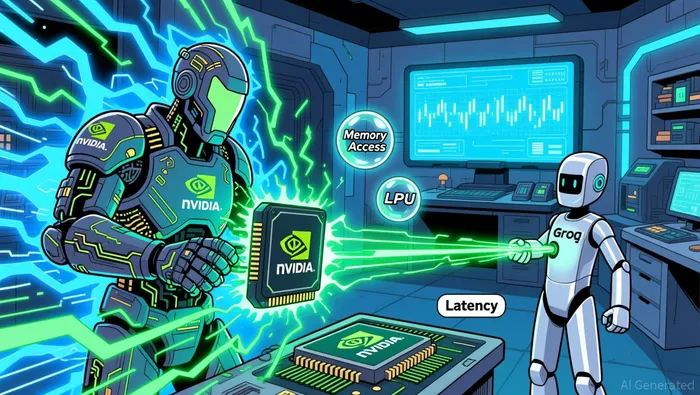
The deal also neutralizes a potential competitor. Groq, , had been positioning itself as a challenger to Nvidia's inference dominance. By acquiring Groq's intellectual property and key personnel-including co-founder Jonathan Ross (a former Google lead) and president Sunny Madra)-Nvidia ensures that its rivals cannot replicate Groq's breakthroughs according to a recent analysis. This dual strategy of technological integration and talent acquisition strengthens Nvidia's "moat" by deepening its R&D capabilities and accelerating its roadmap for inference-specific hardware.
Navigating Antitrust Challenges
The non-exclusive nature of the agreement is a masterstroke in regulatory strategy. Unlike full acquisitions, which often trigger antitrust investigations, licensing deals allow companies to collaborate without triggering ownership-based scrutiny. This approach mirrors recent moves by Microsoft and Google, which have opted for partnerships over acquisitions to avoid regulatory hurdles. For Nvidia, this structure ensures compliance while enabling it to absorb Groq's innovations and expertise. , offering a financial windfall for investors according to CNBC.
AI Inference Market Growth: A $94 Billion Opportunity
The strategic value of the Groq deal becomes even clearer when viewed through the lens of market projections. , . This growth is driven by industries like finance, healthcare, and retail, where real-time decision-making is becoming table stakes according to Markets and Markets.
Nvidia is uniquely positioned to capitalize on this expansion. Its Blackwell architecture and Rubin CPX GPU, already at the forefront of AI hardware innovation, will now be complemented by Groq's LPU technology. , fueled by its dominance in both training and inference markets. , assuming continued leadership in AI infrastructure according to The Fool.
Long-Term Leadership and Risks
While the Groq deal solidifies Nvidia's short-term advantages, long-term risks persist. Cloud providers like Amazon and Microsoft are increasingly developing custom AI chips, threatening to erode Nvidia's market share. Additionally, geopolitical tensions, particularly in China-a key growth market-could disrupt supply chains or limit access to critical technologies according to Yahoo Finance. However, Nvidia's ecosystem and strategic partnerships (e.g., with Microsoft Azure and Google Cloud) provide a buffer against these challenges. The company's ability to integrate Groq's talent into its existing R&D pipeline also ensures a steady stream of innovation, a critical factor in maintaining its edge according to EETimes.
Conclusion
Nvidia's $20 billion Groq deal is more than a financial transaction-it is a strategic masterclass in expanding a competitive moat. By securing Groq's LPU technology, neutralizing a potential rival, and navigating regulatory constraints, Nvidia has positioned itself to dominate the AI inference market as it surges toward $94 billion. For investors, this move signals a company that is not only adapting to the AI revolution but actively shaping its trajectory. As the demand for real-time AI applications accelerates, Nvidia's leadership in both training and inference will likely remain unchallenged-provided it continues to execute with the same precision demonstrated in this landmark deal.







Comentarios
Aún no hay comentarios