
Nvidia's $2 Billion Synopsys Investment and the Future of AI-Driven Engineering
The semiconductor industry is undergoing a seismic shift, driven by the relentless demand for AI-powered solutions. , a strategic move that underscores the company's commitment to dominating the AI semiconductor ecosystem. This partnership, announced in 2025, is not merely a financial transaction but a calculated step to accelerate the integration of AI into engineering workflows, solidify Nvidia's leadership in AI infrastructure, and address the escalating complexity of chip design.
Strategic Capital Allocation: A Win-Win for NvidiaNVDA-- and Synopsys
. By acquiring a stake in SynopsysSNPS--, a leader in (EDA) tools, Nvidia is effectively securing a critical link in the AI chip design chain. Synopsys' AI-driven design platforms, such as its Synopsys.ai suite, are indispensable for optimizing Power, Performance, and Area metrics in next-generation AI accelerators. This partnership allows Nvidia to leverage Synopsys' expertise to enhance its own AI-Physics technologies and CUDA-X libraries, enabling faster and more efficient simulations across scales-from atoms to entire systems according to market analysis.
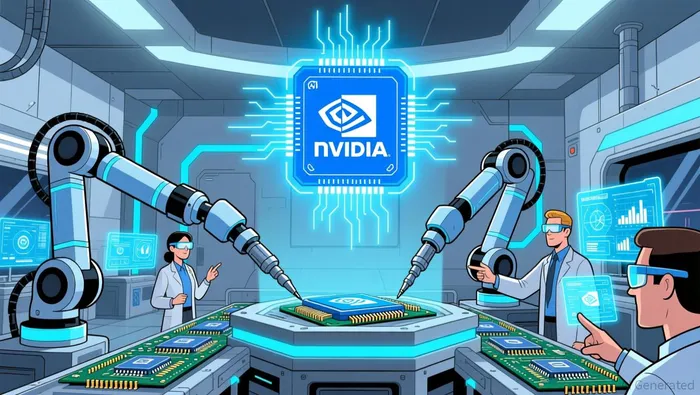 The investment also aligns with Nvidia's broader capital allocation strategy. Over the past year, the company has poured billions into AI startups, cloud platforms, and infrastructure partnerships, according to financial reports. These moves reflect a disciplined approach to locking in key players in the AI ecosystem, ensuring Nvidia remains at the forefront of AI-driven innovation.
Ecosystem Dominance: Strengthening the AI Infrastructure Flywheel
Nvidia's dominance in the AI semiconductor industry is unparalleled. The company for data centers and is the de facto standard for AI training and inference workloads. Its Blackwell and Rubin CPX architectures are setting new benchmarks for performance, while its CUDA software ecosystem continues to attract developers and enterprises. The Synopsys partnership further cements this dominance by addressing a critical bottleneck: the complexity of designing AI-specific hardware.
Synopsys, in turn, benefits from Nvidia's vast resources and market reach. By integrating its technology with Nvidia's AI toolkits, Synopsys is positioning itself as a key player in agentic AI engineering-a field poised for explosive growth. The collaboration also accelerates the development of cloud-ready engineering solutions, a necessity in an era where time-to-market pressures are intensifying.
Competitive Landscape: Nvidia's Moat in a Crowded Market
While competitors like Broadcom and AMD are making strides in AI hardware, Nvidia's ecosystem advantages remain formidable. Its partnerships with cloud providers, foundries, and AI startups create a flywheel effect: the more companies rely on Nvidia's hardware and software, the harder it becomes for rivals to displace it. The Synopsys investment exemplifies this strategy, as it not only enhances Nvidia's internal capabilities but also strengthens its relationships with foundries like TSMC and Samsung, which are critical for manufacturing AI chips according to industry analysis.
Moreover, Nvidia's financial performance reinforces its competitive edge. In Q2 FY2026, the company , . These figures highlight its ability to convert AI investments into high-margin revenue, a rarity in the capital-intensive semiconductor industry.
The Road Ahead: AI as the Semiconductor Industry's Growth Engine
The AI semiconductor market is projected to grow exponentially, driven by generative AI's insatiable demand for computing power. According to Yole Group, AI is no longer just a workload but the semiconductor industry's primary growth engine, with memory and storage requirements expanding rapidly. Nvidia's Synopsys partnership is a strategic bet on this future, enabling the development of digital twins via NVIDIA Omniverse and accelerating the adoption of GPU-accelerated engineering solutions across industries according to official statements.
However, challenges remain. Rising competition, particularly from TPU alternatives and open-source AI frameworks, could erode margins. Yet, Nvidia's vertical integration-spanning hardware, software, and networking-provides a durable moat. further underscores its long-term vision.
Conclusion: A Strategic Bet on the Future
Nvidia's $2 billion investment in Synopsys is more than a financial play-it's a strategic move to future-proof its dominance in the AI semiconductor ecosystem. By combining Synopsys' design expertise with its own AI and accelerated computing capabilities, Nvidia is addressing the systemic complexity of next-generation chip design while reinforcing its position as the go-to provider for AI infrastructure. according to market projections, this partnership positions Nvidia to capture a significant share of the growth, making it a compelling long-term investment for those willing to ride the AI wave.







Comentarios
Aún no hay comentarios