
NVIDIA's $2 Billion Stake in Synopsys: A Strategic Bet on AI-Driven Semiconductor Innovation
Strategic Synergy: NVIDIA and SynopsysSNPS-- Redefine Engineering Workflows
NVIDIA's investment in Synopsys is more than a financial commitment-it is a strategic alliance to integrate AI-driven innovations into the core of semiconductor design. The collaboration focuses on three pillars: accelerating compute-intensive applications using NVIDIA's CUDA-X libraries, advancing , and developing capabilities via NVIDIA Omniverse. These initiatives aim to streamline workflows for industries such as semiconductors, aerospace, and automotive, enabling R&D teams to design and verify intelligent products with greater precision and speed.
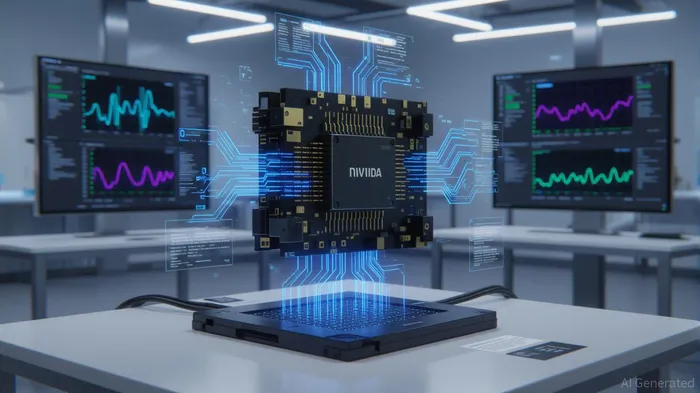
Synopsys, a leader in EDA tools, already commands a significant market share, with in revenue in 2025, . The partnership with NVIDIA enhances Synopsys' AI-driven design capabilities, particularly through the integration of NVIDIA's into Synopsys' simulation and verification tools. This synergy is expected to reduce development costs and time-to-market pressures, critical advantages in an industry where innovation cycles are accelerating.
Competitive Positioning: NVIDIA's Ecosystem vs. AMD and Intel
NVIDIA's dominance in the AI chip market--is underpinned by its advanced GPU technology, such as the Blackwell series, and strategic partnerships with hyperscalers and foundries. However, competitors like AMD and Intel are closing the gap. , , driven by its full-stack AI solutions, including Instinct MI300 accelerators and the . AMD's CEO, , has over the next five years, .
Intel, meanwhile, faces headwinds, including declining data center sales and a weak position in foundry services, where TSMC dominates. While Intel has partnered with NVIDIA, its ability to challenge NVIDIA's leadership remains uncertain. The investment in Synopsys allows NVIDIA to further entrench its ecosystem by influencing the early stages of chip design, ensuring that its AI tools become indispensable to semiconductor developers.
Long-Term Value Creation: Risks and Opportunities
The partnership's long-term value hinges on its ability to drive adoption of GPU-accelerated engineering solutions. Synopsys' global sales network, combined with NVIDIA's technological edge, positions the duo to capture market share in cloud-ready design tools. However, the non-exclusive nature of the partnership means NVIDIA must balance collaboration with Synopsys against maintaining relationships with other semiconductor players. For AMD and Intel, the challenge lies in replicating NVIDIA's ecosystem. AMD's focus on developer lock-in through ROCm and partnerships with hyperscalers like Microsoft and OpenAI could disrupt NVIDIA's dominance, but its AI chip market share remains a fraction of NVIDIA's. Intel's struggles with innovation and market share losses in foundry services further limit its immediate threat.
Conclusion: A Calculated Move in a High-Stakes Game
NVIDIA's $2 billion stake in Synopsys is a strategic bet on the future of AI-driven semiconductor innovation. By integrating its AI technologies into Synopsys' EDA tools, NVIDIA not only strengthens its control over the design phase but also accelerates the adoption of GPU-accelerated workflows across industries. While AMD and Intel pose growing challenges, NVIDIA's ecosystem, technological lead, and strategic partnerships provide a formidable barrier to entry. For investors, the partnership underscores NVIDIA's commitment to maintaining its leadership in an AI-driven world, though the evolving competitive landscape will require continued innovation and adaptability.







Comentarios
Aún no hay comentarios