
NVIDIA's $1B Bet on Lilly: Assessing the AI Drug Discovery S-Curve
This $1 billion partnership is a high-stakes bet on the convergence of AI and biology, aiming to capture the exponential growth of the AI drug discovery market by building proprietary infrastructure. The core thesis is to capture the foundational layer of a new paradigm, much like NVIDIANVDA-- did with GPUs for AI itself.
The commitment is substantial: up to $1 billion in talent, infrastructure and compute over five years. This isn't a token collaboration; it's a dedicated, incremental investment from both sides. LillyLLY-- brings its deep drug R&D expertise and laboratory infrastructure, while NVIDIA provides its AI capabilities, including open biology models and DGX Cloud capacity. The physical manifestation is a new co-innovation lab in the Bay Area, where scientists from both firms will work side-by-side, creating a lab-in-the-loop workflow designed for rapid experimentation.
The technological foundation is NVIDIA's own stack. The lab's infrastructure will be built on the NVIDIA BioNeMo platform and the NVIDIA Vera Rubin architecture. BioNeMo is specifically designed to accelerate the most expensive parts of AI model development for biopharma, offering curated tools and recipes for DNA, RNA, and protein data. This move positions NVIDIA to capture the infrastructure layer of a market projected to grow from $6.93 billion in 2025 to approximately $17.81 billion by 2035. That's a compound annual growth rate of nearly 10% over the decade, but the real opportunity lies in the exponential adoption curve that often follows a technological S-curve. By embedding its platform and architecture into the core discovery process at a major pharma, NVIDIA is betting it can become the indispensable compute layer for the next generation of medicine.
The Exponential Growth Engine: Metrics and Financial Impact
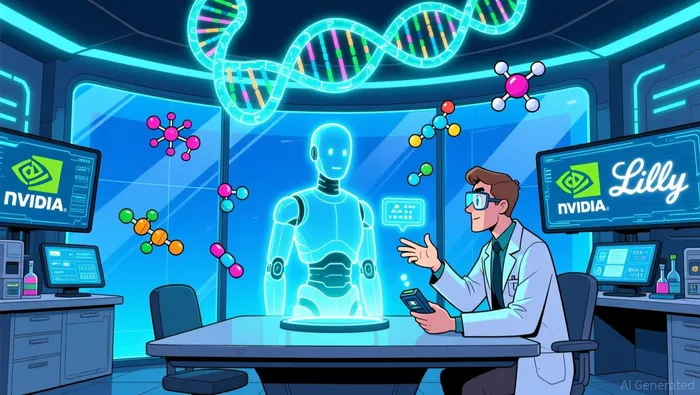
The partnership's promise hinges on translating its massive compute power into measurable compression of the drug discovery timeline. The centerpiece is Lilly's new AI factory, a world's first NVIDIA DGX SuperPOD with DGX B300 systems powered by 1,016 NVIDIA Blackwell Ultra GPUs. This isn't just a supercomputer; it's an industrial-scale engine designed to train the largest biomedical models, aiming to accelerate the entire discovery and development lifecycle.
The financial impact for both companies is rooted in attacking a colossal cost base. The biopharma industry currently spends an estimated $300 billion a year on R&D. By enabling AI-driven model training and validation at an unprecedented scale, the partnership aims to drastically reduce the time and resources required to identify viable drug candidates. This compression of the discovery timeline is the core lever for reducing costs and increasing the probability of success-a fundamental shift in the industry's economic model.
For NVIDIA, the financial story is one of capturing the infrastructure layer of this new paradigm. The company's stock, while showing recent volatility with a -1.531% change over the last five days, has delivered a powerful 42.32% rolling annual return. That long-term momentum reflects market confidence in its role as the indispensable compute provider for exponential growth sectors. The Lilly deal is a direct bet on that thesis, embedding NVIDIA's full-stack architecture-hardware, networking, and software-into the core workflow of a major pharmaceutical innovator.
The setup creates a flywheel effect. Lilly's proprietary data, now being used to train frontier models, will be fed back into the system, improving AI accuracy and speed. Some of these models will be made available via Lilly's TuneLab platform, which uses NVIDIA's federated learning infrastructure. As more biotech firms participate, the models improve, further accelerating discovery across the ecosystem. This network effect amplifies the value of the initial $1 billion investment, turning a single partnership into a potential industry-wide standard. The bottom line is that this deal is about building the rails for a technological S-curve, where the financial returns will follow the adoption rate of AI-driven medicine.
Catalysts, Scenarios, and Key Risks
The partnership's forward path is now set, with clear milestones that will validate its exponential growth thesis. The primary catalyst is the opening of the co-innovation lab in the Bay Area by the end of March. This physical convergence of Lilly's R&D expertise and NVIDIA's AI infrastructure marks the start of closed-loop discovery. It transitions the deal from announcement to execution, where the real test begins: can the combined compute power and talent compress discovery timelines in practice? Success here would demonstrate the core value proposition and likely accelerate adoption across the industry.
A key risk to this optimistic scenario is the slow, incremental adoption of AI within the entrenched pharma ecosystem. Despite the technology's promise, traditional screening processes and established workflows remain a major bottleneck. The partnership's success depends on Lilly's ability to embed AI deeply into its operations, overcoming internal inertia. If the AI factory and co-innovation lab fail to show a decisive, measurable improvement in candidate selection or clinical development speed, it could stall the broader adoption curve that NVIDIA is banking on.
Regulatory uncertainty around AI-generated data for drug approval is a significant guardrail that could derail commercialization timelines. As the McKinsey Global Institute notes, AI could generate $60 to $110 billion a year in economic value for pharma, but regulatory agencies like the FDA are still developing frameworks for this new data. The partnership must navigate a landscape where the acceptability of AI-derived insights for clinical trial design or regulatory submissions is not yet standardized. Any delay or stringent requirement from regulators on AI-generated data could push back the timeline for bringing AI-optimized drugs to market, testing the patience of investors and partners alike.
The bottom line is a high-stakes race between technological execution and institutional friction. The March lab opening is the first major checkpoint. If it delivers on accelerated discovery, the flywheel of better models and more data could gain unstoppable momentum. If it stumbles against adoption barriers or regulatory walls, the billion-dollar bet risks becoming a costly proof-of-concept rather than the foundation of a new paradigm.





Comentarios
Aún no hay comentarios