
Nvidia's 10-Year Run: A Case Study in Priced-In Expectations vs. Reality
The story of Nvidia's decade-long run is a masterclass in expectation arbitrage. For an investor who bought $100 of stock in 2016, the journey was defined not by isolated good news, but by a relentless series of expectation gaps. The market consistently underestimated the scale and speed of Nvidia's pivot, turning each reset into a powerful catalyst for growth.
The first major gap opened in 2016. At the time, the consensus was for modest expansion, with the company's full-year revenue growth forecast hovering around 7 percent. NvidiaNVDA-- shattered that baseline, delivering a record $5.01 billion in revenue for the fiscal year. This wasn't just a beat; it was a fundamental redefinition of the company's growth trajectory, setting a new floor for what was possible.
By 2017, the market was still focused on the familiar engines of growth-gaming and visualization. The reality was far more transformative. While gaming sales surged 44% and professional visualization grew 11%, the true breakout was in the datacenter, driven by the early, explosive adoption of AI. This segment's growth was the hidden engine, and the market's continued focus on legacy segments meant it missed the early signs of the AI revolution that would later drive 62% revenue growth in a single quarter.
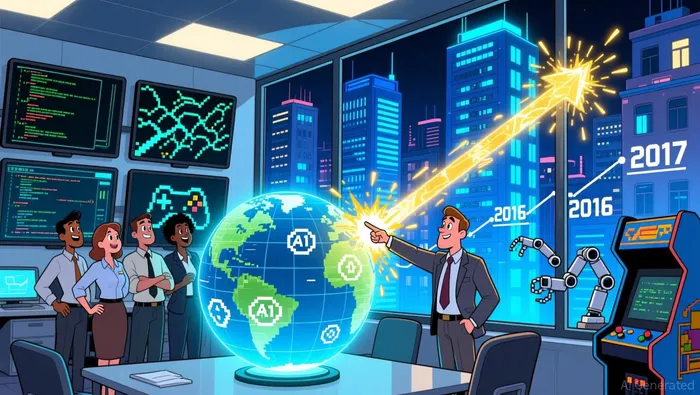
The most dramatic expectation reset unfolded in the 2025-2026 period. In the third quarter, Nvidia posted revenue of $57 billion, a figure that already topped the $55.5 billion Wall Street expected. But the real gap was in the forward view. The company's forecast for the current quarter, between $63.7 billion and $66.3 billion, completely dwarfed the $62.4 billion consensus. This wasn't just a beat; it was a guidance reset that forced the entire market to recalibrate its view of the AI demand cycle, often referred to as the "Blackwell" cycle.
Each of these inflection points followed the same pattern: the market priced in a certain path, Nvidia delivered a reality that was both larger and faster. The investment story wasn't about predicting the future; it was about identifying when the market's view lagged behind the company's actual momentum.
The Current Reality Check: Stock Performance vs. Fundamental Momentum
The disconnect between Nvidia's strong underlying business and its recent stock price action is a classic case of expectations being fully priced in. The company delivered record results, but the market's reaction suggests that even that level of performance may no longer be enough to drive the stock higher.
Despite the robust Q3 earnings, the stock has pulled back, falling 2.1% over the past five days. This is the "sell the news" dynamic in action. The market had already baked in a powerful rally, and the actual print, while strong, failed to exceed the new, elevated expectations set by the company's own guidance reset. The stock is now trading 14.8% below its 52-week high of $212.19, a level it touched just last October. That high came after a staggering 38.9% gain in 2025, a run that has left the stock vulnerable to any sign of a slowdown.
The longer-term trend remains positive, with the stock up 7.9% over the past 120 days. But this uptick is a reminder of the stock's sensitivity. The recent pullback highlights how quickly sentiment can shift when the pace of growth deviates from the hyper-expectations fueled by the Blackwell AI cycle. The market is no longer rewarding simple beats; it is demanding flawless execution and accelerating momentum. Any deviation from that path triggers profit-taking.
The bottom line is that Nvidia's valuation now reflects a near-perfect future. With a forward P/E above 49 and a price-to-sales ratio near 24, the stock is priced for continued dominance. This creates a high-wire act: the company must consistently outperform to justify the premium, leaving little room for error. The current price action is the market's way of saying the easy money from the last leg up has been made.
Catalysts and Risks: What Could Reset Expectations Again
The market's current stance is one of high-wire precision. Nvidia's stock is priced for a flawless continuation of its recent run, leaving it highly sensitive to any deviation from the path of accelerating growth. The next major expectation gap will likely be driven by the company's own guidance, which sets the bar for the coming quarter.
The most immediate positive catalyst is the continued ramp of Blackwell chips. CEO Jensen Huang's statement that sales are "off the charts" and that cloud GPUs are sold out provides a powerful narrative for the next earnings report. If the company's Q4 revenue guidance, due in February, falls within or above the already-strong range of $63.7 billion to $66.3 billion, it would confirm the AI demand cycle is on track. A beat within that range could still spark a rally, as the market would view it as evidence that the Blackwell momentum is holding firm. The key is maintaining this trajectory; any stumble would be magnified.
The primary risk, however, is a reset in the other direction. The core vulnerability is demand saturation or a slowdown in cloud data center spending. The market has priced in relentless growth, but if the guidance for the next quarter were to fall below the current $63.7B-$66.3B range, it would signal a major expectation gap. This would force a reassessment of the premium valuation, as the stock's forward P/E above 49 and price-to-sales ratio near 24 assume no deceleration. The recent investor reassessment of expectations, asking "Has there been too much exuberance?", underscores this fragility.
In practice, the stock's sensitivity to guidance changes is the central dynamic. After the powerful rally fueled by the last guidance reset, the market is now waiting for the next print to exceed the new, elevated baseline. Any sign of a slowdown would trigger a sharp correction, while a strong beat could reignite the momentum. The setup is clear: Nvidia must continue to outperform to justify its price, making the next earnings report a critical event for the stock's trajectory.





Comentarios
Aún no hay comentarios