
Nvidia's $1 Billion Platform Bet: Assessing the Scalability of AI Drug Discovery
This partnership is Nvidia's boldest move yet to establish its AI platform as the indispensable operating system for a new scientific frontier. The core investment thesis is clear: by co-investing more than $1 billion over five years with Eli LillyLLY--, NvidiaNVDA-- is not just selling chips; it is building a scalable, revenue-generating platform for life sciences. The commitment is substantial, with both companies allocating dedicated, incremental resources. LillyLLY-- brings its deep pharmaceutical R&D expertise and laboratory infrastructure, while Nvidia provides its AI capabilities, including open biology models and DGX Cloud capacity.
The structure of this bet is designed for maximum leverage. The new AI co-innovation lab, set to open in the Bay Area by late March, is a physical and strategic convergence point. Its primary mission is to create a closed-loop discovery workflow, using real-world lab data to train and validate advanced AI models. This directly leverages Nvidia's BioNeMo platform and its specialized 'Vera Rubin' chip architecture, which are engineered to handle the complex, multimodal data of biology. The goal is to shorten the path from hypothesis to discovery, a paradigm shift that could dramatically accelerate drug development timelines for Lilly and, by extension, the entire industry.
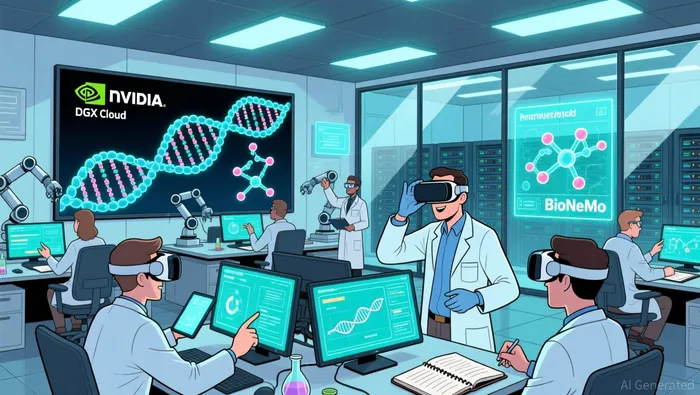
Viewed through a growth lens, this represents a fundamental strategic shift. Nvidia is moving from being a hardware provider to becoming the foundational platform for life sciences. The monetization extends far beyond the initial lab investment. The partnership will likely drive software licensing for BioNeMo and related tools, as well as increased demand for DGX Cloud services. Furthermore, the collaboration's focus on applying AI across Lilly's manufacturing and commercial operations opens additional, high-margin service avenues. This is a classic platform play: Nvidia is creating a proprietary ecosystem where its technology becomes the standard, locking in customers and generating recurring revenue streams. For a growth investor, this is the essence of scalability-turning a massive, one-time hardware sale into a long-term, sticky software and services business.
Market Dynamics and Scalability: TAM vs. Execution
The growth potential for Nvidia's AI drug discovery platform hinges on a powerful combination: a massive, expanding market and a critical execution gap that the partnership is uniquely positioned to fill. The total addressable market is substantial and accelerating. The global AI in drug discovery market is projected to grow at a CAGR of 24.8% from 2026 to 2033, expanding from an estimated $2.35 billion in 2025 to $13.77 billion by 2033. This trajectory is fueled by the industry's relentless need for cost-effective development and the promise of AI to cut the decade-long, multi-billion dollar drug discovery timeline. For Nvidia, capturing even a fraction of this future revenue stream would be a transformative growth vector.
Yet the path from market opportunity to commercial reality is fraught with a well-documented execution gap. Despite a decade of hype and billions in investment, few AI-discovered or AI-designed drugs have entered human clinical trials, and none have achieved clinical approval. This highlights a critical bottleneck: translating sophisticated algorithms into validated, safe, and effective medicines. The partnership with Lilly directly targets this chasm. By embedding Nvidia's AI capabilities within Lilly's own R&D engine, the collaboration creates a closed-loop system where real-world lab data is used to train and refine models. This practical, iterative approach is designed to move beyond theoretical promise and build the kind of "ground truth data" needed to de-risk AI-driven discovery.
Lilly's own massive internal investment underscores the scale of the opportunity and the need for a robust platform. The company's $15 billion acquisition of Abivax signals a parallel, parallel commitment to expanding its own R&D capacity. This isn't just a customer; it's a potential anchor tenant for Nvidia's platform. The AI co-innovation lab is built to serve Lilly's needs, but its architecture and workflows could become the blueprint for scaling across the broader pharmaceutical industry. The partnership's success in accelerating Lilly's own pipeline would provide the most compelling proof of concept, demonstrating the platform's ability to deliver tangible, time- and cost-saving results. For Nvidia, the scalability of this model depends on turning this internal success into a repeatable, licensable system for others. The market is growing rapidly, but the real test is whether this $1 billion bet can bridge the gap between AI's potential and its proven impact in the clinic.
Financial Impact and Valuation Implications
The market has already placed a massive bet on Nvidia's future growth, and the Lilly partnership is a key component of that story. The company's valuation reflects this premium. With a forward P/E of 50 and a trailing price-to-sales ratio of 24, investors are pricing in extraordinary future earnings power. This setup makes the success of strategic initiatives like the $1 billion AI drug discovery platform not just desirable, but essential. Any material contribution to revenue growth is critical to justifying the current stock price.
The financial model for this partnership must move beyond hardware sales. The $1 billion investment is a platform play, and its financial payoff hinges on Nvidia's ability to monetize its software and services. The collaboration will drive demand for DGX Cloud capacity and likely generate licensing revenue for its BioNeMo generative AI platform. The closed-loop lab workflow, designed to create proprietary "ground truth data," could also lead to new, high-margin software tools for managing and analyzing biological AI models. For Nvidia, this is the scalability equation: turning a significant capital outlay into recurring, high-margin software and cloud revenue streams that directly feed the top line.
Yet the high cost of capital presents a clear risk. The partnership's success is measured not just by scientific milestones, but by its return on investment relative to Nvidia's premium valuation. The company must demonstrate that this platform can capture a meaningful share of the growing AI drug discovery market to materially move the needle for its own financials. If the monetization path is slow or the returns fall short of expectations, the partnership could become a costly distraction rather than a growth catalyst. For now, the market is giving Nvidia the benefit of the doubt, but the pressure to convert this strategic bet into tangible financial results is intense.
Catalysts, Risks, and What to Watch
The investment thesis for Nvidia's $1 billion AI drug discovery bet now enters a critical validation phase. The primary near-term catalyst is the opening of the AI co-innovation lab in the Bay Area by the end of March. This physical convergence of Lilly's R&D talent and Nvidia's AI expertise is the first tangible step from announcement to execution. The real test will follow: the first public demonstration of accelerated drug discovery cycles from this closed-loop system. Success here would provide the concrete proof of concept needed to convince other pharmaceutical giants to adopt the platform, turning a partnership with one anchor tenant into a scalable industry standard.
Key risks to the growth narrative, however, are substantial and legal. The partnership must navigate a complex web of intellectual property and regulatory uncertainty. Disputes over the ownership of AI-generated drug candidates or models trained on Lilly's proprietary data could stall progress and create costly litigation. Furthermore, the regulatory path for drugs developed with significant AI input remains uncharted, posing a potential bottleneck for commercialization. There is also the risk that the collaboration becomes a costly internal R&D project for Lilly, diverting capital from other strategic initiatives without delivering a clear, platform-wide return.
For investors, the next major checkpoint is Nvidia's Q3 2026 earnings report, scheduled for February 25. While the partnership is a multi-year bet, this earnings call will be the first opportunity for management to provide explicit guidance or any financial impact from the Lilly collaboration. Watch for mentions of BioNeMo licensing revenue, DGX Cloud capacity utilization tied to the lab, or any updates on the closed-loop workflow's efficiency. The market's high valuation demands that Nvidia begin to show how this strategic platform is translating into tangible, recurring revenue streams.





Comentarios
Aún no hay comentarios