
NVDX as a Leveraged Play on Long-Term Tech Innovation: Strategic Allocation for Amplified Exposure to AI and Semiconductor Growth
In the rapidly evolving landscape of artificial intelligence (AI) and semiconductor innovation, investors seeking amplified exposure to secular growth must balance ambition with prudence. The T-Rex 2X Long NVIDIANVDA-- Daily Target ETF (NVDX) offers a compelling case study: a leveraged vehicle designed to magnify returns from NVIDIA's (NVDA) dominance in AI infrastructure. However, its utility as a long-term strategic allocation tool requires a nuanced understanding of leverage mechanics, market dynamics, and risk management.
NVDX: A 2x Leveraged Bet on NVIDIA's AI Supremacy
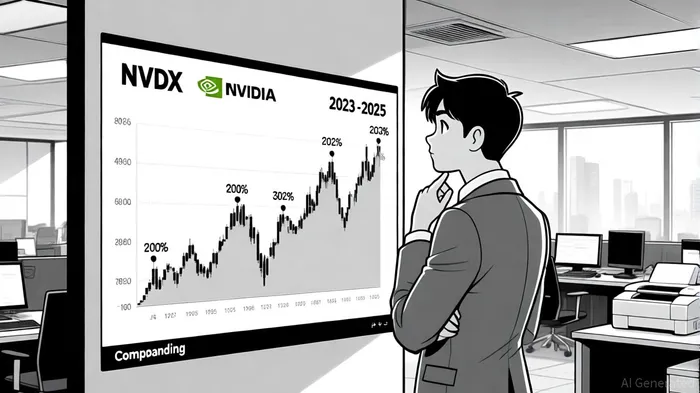
NVDX, launched in October 2023, aims to deliver 200% daily returns relative to NVIDIA's stock performance, as noted in a risk-parity analysis. As of September 2025, it has delivered a staggering 384.09% return in 2024 and a 39.86% year-to-date (YTD) gain, per financecharts performance data. These figures underscore its potential to capitalize on NVIDIA's meteoric rise. Yet, leveraged ETFs like NVDXNVDX-- are inherently volatile. A 72.15% drawdown in early 2025, according to PortfoliosLab, highlights the compounding risks of daily rebalancing and the perils of holding leveraged instruments during market corrections.
NVIDIA's market leadership is the bedrock of NVDX's appeal. The company commands 75–85% of the high-performance data center AI GPU market, driven by its Hopper and Blackwell architectures, according to a Monexa analysis. Its software ecosystem-CUDA, cuDNN, and TensorRT-further cements its dominance by enabling seamless AI workload optimization, as that Monexa analysis notes. Financially, NVIDIA's fiscal year 2025 revenue surged to $130.5 billion, a 114.20% increase year-over-year, while analysts project AI-related sales could reach $400 billion by 2028 (financecharts projections).
Historical analysis of NVIDIA's earnings-beat events since 2022 reveals critical insights for leveraged investors. Despite NVIDIA's strong fundamentals, the market often prices positive results ahead of announcements, leading to a "sell-the-news" pattern. For instance, after five qualifying earnings-beat events, NVIDIA's median excess return peaked at +0.8% by day 2 but faded rapidly, with cumulative alpha turning negative by day 10, according to an earnings-beat backtest. A statistically significant underperformance of -9% relative to its adjusted price trend emerged around day 11, persisting for most of the 30-day window, per the same backtest. The win rate of outperforming the benchmark never exceeded 80% and dropped to 40% beyond the first week, again as the backtest shows. These findings suggest that while NVIDIA's long-term growth trajectory is robust, short-term volatility and market anticipation can erode gains-particularly for leveraged products like NVDX, which amplify both upside and downside risks.
Strategic Allocation: Balancing Leverage and Long-Term Growth
For investors seeking amplified exposure to AI and semiconductor growth, NVDX's 2x leverage is a double-edged sword. While it magnifies gains during upward trends, it also exacerbates losses during downturns. Strategic allocation must therefore prioritize diversification and active management.
- Diversification Across Sectors and ETFs: Pairing NVDX with broader semiconductor ETFs like the VanEck Semiconductor ETF (SMH) or iShares Semiconductor ETF (SOXX) can mitigate over-concentration risk, as suggested in a OneDayAdvisor guide. SMH, for instance, includes TSMC and Broadcom alongside NVIDIA, offering a more balanced exposure to the sector's growth drivers.
- Risk Parity and Position Sizing: A risk parity approach-allocating capital based on risk contribution rather than expected returns-can help manage volatility. For example, combining NVDX with low-volatility assets like gold (UGL) or long-term bonds (TMF) creates a balanced risk profile; a risk-parity analysis explores these mechanics. Position sizing, guided by the Kelly Criterion or percentage risk methods, further limits downside exposure as many ETF-selection guides explain.
- Active Rebalancing and Hedging: Given NVDX's short-term design, investors must rebalance portfolios regularly to maintain target allocations. Hedging with inverse ETFs or options can offset potential losses during AI sector corrections; PortfoliosLab and similar services document typical hedging effectiveness.
Long-Term Considerations: Navigating Decay and Expense
Leveraged ETFs are notorious for decay risk-the erosion of returns due to compounding effects in volatile markets, a dynamic explored in the risk-parity analysis referenced earlier. NVDX's 1.05% expense ratio, above average for equity ETFs per PortfoliosLab, compounds this challenge. For long-term investors, the solution lies in tactical use: holding NVDX for short-term gains while reinvesting profits into non-leveraged positions like NVIDIA stock or broad AI ETFs (e.g., AIEQ, ARTY), as many ETF-selection resources recommend.
The WisdomTree U.S. Efficient Core Fund (NTSX), a rare leveraged ETF designed for long-term holding, offers a template for integrating leverage into a capital-efficient portfolio; while NTSX focuses on large-cap equities and Treasuries, its 90/60 strategy illustrates how leverage can be harnessed without sacrificing stability-a principle adaptable to AI and semiconductor allocations.
Conclusion: A Calculated Play on the AI Revolution
NVDX is not a passive investment but a high-conviction tool for investors who recognize NVIDIA's pivotal role in the AI revolution. Its 2x leverage amplifies the potential of NVIDIA's secular growth, yet its risks demand disciplined strategy. By diversifying across ETFs, employing risk parity frameworks, and actively managing rebalancing, investors can harness NVDX's power while mitigating its inherent volatility.
As the AI and semiconductor sectors redefine global innovation, NVDX stands as a testament to the opportunities-and challenges-of leveraging growth. For those prepared to navigate the complexities, it offers a pathway to amplified returns in one of the most transformative industries of the 21st century.
```





Comentarios
Aún no hay comentarios