
NuScale Power: Assessing the Scalability of a First-Mover SMR Play
The market opportunity for small modular reactors is not a distant dream; it is a defined, multi-billion dollar trajectory. The global SMR market was valued at $7.49 billion in 2025 and is projected to expand at an 8.9% compound annual growth rate, reaching an estimated $16.13 billion by 2034. This represents a clear, scalable path for a company that can execute.
NuScale's position within this growth story is built on a formidable regulatory moat. It is the only company to have received Standard Design Approvals (SDAs) from the U.S. Nuclear Regulatory Commission for its SMR designs. This exclusive U.S. NRC approval is a critical first-mover advantage, significantly de-risking the path to deployment for any U.S. customer and creating a high barrier to entry for competitors.
This regulatory edge is perfectly matched to NuScale's core technological strength: a modular design engineered for scalability. The company's reactors are pre-fabricated and assembled on-site, a model that reduces construction time and cost. This modularity isn't just a design feature; it's a repeatable deployment engine. The landmark partnership with the Tennessee Valley Authority (TVA) and ENTRA1 Energy to launch the largest SMR program in U.S. history-aiming for up to 6 gigawatts of capacity-serves as a blueprint. 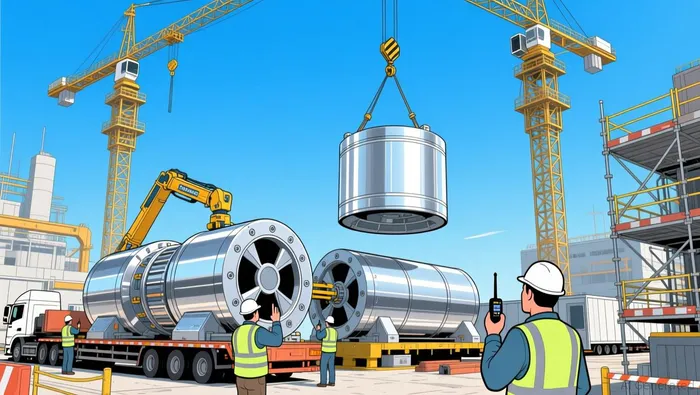 It demonstrates how NuScale's technology can be scaled across a seven-state region, meeting the surge in demand from energy-intensive sectors like AI and data centers. For a growth investor, this is the setup: a massive, growing market, a unique regulatory asset, and a proven, scalable model ready for replication.
The Catalyst: TVA's 6-GW Program as a Growth Engine
The largest announced SMR project is now the primary near-term catalyst for NuScaleSMR--. In September 2025, the company's exclusive partner, ENTRA1 Energy, signed a landmark agreement with the Tennessee Valley Authority to deploy up to six gigawatts of NuScale SMR capacity. This is the largest SMR deployment program in U.S. history, a concrete commitment that moves the technology from pilot concepts to full-scale commercial nuclear generation.
This program's role is critical as a repeatable model for large-scale deployment. It demonstrates that advanced nuclear is commercially viable and investable. The modular design allows plants to add more reactor units as energy demand grows, a feature perfectly aligned with the program's goal of meeting the surge in power needs from sectors like AI and data centers. For NuScale, this is the blueprint: a proven, scalable model ready for replication across the seven-state TVA region and, by extension, the nation.
The importance of successful execution cannot be overstated. This program is the essential path to unlocking NuScale's high-growth market capture. It validates the company's regulatory moat and technological design, providing the real-world case study needed to de-risk future projects for other utilities and governments. As the company's CEO stated, this agreement underscores NuScale's position as the first and only SMR technology provider ready for commercial deployment. The successful delivery of this 6-gigawatt program will be the definitive proof point that the company's scalable model works, paving the way for a wave of follow-on orders and accelerating its journey toward capturing a dominant share of the expanding global SMR market.
Financial Projections and the Path to a Ten-Bagger
The path to a ten-bagger return for NuScale is a classic growth story: it requires the company to scale its revenue from a near-zero base to a multi-billion dollar enterprise while navigating a period of significant losses. The current stock price, hovering around $19, represents a steep discount from its all-time high of $53.43 last October. For patient investors, the thesis is that this volatility reflects the market's struggle to price a company that is not yet selling its core product, but is positioned to capture a massive, growing market. The key narrative is that exponential returns hinge on rapid revenue growth and a successful transition to profitability, which the TVA program is designed to catalyze.
One analyst framework illustrates the math required. A discounted cash flow model suggests the stock trades at a 62.8% discount to its estimated intrinsic value of $52.35 per share. This implies a potential for substantial upside, but the model's projections are critical. It assumes free cash flow will remain negative for several years before turning positive, reaching $300.66 million by 2030. For this to translate into a ten-bagger, revenue growth must accelerate dramatically to fund that expansion and eventually generate those positive cash flows. The model's output underscores the high-risk, high-reward nature of the investment: the market is pricing in a long runway of losses, betting on a future where NuScale's scalable model pays off.
A more specific narrative points to a future where the stock's valuation multiples expand alongside its growth. One projection suggests a future P/E multiple of 11.82% combined with a revenue growth rate of 40% CAGR could support a fair value of approximately $36.58 per share. This scenario is more conservative than the DCF model but still implies significant upside from current levels. It hinges on NuScale not only growing revenue at a blistering pace but also achieving profitability at a scale that justifies a multiple expansion. The company's current financials show the early stages of this journey: revenue grew by $7.8 million in the third quarter of 2025, primarily from engineering services for the Romanian project, but it has not yet sold or deployed any SMRs.
The company's ability to fund this growth is now a critical factor. NuScale has taken decisive steps to strengthen its balance sheet. In the third quarter, it sold 13.2 million shares through an at-the-market program, generating $475.2 million in gross proceeds. This activity, combined with its existing cash position, has bolstered its liquidity. The company ended the quarter with $753.8 million in cash, cash equivalents, and investments. This war chest is essential. It provides the runway to execute the TVA program, advance the Romanian project, and continue R&D without the immediate pressure of raising capital at potentially unfavorable terms. For a growth investor, this strengthened cash position is a necessary condition for the company to scale its operations and eventually achieve the revenue trajectory needed to justify its future valuation. The bottom line is that the ten-bagger potential is real, but it is a function of flawless execution on a multi-year growth plan, funded by the capital NuScale has recently secured.
Catalysts, Risks, and What to Watch
The path to scaling NuScale's growth thesis is now defined by a few critical milestones. The primary near-term catalyst is the successful execution of the TVA program. This landmark agreement is the blueprint for commercialization. Investors must watch for the company to secure final investment decisions and begin construction on the first units. The program's timeline, with full activation not expected until 2032, means progress will be measured in regulatory approvals, engineering milestones, and the start of on-site work. Each step forward validates the company's ability to move from design to deployment at scale, which is essential for de-risking future projects and attracting follow-on orders.
A major risk to this scalability is execution on large-scale projects. The company's own history provides a cautionary tale. NuScale initially planned to deploy six of its 77 MWe SMRs in Idaho to power a 462 MWe plant, but it abandoned that expensive project in 2023. This past delay and cost overrun highlight the significant engineering, regulatory, and financial challenges inherent in building nuclear facilities. For a growth investor, the key question is whether the company has learned from that experience and can now manage a multi-gigawatt program like the TVA project without similar setbacks. Any further delays or cost overruns on the TVA program would directly threaten the growth timeline and investor confidence.
Progress on international expansion is another critical indicator. The Phase 2 Front-End Engineering and Design (FEED) study for the RoPower Doicești project in Romania is a key step toward a final investment decision this year. While the project is still in the FEED phase, its advancement signals NuScale's ability to replicate its model abroad. A successful conclusion and subsequent FID would demonstrate the global scalability of its technology and regulatory moat, opening a second major market channel for revenue growth. Until that decision is made, the Romanian project will only generate modest revenue from engineering services, limiting its near-term financial impact.
The bottom line is that NuScale's growth story is now in the execution phase. The TVA program is the primary catalyst to watch, but its success is not guaranteed. The company must navigate the well-known risks of large-scale nuclear construction, a challenge it has already faced. At the same time, progress on international projects like Romania will show if its scalable model can be replicated beyond the U.S. For a growth investor, the coming months will reveal whether NuScale can translate its regulatory first-mover advantage and massive TAM into tangible, on-time, and on-budget project deliveries.





Comentarios
Aún no hay comentarios