
NuScale Power and the AI-Powered Nuclear Energy Revolution: Assessing Strategic Position in the Evolving Energy Infrastructure Landscape
The global energy landscape is undergoing a seismic shift, driven by the insatiable demand for power from artificial intelligence (AI) data centers, semiconductor manufacturing, and other high-intensity industries. At the forefront of this transformation is NuScale PowerSMR--, a pioneer in small modular reactor (SMR) technology, which is uniquely positioned to address the dual challenges of energy security and decarbonization. As the U.S. and global markets race to meet surging electricity needs, NuScale's strategic partnerships, regulatory advantages, and technological differentiation are reshaping the narrative around nuclear energy's role in the AI era.
Strategic Partnerships and Capital Mobilization
NuScale's recent collaborations underscore its central role in the AI-powered energy revolution. The company has secured a landmark agreement with ENTRA1 Energy, its exclusive global strategic partner, to deploy up to 6 gigawatts of NuScaleSMR-- SMR capacity under the $550 billion U.S.-Japan Framework Agreement. This initiative, which includes a $25 billion investment, is designed to meet the energy demands of AI data centers and critical manufacturing sectors while creating high-quality jobs. The partnership with the Tennessee Valley Authority (TVA) further solidifies NuScale's market position, as the 6-gigawatt deployment will provide carbon-free power to the Dallas-Fort Worth metropolitan area-a critical hub for AI infrastructure.
These partnerships are not merely symbolic; they reflect a strategic alignment with the financial and regulatory frameworks needed to scale SMR technology. ENTRA1's role as a developer, owner, and operator of the facilities reduces risk for entities like TVA, making SMRs a more bankable asset class. This model, often termed "nuclear-as-a-service," is particularly appealing to hyperscalers and industrial clients seeking reliable, decentralized power solutions.
Technological Edge and Regulatory Leadership
NuScale's technological differentiation lies in its 77-megawatt SMR design, which has received U.S. Nuclear Regulatory Commission (NRC) standard design approval-a milestone no other SMR developer has achieved. The modular nature of its reactors allows for rapid deployment and scalability, critical attributes for AI-driven infrastructure that requires both baseload power and redundancy. For instance, a NuScale-powered plant can continue operating even if one module is offline for refueling, mirroring the resilience of RAID systems in data storage.
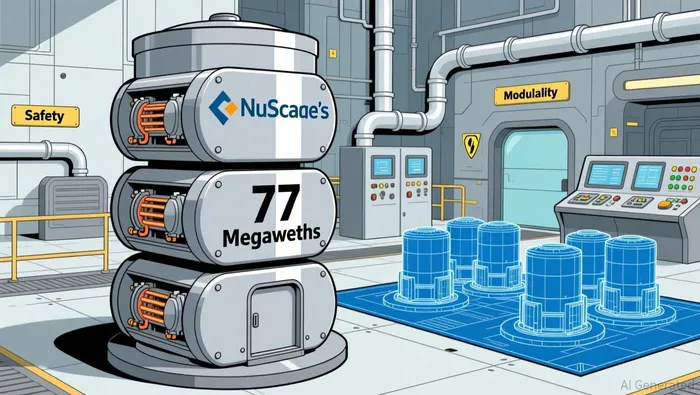
The company's recent uprated SMR design approval in May 2025 further strengthens its competitive edge, enabling it to meet the multi-gigawatt energy demands of hyperscalers like Meta. Passive safety systems, which rely on natural processes like gravity and convection, also enhance the appeal of NuScale's technology by minimizing operational risks and reducing reliance on human intervention.
Financial Resilience and Market Position
NuScale's financial health is another pillar of its strategic strength. As of Q3 2025, the company reported $753.8 million in cash, cash equivalents, and investments, providing a robust foundation for capital-intensive projects. This liquidity is critical in an industry where upfront costs are high, and regulatory timelines are long. The recent House of Representatives' review of the nuclear sector has also bolstered investor confidence, with NuScale's stock climbing 15% in response.
While NuScale has yet to secure a direct partnership with a hyperscaler like Meta, its regulatory lead and scalable designs position it as a prime candidate for future deals. The company's international projects in Romania and Poland further diversify its revenue streams and reinforce its global market presence.
Competitive Landscape and Technological Differentiation
NuScale's primary competitors, such as Oklo and NANO Nuclear Energy, are pursuing distinct but complementary strategies. Oklo, backed by Sam Altman of OpenAI, is developing compact fast reactors and a vertically integrated power-as-a-service model. However, Oklo's lack of NRC approval and its focus on fuel recycling place it several years behind NuScale in commercialization. NANO Nuclear Energy, meanwhile, is advancing microreactor designs for remote applications but remains in the pre-revenue phase.
NuScale's regulatory head start and proven deployment capabilities give it a clear advantage. While Oklo and NANO innovate in niche markets, NuScale's focus on large-scale, grid-connected SMRs align directly with the energy needs of AI data centers and industrial hubs. This strategic focus, combined with its $227.7 million capital infusion in December 2024, positions NuScale to dominate the SMR market in the late 2020s.
Conclusion: A Strategic Bet on the Future of Energy
The AI-powered nuclear energy revolution is not a distant possibility but an unfolding reality. NuScale Power's strategic partnerships, regulatory leadership, and technological innovation make it a linchpin in this transition. As energy demand surges and decarbonization goals tighten, the company's ability to deliver scalable, carbon-free power will be critical. While challenges remain-such as securing direct hyperscaler contracts and navigating complex regulatory environments-NuScale's current trajectory suggests it is well-positioned to lead the next phase of the nuclear renaissance. For investors, the company represents a compelling opportunity to capitalize on the intersection of AI, energy, and infrastructure.





Comentarios
Aún no hay comentarios