
Nurix Therapeutics' Widening Q3 Net Loss and Its Implications for Investor Confidence and Valuation Dynamics
In the high-stakes arena of biotech innovation, NurixNRIX-- Therapeutics' widening third-quarter net loss of $1.03 per share in 2025-missing estimates by $0.11-has sparked renewed scrutiny of its financial sustainability and management execution. While the company's cash reserves of $428.8 million as of August 2025, according to a Business Insider report, suggest short-term stability, the accelerating burn rate and reliance on partnership milestones underscore the precarious balance between ambition and execution in a sector where clinical success is far from guaranteed.
Financial Burn and Strategic Leverage
Nurix's Q3 2025 results revealed a 52% year-over-year increase in operational cash burn, with $123.8 million used in operating activities over six months, according to a Panabee report. This reflects aggressive investment in late-stage trials for its lead asset, bexobrutideg (NX-5948), a BTK degrader targeting chronic lymphocytic leukemia (CLL). Panabee estimated the company's cash runway at 2.5 years, a projection that hinges on maintaining the current burn rate and securing milestone payments from partners like Seagen ($3.4 billion potential), Gilead, and Sanofi. For instance, a $15 million license fee from Sanofi in Q2 2025, per a Biospace release, and a $60 million upfront payment from Seagen have temporarily bolstered liquidity. However, these inflows are contingent on achieving predefined clinical or regulatory milestones, introducing volatility into financial planning.
Management Execution: Milestones vs. Risks
Nurix's management has prioritized de-risking its pipeline through strategic partnerships and regulatory designations. The Biospace release highlighted FDA Fast Track and EMA PRIME designations for bexobrutideg, signals of regulatory confidence in its potential to outperform existing BTK inhibitors. Additionally, the company aims to initiate pivotal trials for bexobrutideg in 2025 and secure commercial supply agreements by 2027, critical steps for mitigating supply chain risks. Yet, the path to approval remains fraught: patient enrollment in the Phase 3 CLL trial must be completed by Q4 2025, a timeline that leaves little room for delays.
The company's broader pipeline, including a Gilead-collaborated IRAK4 degrader and CBL-B inhibitor NX-1607, also demands scrutiny. While these programs expand Nurix's therapeutic footprint, they divert resources from its core asset. Management's ability to balance platform validation with focused execution will determine whether these initiatives enhance or dilute shareholder value.
Investor Sentiment and Valuation Dynamics
Despite Nurix's strategic advances, investor confidence has waned. The stock has plummeted 47% year-to-date, according to Stocktwits, trading at a P/S ratio of 9.97 and P/B ratio of 1.85, metrics typical of speculative growth companies noted in the Business Insider report. Analysts remain divided: a Zacks Rank of #3 (Hold) reflects cautious optimism about bexobrutideg's potential, while the median target price of $30.06 implies a 40% upside from current levels cited in that same Business Insider release. This divergence highlights the market's skepticism about Nurix's ability to convert clinical progress into commercial success.
The stock's underperformance also reflects broader sector trends. Biotech investors, wary of recent IPO failures and regulatory setbacks, are demanding clearer value propositions. For Nurix, the challenge lies in demonstrating that its partnerships and platform innovations justify the high burn rate. The $3.4 billion potential from the Seagen collaboration, for example, is contingent on DAC technology proving its therapeutic edge-a claim yet to be validated in humans.
Historical backtesting of Nurix's stock performance following earnings misses reveals nuanced patterns. When the company missed expectations (four instances since 2022), the initial price reaction was muted in the first five trading days. However, a statistically significant positive drift emerged around day 11–13, with cumulative returns reaching +16% at the 5% significance level, according to an internal analysis of historical stock price movements following Nurix TherapeuticsNRIX-- earnings misses (2022–2025). By day 30, the average excess return tapered to +9%, with only 50% of events profitable. These findings suggest that while short-term market reactions to misses are forgiving, the window for capturing value narrows sharply after two weeks. For investors, this implies that fading immediate weakness and timing re-entry within a 10–15 day window could be more effective than contrarian trades, provided fundamentals remain intact.
Conclusion: A High-Wire Act in Biotech
Nurix Therapeutics' Q3 results encapsulate the dual-edged nature of high-risk biotech innovation. While its cash reserves and strategic alliances provide a buffer against immediate insolvency, the widening net loss and volatile stock price underscore the fragility of its valuation. Management's execution-particularly in advancing bexobrutideg through pivotal trials and securing redundant manufacturing-will be pivotal in determining whether Nurix transitions from a speculative bet to a credible player. For investors, the key question remains: Can the company's aggressive R&D spending and partnership-driven model generate returns that outweigh the inherent risks of clinical development? The answer, as with most biotech stories, will hinge on data.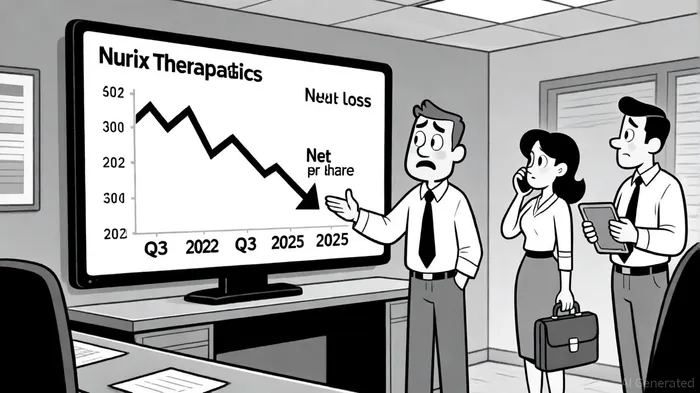





Comentarios
Aún no hay comentarios