
Nuclear Power Plays: How Private Credit is Revitalizing Europe's Energy Future with Hinkley Point C
The £4.5 billion bond deal between Apollo Global ManagementAPO-- and Électricité de France (EDF) for the UK's Hinkley Point C nuclear project marks a pivotal moment in the evolution of private credit's role in European infrastructure. This transaction, the largest-ever private credit deal in sterling and a lifeline for EDF's delayed £46 billion project, underscores a broader trend: private capital is filling critical funding gaps in strategic energy assets, often perceived as undervalued due to short-term risks but rich in long-term value.
A Strategic Lifeline for Hinkley Point C
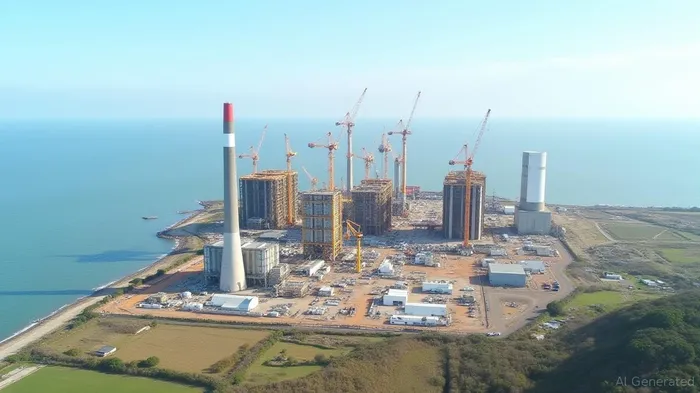
The Hinkley Point C project—Europe's largest nuclear plant—has been mired in delays and cost overruns since its 2016 approval. Originally budgeted at £18 billion, its price tag has nearly tripled, while its start date has slipped to 2029–2031. These challenges, exacerbated by China General Nuclear Power Corp's 2023 withdrawal, left EDF struggling to secure financing. Apollo's fixed-rate callable notes, structured under EDF's EMTN program, now provide the missing capital while offering investors a 7% yield—a competitive return in a low-yield environment.
The transaction's brilliance lies in its risk-mitigation framework. The UK's Contract for Difference (CfD), guaranteeing a minimum inflation-adjusted £128/MWh for 15 years, insulates investors from market volatility. This regulatory underpinning transforms Hinkley Point C from a risky bet into a predictable cash flow generator, aligning with Apollo's High-Grade Capital Solutions strategy.
Why Private Credit is Dominating Infrastructure Financing
Apollo's move reflects a seismic shift in capital allocation. Public infrastructure funding has faltered in the face of rising debt and fiscal constraints, while private credit firms—armed with flexibility, long-term horizons, and risk appetite—are stepping in. The Hinkley deal exemplifies this:
- Yield-Hungry Markets: In a world of sub-2% bond yields, the 7% return on Hinkley's unsecured notes is compelling, especially for pension funds and sovereign wealth seeking inflation protection.
- Regulatory Backstops: Projects with government-backed guarantees, like Hinkley's CfD, attract capital by minimizing downside risks.
- Strategic Asset Scarcity: Nuclear energy's role in decarbonization and energy security makes it a must-have asset class. With only 2 reactors under construction in Europe (Hinkley and France's Flamanville 3), new projects are scarce and highly valued.
EDF's share price has lagged broader markets amid project delays and cost concerns, creating an undervaluation opportunity for long-term investors.
The Undervalued Opportunity in European Energy Assets
Hinkley Point C's struggles have masked its true strategic worth. The plant's 7% contribution to UK electricity supply and its 60-year operational lifespan make it a cornerstone of energy security—a value not fully captured in EDF's current valuation. Key undervaluation triggers include:
- Geopolitical Risk Premium: Investors may be discounting the project due to China's exit, but the UK government's guarantees and Apollo's confidence suggest this risk is overblown.
- Operational Learning Curve: Delays at Hinkley have spurred innovations in modular construction (e.g., pre-fabricating Unit 2's dome), reducing costs for future projects like Sizewell C.
- ESG Alignment: Nuclear's zero-emission profile and role in grid stability are increasingly recognized by ESG investors, who may re-rate EDF's assets upward.
Investment Implications: Playing the Long Game
For investors, the Hinkley deal offers a template for capitalizing on undervalued energy assets:
- Direct Exposure to EDF: EDF's shares (EDF.PA) trade at a P/E ratio of 14x, below its five-year average of 18x, reflecting short-term cost concerns. Investors willing to look past Hinkley's hiccups may find value in its 40% stake in France's nuclear fleet and its leadership in advanced reactor technologies.
- Private Credit Funds: Apollo's High-Grade Capital Solutions strategy, which has deployed over $100 billion since 2020, provides a vehicle for accessing projects like Hinkley without equity volatility.
- Sector ETFs: The iShares Global Clean Energy ETF (ICLN) offers diversified exposure to nuclear and renewables, capitalizing on Europe's energy transition.
Risks and Considerations
While the Hinkley deal is compelling, risks remain:
- Further Delays/Cost Overruns: Unresolved technical issues or inflation spikes could strain EDF's balance sheet.
- Regulatory Shifts: Anti-nuclear sentiment or changes to CfD terms could undermine cash flows.
Yet these risks are mitigated by Hinkley's strategic necessity and the UK government's financial guarantees. For long-term investors, the upside—stable returns tied to decarbonization goals—far outweighs the downside.
Conclusion: The New Energy Equation
Apollo's Hinkley Point C financing is more than a bond deal; it's a blueprint for how private credit can unlock value in critical, underappreciated infrastructure. In a world hungry for yield and decarbonization, nuclear energy's renaissance is fueling opportunities. Investors who recognize the gap between short-term project risks and long-term strategic value stand to profit handsomely.
The message is clear: in the race to Europe's energy future, private credit is no longer a sideshow—it's the main event.





Comentarios
Aún no hay comentarios