
Nuclear Energy's Resurgence and the Uranium ETF (URA): A Strategic Investment Play in 2025
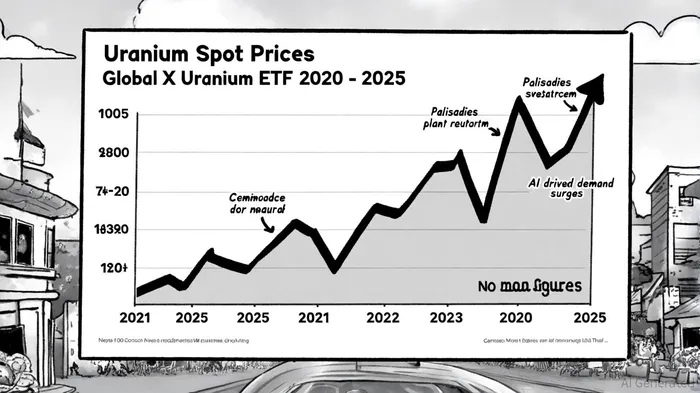
The nuclear energy sector is undergoing a transformative resurgence in 2025, driven by a confluence of policy tailwinds, technological innovation, and the urgent need for reliable low-carbon power. As artificial intelligence (AI) and data centers consume an estimated 8% of global electricity by 2030, according to an Investing.com analysis, governments and corporations are pivoting toward nuclear energy to meet this demand. This shift has positioned uranium-focused ETFs like the Global X Uranium ETF (URA) as critical vehicles for investors seeking exposure to the sector's long-term potential.
Policy and Technological Catalysts for Nuclear's Renaissance
Recent policy developments have been instrumental in reinvigorating nuclear energy. The U.S. Department of Energy's allocation of funding for domestic nuclear fuel production and advanced reactor development aims to reduce reliance on foreign sources while bolstering energy security, according to an Energy Department article. Notably, the anticipated 2025 decision on restarting the Palisades nuclear plant in Michigan would mark the first recommissioned nuclear facility in the U.S., signaling a pivotal shift in regulatory momentum (the Energy Department article highlights this potential milestone).
Technological advancements, particularly in Generation III and IV reactor designs, have also reshaped public perception. These reactors incorporate passive safety systems, reducing operational risks and enhancing scalability, as discussed in the Energy Department article. Additionally, the U.S. is pioneering clean hydrogen production using nuclear power, with projects at facilities like Davis-Besse and Prairie Island exploring hydrogen's role in decarbonizing industrial and transportation sectors, another point noted by the Energy Department article.
URA ETF: A Focused Bet on Uranium and Nuclear Innovation
The Global X Uranium ETF (URA) offers targeted exposure to the nuclear energy value chain, holding 53 assets with 70.85% of its portfolio concentrated in the top 10 holdings, including CamecoCCJ-- Corp, Oklo Inc, and Uranium EnergyUEC-- Corp, according to the BestETF profile. As of September 2025, URA's portfolio is weighted heavily toward uranium mining (51.7%) and Canadian equities (48.23%), reflecting the sector's geographic and operational concentration (data from the BestETF profile).
URA's performance has mirrored the volatility of uranium prices, which surged to $82.63 per pound in September 2025 from a 2024 low of $59.58, according to a Discovery Alert analysis. Over five years, URA has delivered a staggering 408.83% total return, with a compound annual growth rate (CAGR) of 37.56%, per FinanceCharts data. However, the ETF's high expense ratio (0.69%) and concentrated portfolio of small- to mid-cap mining firms introduce risks, particularly in a market sensitive to regulatory shifts and supply-demand imbalances (see BestETF profile for holdings and expense details).
URA vs. Competitors: Performance and Risk-Adjusted Metrics
URA's performance in 2025 outpaces peers like the VanEck Uranium+Nuclear Energy ETF (NLR) and Sprott Uranium Miners ETF (URNM). As of September 2025, URA's year-to-date (YTD) return of 54.37% exceeded NLR's 41.65% and URNM's 28.73%, according to a PortfolioLab comparison. Over three years, URA's 26.77% return lagged NLR's 52% but outperformed URNM's -11.7% decline (the PortfolioLab comparison provides these cross-ETF figures). Risk-adjusted metrics further highlight URA's strength, with a Sharpe Ratio of 1.90 and Sortino Ratio of 2.26, compared to URNM's 0.89 and 1.25 (PortfolioLab comparison).
Uranium Price Dynamics and Market Fundamentals
The uranium market's fundamentals remain robust. With over 60 reactors under construction globally and utilities reporting low inventory levels, supply constraints are expected to persist, as noted in the Investing.com analysis. The U.S. aims to expand nuclear capacity to 400 gigawatts by 2050, streamlining licensing processes and capping costs to accelerate project deployment, according to a Global X article. Meanwhile, AI-driven demand for stable power has spurred tech giants like Microsoft and Amazon to invest in nuclear-powered data centers (covered in the Investing.com analysis).
URA's performance is intrinsically linked to uranium prices, which have surged 6.58% in September 2025 alone (Discovery Alert analysis). Historical data shows uranium prices climbing from a 2016 low of $18 per pound to $76.95 as of September 8, 2025, per a uranium price chart. Analysts project prices could reach $135 per pound by 2026, driven by constrained supply and decarbonization mandates (Discovery Alert analysis).
Risks and Considerations for Investors
Despite its potential, URA carries significant risks. Uranium prices remain volatile, with a 5.59% decline in August 2025 (see FinanceCharts data), and the ETF's concentrated portfolio amplifies exposure to regulatory and geopolitical shifts. For instance, the Biden Administration's push for 400 gigawatts of nuclear capacity by 2050 could face legislative hurdles or delays in reactor approvals, a risk highlighted in the Global X article. Additionally, URA's high expense ratio and recent outflows (-$102.2 million in one year, per the BestETF profile) suggest tactical investor caution.
Conclusion: A Strategic Play for the Energy Transition
The nuclear energy sector's resurgence is firmly anchored in its role as a cornerstone of the global energy transition. For investors, URA offers a compelling, albeit volatile, vehicle to capitalize on this shift. While uranium prices and policy developments will remain key drivers, the ETF's alignment with long-term decarbonization goals and AI-driven demand positions it as a strategic holding for those willing to navigate its risks. As the U.S. and global markets accelerate nuclear deployment, URA's performance could serve as a barometer for the sector's broader trajectory.





Comentarios
Aún no hay comentarios