
Nuclear Energy's Renaissance in the U.S.: Strategic Partnerships and Energy Security Drive Sector Growth
The U.S. nuclear energy sector is undergoing a transformative renaissance, driven by a confluence of strategic partnerships, regulatory reforms, and executive-level policy shifts. As global energy markets grapple with the dual imperatives of decarbonization and energy security, the United States is leveraging its industrial and technological prowess to reassert leadership in nuclear innovation. Recent developments—from cross-industry collaborations to transatlantic alliances—underscore a coordinated effort to scale domestic capacity, secure supply chains, and position nuclear energy as a cornerstone of long-term energy independence.
Supply Chain Resilience: The Nuclear Company and Nucor's Steel Partnership
A pivotal development in 2025 is the strategic alliance between The Nuclear Company and Nucor CorporationNUE--, announced on September 26, 2025[1]. This partnership aims to assess the use of NQA-1 steel—a high-grade material critical for reactor construction—for gigawatt-scale nuclear projects. By anchoring domestic steel production to the nuclear supply chain, the collaboration addresses a longstanding vulnerability in the sector: reliance on foreign materials.
This initiative aligns with President Donald Trump's executive orders, which set an ambitious target of 400 gigawatts of nuclear capacity by 2050[2]. The partnership not only strengthens the U.S. industrial base but also reduces exposure to geopolitical risks in global steel markets. For investors, this signals a shift toward localized, secure production models that could mitigate cost overruns and delays in reactor deployment.
Transatlantic Collaboration: U.S.-U.K. Regulatory and Technological Synergy
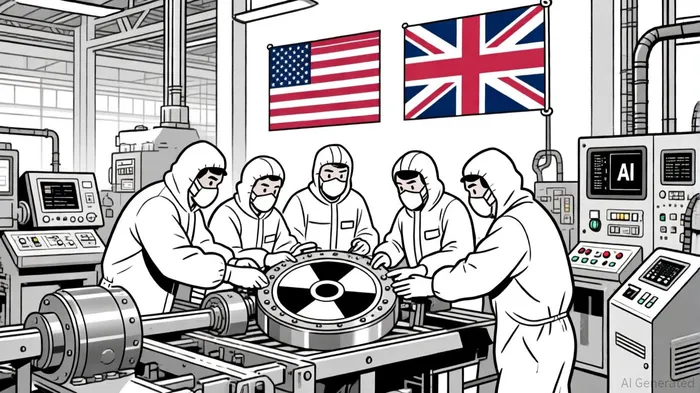
On September 15, 2025, the U.S. Nuclear Regulatory Commission (NRC) and the United Kingdom's Office for Nuclear Regulation (ONR) renewed and expanded their memorandum of understanding (MOU) to streamline advanced reactor design reviews[3]. This agreement aims to cut duplication in regulatory processes, targeting reactor design approvals within two years and site licensing within one year. Such efficiency gains are critical for attracting private capital to long-lead-time projects.
The U.S.-U.K. collaboration extends beyond regulation. A Technology Prosperity Deal, signed in the same month, formalizes joint research in AI, fusion, and quantum technologies while prioritizing the replacement of Russian nuclear fuel by 2028[3]. This partnership not only diversifies supply chains but also accelerates the commercialization of next-generation nuclear technologies, such as small modular reactors (SMRs) and advanced fuel cycles.
Policy Catalysts: Executive Orders and Industrial Base Reforms
The Trump administration's May 2025 nuclear executive orders[4] provide a 25-year roadmap for domestic and international deployment. Key measures include reforming the National Environmental Policy Act (NEPA) to expedite project approvals, leveraging the Defense Production Act (DPA) to boost uranium and high-assay low-enriched uranium (HALEU) production, and fast-tracking reactor construction. These actions address historical bottlenecks in the nuclear sector, such as protracted permitting and limited fuel availability.
The White House's “Reinvigorating the Nuclear Industrial Base” initiative[5] further emphasizes workforce development, supply chain diversification, and public-private partnerships. By aligning federal incentives with private-sector innovation, the administration is creating a fertile ground for sustained investment.
Investment Implications and Long-Term Outlook
For investors, the convergence of these factors presents a compelling case for nuclear energy. Strategic partnerships like those between The Nuclear Company and NucorNUE--, or the U.S.-U.K. alliance, are not just about scaling capacity—they are about building a resilient, self-sufficient industry. The regulatory and policy reforms, meanwhile, reduce the risk profile of nuclear projects, making them more attractive to institutional capital.
Conclusion
The U.S. nuclear renaissance is no longer a distant aspiration but a tangible reality, underpinned by strategic alliances, regulatory agility, and executive-level commitment. As the sector transitions from policy to practice, investors who align with these trends—whether through supply chain players, reactor developers, or technology enablers—stand to benefit from a sector poised for decades of growth. In an era of energy uncertainty, nuclear power is emerging not just as a clean energy solution, but as a linchpin of national security and economic resilience.





Comentarios
Aún no hay comentarios