
Nuclear Energy ETFs and Stocks: High-Growth Opportunities in 2025–2026 Amid Government-Backed Innovation
The nuclear energy sector is undergoing a transformative renaissance in 2025–2026, driven by a confluence of government-backed innovation, surging demand for reliable clean energy, and strategic investments from private-sector giants. As the U.S. government accelerates its push to quadruple nuclear capacity from 100 gigawatts (GW) in 2024 to 400 GW by 2050, investors are increasingly turning to nuclear energy ETFs and stocks to capitalize on this momentum. This analysis explores the sector's growth drivers, high-potential investment opportunities, and the risks that come with its unique challenges.
Government Policies: A Catalyst for Nuclear Innovation
The U.S. Department of Energy (DOE) has emerged as a central force in reshaping the nuclear landscape. In 2025, the agency awarded $800 million to TVA and Holtec to advance small modular reactor (SMR) deployment, while also launching the Advanced Nuclear Fuel Line Pilot Projects to secure domestic uranium supply chains. Executive Order 14299, issued by President Trump on May 23, 2025, further solidified this momentum by prioritizing domestic uranium enrichment, reprocessing spent fuel, and expanding the nuclear industrial base.
 Regulatory reforms have also accelerated. The ADVANCE Act of 2024 streamlined licensing for advanced reactors, enabling NuScale Power to achieve NRC approval for its 77 MWe SMR design-a critical milestone for scalable nuclear deployment. Meanwhile, the DOE's Fuel Line Pilot Program, which selected Standard Nuclear to produce high-assay low-enriched uranium (HALEU), directly addresses vulnerabilities in the U.S. nuclear fuel supply chain. These initiatives, coupled with $355 million in funding for next-generation mining technologies, underscore a strategic shift toward energy independence and decarbonization.
Market Dynamics: Big Tech and the AI-Driven Energy Boom
The surge in electricity demand from AI data centers and electric vehicles (EVs) has created a tailwind for nuclear energy. Major tech firms like Amazon, Google, and Meta are now investing heavily in nuclear projects to meet their clean energy goals. Amazon's Climate Pledge Fund led a $500 million investment in X-energy to expand carbon-free power, while Meta signed a 20-year agreement with Constellation Energy for nuclear-generated electricity.
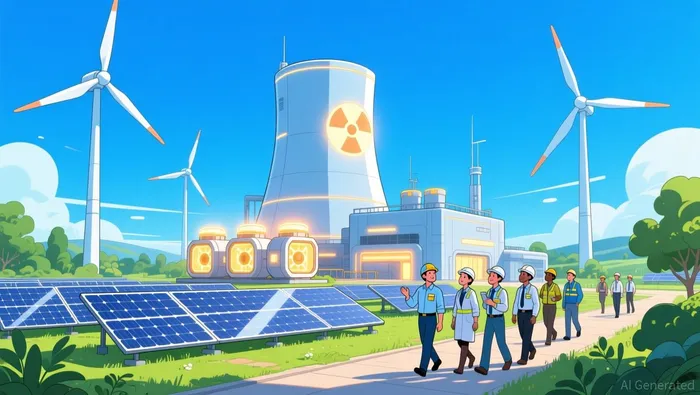
Private-sector partnerships are further amplifying growth. The Fermi America "Hypergrid" project in Texas, backed by $350 million in state funding, aims to co-locate 4.4 GW of nuclear capacity with solar and battery storage, showcasing the sector's integration with renewable energy. Similarly, the U.S. Army's Janus Program for nuclear microreactors and collaborations like Google and NextEra Energy's revival of Iowa's Duane Arnold Energy Center highlight the sector's expanding applications.
High-Growth ETFs and Stocks: Navigating the Investment Landscape
For investors seeking exposure to this evolving sector, both ETFs and individual stocks offer compelling opportunities. The Range Nuclear Renaissance Index ETF (NUKZ) has outperformed peers, returning 76.3% over the last 12 months, driven by holdings like Constellation Energy and Quanta Services. The Global X Uranium ETF (URA) and VanEck Uranium and Nuclear ETF (NLR) provide diversified access to uranium producers and utilities, with a focus on companies such as Cameco and NuScale Power.
Individual stocks like ASP Isotopes (ASPI) and Ur-Energy (URG) are positioned to benefit from HALEU demand and domestic uranium production, respectively. Vistra Energy (VST), with its large nuclear fleet and a 20-year data center contract, represents a more established play. Meanwhile, advanced reactor developers like Oklo and Nano Nuclear Energy are attracting attention for their cutting-edge microreactor designs, though their high-risk profiles require careful evaluation.
Risks and Mitigation Strategies
Despite the sector's promise, risks persist. Regulatory delays, long lead times for SMR commercialization, and public perception challenges remain significant hurdles. For example, Nano Nuclear Energy, a pre-revenue company, faces uncertainty despite its innovative microreactor technology. Additionally, competition from alternative energy sources could divert demand from nuclear in the short term.
To mitigate these risks, investors should prioritize ETFs that offer broad exposure to the nuclear value chain. Funds like URA and Sprott Uranium Miners ETF (URNM) include a mix of uranium producers, reactor developers, and utilities, reducing reliance on any single company's success. Diversification is key, especially given the sector's sensitivity to geopolitical developments and safety incidents.
Conclusion: A Strategic Window for Investors
The nuclear energy sector is at a pivotal inflection point, with government-backed innovation and market timing creating a rare alignment of opportunity. As the U.S. aims to secure its energy future through SMRs, HALEU production, and advanced reactor technologies, investors who position themselves now stand to benefit from a decade-long growth trajectory. However, success requires a balanced approach-leveraging ETFs for diversification while selectively targeting high-conviction stocks that align with long-term policy and technological trends.
For those willing to navigate the sector's complexities, nuclear energy ETFs and stocks represent a compelling alternative to traditional energy investments in 2025–2026.







Comentarios
Aún no hay comentarios