
NTT DATA's Strategic Position in the AI Infrastructure S-Curve
The global data center sector is entering a new era, defined by an infrastructure supercycle driven by artificial intelligence. This isn't a minor upgrade to existing systems; it's a fundamental paradigm shift that is redefining the physical and economic foundations of computing. The scale of this transformation is staggering. According to JLL's 2026 Global Data Center Outlook, global data center capacity is expected to nearly double from 103 GW to 200 GW by 2030. Crucially, AI workloads are projected to represent half of all data center capacity by 2030, up from about 25% in 2025. This explosive demand will require up to $3 trillion in total investment over the next five years, marking an infrastructure investment supercycle of historic proportions.
This scale demands a new playbook. The design of facilities is being completely overhauled. As one industry observer notes, the old assumptions are broken. The shift is from cloud-centric to AI-centric data center designs, where entire buildings are now being planned around GPU-heavy racks for training and inference. This move is not incremental. AI training facilities demand 10x the power density of traditional workloads and command significant lease rate premiums. The physics of power distribution, cooling, and network topology must be rethought from the ground up. This creates a massive opportunity for companies that can provide the secure, scalable, and sustainable foundation for this new compute paradigm.
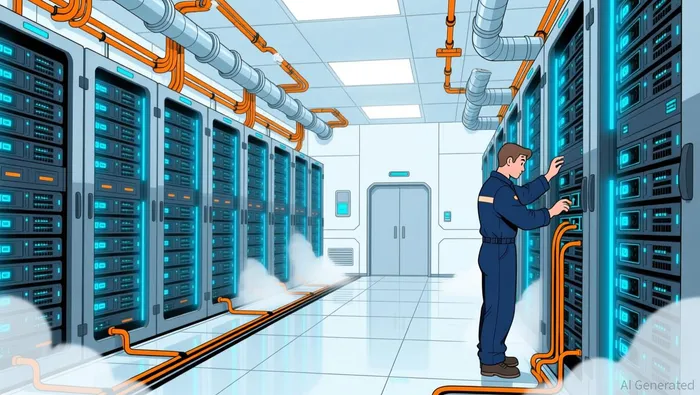
For investors, the thesis is clear. The AI infrastructureAIIA-- supercycle is not a speculative trend; it is the new baseline for enterprise and hyperscaler workloads. The companies that succeed will be those building the fundamental rails for this next paradigm, not just adapting to it. The magnitude of the investment required and the fundamental shift in design underscore that this is a structural, multi-year inflection point. The question is not if this infrastructure will be built, but who will build it and how effectively they can capture value in a market where the rules have changed.
NTT DATA's Strategic Assets and Market Position
The strategic acquisition of NTT DATA by NTT Holdings in September 2025 was not a corporate reshuffle; it was a deliberate power move to solidify its position at the center of the AI infrastructure S-curve. By becoming a wholly-owned subsidiary, the company assumed an even more critical role within the NTT Group, gaining the financial and operational backing to scale aggressively. This move instantly amplified its global footprint, uniting a 200,000+ employee base under a single, unified mission. For the AI supercycle, this translates into immense execution capacity and a proven ability to manage complex, large-scale deployments-a crucial advantage when building the foundational compute rails.
Market recognition validates this strategic build-out. NTT DATA's Global Data Centers business has been named a Leader in the IDC MarketScape for the fourth time. This isn't a one-off award; it's a consistent track record of excellence in delivering the secure, scalable, and high-performance infrastructure that enterprises and hyperscalers demand. The assessment specifically highlights its expansive global footprint, cutting-edge cooling innovations, and strong commitment to sustainability. In an AI era where power density and cooling efficiency are make-or-break factors, these are not just nice-to-haves but core competitive moats. The "Leader" designation signals that NTT DATA is not just keeping pace with the paradigm shift but is being counted among the architects of the new standard.
NTT DATA is not merely a data center operator; it is a full stack of ICT services provider, seamlessly combining colocation with consulting, engineering, networking, and cloud. This vertical integration offers a single point of accountability for clients navigating the complexity of AI adoption. An enterprise or hyperscaler can now partner with one entity for everything from the physical power and cooling of a GPU rack to the network connectivity and application services that run on top. This end-to-end capability, as noted by IDC, is what "further strengthens" its position as a trusted partner. In a market where the rules are being rewritten, NTT DATA's ability to offer a unified, responsible innovation platform is a powerful lever for capturing value across the entire infrastructure stack.
Financial and Operational Implications
The macro opportunity for AI infrastructure is clear, but the financial path is becoming sharply selective. The market is moving from broad enthusiasm to a focus on execution, separating clear leaders from those merely spending. This selectivity creates a powerful performance gap. According to NTT DATA's own research, the top 15% of companies defined by clear AI strategy and focused execution are 2.5x more likely to post >10% revenue growth and over 3x more likely to achieve ≥15% profit margins. For a company like NTT DATA, the strategic integration and global scale it has built position it squarely in this elite cohort. Its ability to deliver an end-to-end platform for AI adoption is the operational foundation for this superior financial profile.
Yet, the market is rotating away from the wrong kind of spenders. Investors are no longer willing to reward all AI big spenders equally. As Goldman Sachs notes, there has been a rotation away from AI infrastructure companies where growth in operating earnings is under pressure and capex spending is debt-funded. This divergence is already visible in the stock market, where correlations among large AI hyperscalers have collapsed from 80% to just 20% since June. The message is clear: capital deployment must generate returns. The market is differentiating between companies that are efficiently building the rails and those that are simply burning cash to fund their own infrastructure build-out.
This sets up a critical divergence risk. Success in the AI supercycle will depend entirely on efficient capital deployment and generating returns that outpace rising costs. The consensus estimate for 2026 capital expenditure by AI hyperscalers is climbing to $527 billion, but the source of that capital matters. NTT DATA's integrated model, which includes consulting and services alongside physical infrastructure, creates a more resilient financial structure. It can generate recurring revenue streams to fund its own capex, reducing reliance on debt. This model aligns with the market's new focus on companies where AI investments demonstrably link to revenue and profitability. For investors, the thesis now hinges on execution: building the fundamental rails for the next paradigm while ensuring the financial returns justify the exponential investment required.
Catalysts, Risks, and What to Watch
The investment thesis for NTT DATA hinges on its ability to capture value in a market that is rapidly evolving from broad enthusiasm to sharp selectivity. The forward view must focus on three key signals: the catalyst that validates its strategic position, the metric that will prove its financial discipline, and the risk that could limit its returns.
The primary catalyst is contract execution. As hyperscalers and enterprises build AI-centric facilities, NTT DATA's ability to secure long-term, multi-year contracts for its integrated platform will be the ultimate validation of its "Leader" status. The company's IDC MarketScape recognition is a starting point, but the real test is converting that trust into committed capital. The market is already rotating away from pure infrastructure spenders, so NTT DATA must demonstrate it is a value-creating partner, not just a vendor. Early wins in securing design-build contracts for GPU-heavy facilities, particularly those leveraging its cooling and power innovations, would signal that its end-to-end model is the preferred choice for navigating the new AI-centric paradigm.
The critical metric to monitor is capex efficiency and debt profile. The market is increasingly scrutinizing how AI spending is funded. As Goldman Sachs notes, investors have rotated away from AI infrastructure companies where capex spending is debt-funded. For NTT DATA, its integrated model is a potential advantage here. Its consulting and services revenue streams can generate cash to fund its own infrastructure build-out, reducing reliance on external debt. The company must show that its capital deployment is generating returns that outpace the rising costs of power and construction. Watch for its debt-to-EBITDA ratio and free cash flow conversion; a disciplined approach here will separate it from companies burning cash for their own infrastructure.
The primary risk is being a pure-play infrastructure provider without a clear path to higher-margin services or software. While its integration is a strength, the company must avoid getting trapped in a commoditized, low-margin colocation business. The AI supercycle rewards those who can move up the stack. The key risk is that NTT DATA's services revenue does not accelerate fast enough to offset the capital intensity of its physical build-out. If its profit margins remain pressured while capex climbs, it could face the same market rotation that is already underway. The company's path to achieving the ≥15% profit margins of the top AI-executing firms depends on its ability to monetize its consulting and engineering expertise more effectively. In a market that is splintering, NTT DATA must prove it is not just building the rails, but also selling the tickets.





Comentarios
Aún no hay comentarios