
Ntorya Gas Project: The Catalyst for East Africa's Energy Infrastructure Boom
The Ntorya gas project in Tanzania is emerging as a linchpin for transforming East Africa's energy landscape. With its massive reserves, strategic government backing, and Chinese engineering prowess, this onshore gas development could accelerate regional energy integration and create lucrative investment opportunities. Here's why investors should take note.
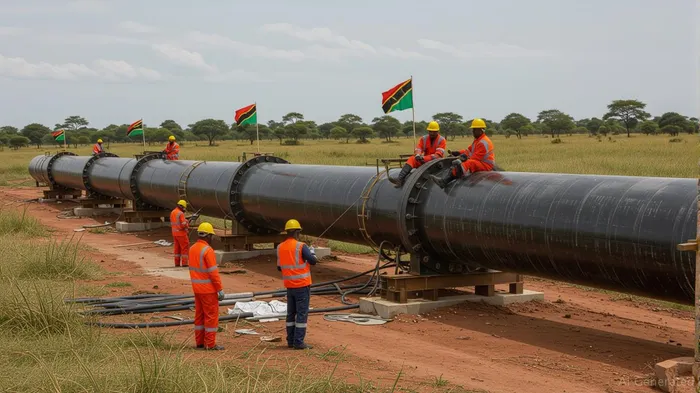
The Scale of Ntorya: A Giant in the Making
Ntorya's resource potential is staggering. The field holds 3.45 trillion cubic feet (TCF) of contingent gas reserves, with unrisked estimates stretching to 16.4 TCF—a scale that qualifies it as a “World Class Giant” gas field (comprising less than 1% of global gas fields). The revised Field Development Plan (FDP) targets 60 million standard cubic feet per day (MMscfd) production by 2026, scaling to 280 MMscfd over five years through 13 new wells. A 35-km pipeline to the Madimba processing plant, capable of transporting 140 MMscfd, will unlock this potential.
Crucially, Ntorya's onshore location slashes costs compared to offshore LNG projects, which can be 10–20 times pricier and take 7–8 years to develop. This makes Ntorya a rapid, affordable solution to Tanzania's 8–10% annual energy demand growth, while also positioning it to supply regional markets like Uganda and Zambia.
Government Commitment: More Than Words
The Tanzanian government's role is pivotal. Through its state-owned Tanzania Petroleum Development Corporation (TPDC), it has fast-tracked approvals, including a 25-year development license and a gas sales agreement secured in 2024. These actions signal a long-term vision to leverage gas for energy security, industrialization, and reducing reliance on coal and wood (currently used by 80% of households).
The pipeline's EPC contract, awarded to China Petroleum Pipeline and China Petroleum Technology & Development Corporation (subsidiaries of CNPC), underscores this commitment. The $45.45 million pipeline project, expected to finish in 12 months, is a critical step toward first gas by mid-2026—a timeline far faster than offshore LNG alternatives.
Aminex's Financial Safeguards: Low Risk, High Reward
Investors in Aminex PLC (AIM:AMNX), which holds a 25% non-operated stake, benefit from a “carry” financing structure. The company's $35 million net contribution (out of a $140 million total work program) is deferred until commercial production begins, shielding shareholders from upfront costs. This structure, paired with Aminex's 40% stock surge after the pipeline contract was announced, highlights market confidence in the project's execution.
China's Role: Infrastructure Powerhouse
China's involvement in the EPC contract is no accident. Its state-owned firms have decades of experience in building pipelines and gas infrastructure, often at lower costs and faster timelines than Western competitors. This aligns with China's “Belt and Road Initiative” (BRI), which seeks to deepen economic ties in Africa through infrastructure projects.
By securing this contract, China gains a foothold in East Africa's energy sector, while Tanzania benefits from technology transfer and cost efficiency. The partnership also reduces geopolitical risks, as China's BRI funding often comes without the stringent governance conditions attached to Western loans.
Synergies with Regional LNG: A Pipeline to Profitability
Ntorya's strategic location near Tanzania's Tanga LNG terminal (under construction) and Mozambique's LNG projects creates synergies. Its low-cost onshore gas could feed into LNG export facilities, boosting their economics. For instance, Shell's $20 billion Mozambique LNG project could blend Ntorya's gas with its offshore supply, reducing feedstock costs and enhancing profitability.
This integration positions East Africa as a stable LNG supplier to Asia and Europe, attracting further investment in regional energy hubs.
Investment Thesis: High Conviction in Ntorya's Momentum
The Ntorya project is a high-conviction opportunity for energy transition plays in Africa:
1. Aminex PLC (AIM:AMNX): The carry structure and low financial risk make Aminex a leveraged play on Ntorya's success.
2. Chinese EPC contractors: Firms like CNPC or its subsidiaries (not directly listed but part of state-owned entities) benefit from infrastructure demand.
3. Regional energy stocks: Companies like Tanzanian Energy Corporation or Equatorial Power could see demand boosts from Ntorya's gas-driven industrial growth.
Risks to Consider
While risks are mitigated by the project's progress, investors should monitor:
- Pipeline delays: Though the 12-month timeline is ambitious, any slippage could push first gas beyond 2026.
- Global gas prices: A prolonged downturn could reduce export viability, though domestic demand in Tanzania is robust.
Conclusion: Ntorya is East Africa's Energy Crossroads
The Ntorya gas project is more than a single development—it's a catalyst for regional energy integration, Chinese-African infrastructure collaboration, and African energy transition leadership. With its scale, government backing, and financial safeguards, Ntorya offers a rare combination of growth potential and execution certainty. For investors seeking exposure to Africa's energy renaissance, this project is a must-watch.
Positioning now could yield outsized returns as East Africa's gas-driven industrialization takes off.







Comentarios
Aún no hay comentarios