
Novo Nordisk's Workforce Restructuring: Strategic Shift or Warning Signal for Long-Term Growth?
The pharmaceutical industry's obesity drug boom has become a battleground for innovation and market dominance. Novo NordiskNVO--, long the leader in GLP-1 therapies, has embarked on a dramatic restructuring plan, cutting 9,000 global jobs (11% of its workforce) to reallocate resources toward diabetes and obesity treatments[1]. This move, framed as a strategic pivot to streamline operations and counter competition, raises critical questions for investors: Is this a calculated rebalancing of priorities, or does it signal deeper vulnerabilities in Novo's long-term growth strategy?
Strategic Rationale: Efficiency Over Expansion
Novo's restructuring aims to generate annual savings of DKK 8 billion ($1.25 billion) by 2026, with funds redirected to R&D and commercial initiatives[2]. The company cites slowing sales growth for Wegovy and Ozempic, intensified competition from Eli Lilly's tirzepatide (Mounjaro/Zepbound), and the rise of compounded GLP-1 alternatives as key drivers[3]. By trimming non-core roles—particularly in sales, marketing, and HR—Novo seeks to accelerate decision-making and focus on “high-potential” therapies like amycretin (a GLP-1/amylin agonist) and CagriSema (a dual GLP-1/cagrilintide agent)[4].
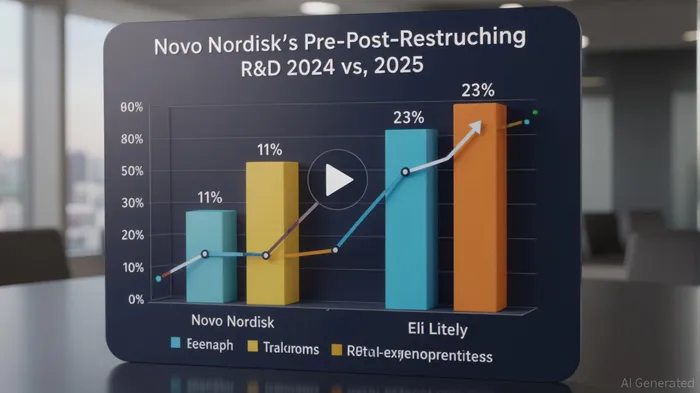
However, this approach contrasts sharply with Eli Lilly's R&D strategy. While NovoNVO-- cut R&D spending by 11% in Q2 2025, LillyLLY-- increased its R&D budget by 23% to $3.3 billion, prioritizing next-gen candidates like retatrutide (a triple agonist) and oral forglipron[5]. Lilly's aggressive pipeline expansion, coupled with its bold pre-launch investment in oral weight-loss drugs, underscores a willingness to take risks that Novo has historically avoided[6].
Financial Implications and Investor Sentiment
The restructuring has immediate financial costs: a one-time $1.4 billion charge in Q3 2025 and a revised operating profit growth forecast of 4–10% for 2025 (down from 10–16%)[7]. Novo's stock price, which plummeted from over $130 in 2024 to $54.30 by September 2025, reflects investor uncertainty. Analysts remain divided, with 47% recommending a “buy” and 50% a “hold,” though price targets suggest potential upside to $64.10[8].
The leadership transition—from Lars Fruergaard Jørgensen to Maziar Mike Doustdar—has further muddied the waters. Doustdar's emphasis on a “performance-based culture” and cost discipline is laudable, but the abrupt departure of the Head of Global R&D has raised concerns about continuity in innovation[9]. Meanwhile, Lilly's stock, buoyed by Zepbound's success and a robust R&D pipeline, has outperformed Novo's in 2025, highlighting divergent investor perceptions of risk and reward.
Long-Term Risks and Opportunities
The obesity drug market is projected to exceed $200 billion by 2035, driven by broader adoption and new formulations[10]. Novo's amycretin and CagriSema could still carve out a niche, particularly if they demonstrate superior efficacy or tolerability. However, the company's decision to abandon a GLP-1/GIP co-agonist and a CB1 antagonist—programs with potentially differentiated mechanisms—signals a risk-averse approach that may limit its ability to disrupt the market[11].
For investors, the key question is whether Novo's cost-cutting will free up capital for transformative R&D or merely delay inevitable competition. While the savings from restructuring are tangible, they must be weighed against the long-term cost of reduced innovation. Lilly's pipeline, with its triple-agonist and oral therapies, represents a more aggressive bet on the future of metabolic disease treatment[12].
Conclusion: A Calculated Gamble
Novo Nordisk's restructuring is a strategic recalibration, not a surrender. By focusing on operational efficiency and core franchises, the company aims to defend its market share in a hyper-competitive landscape. Yet, the pharma sector's history shows that cost-cutting alone rarely sustains long-term growth without complementary innovation. Investors must monitor Novo's ability to balance short-term savings with long-term R&D investment, particularly as Lilly and others push the boundaries of GLP-1 science.
In the end, Novo's success will hinge on execution: Can it reinvest savings effectively, navigate regulatory and supply chain challenges, and outmaneuver rivals in a market where first-mover advantage is eroding? For now, the restructuring appears to be a defensive pivot—a necessary but insufficient step in a high-stakes game.





Comentarios
Aún no hay comentarios