
Novo Nordisk's Restructuring: A Strategic Shift or a Sign of Erosion in Growth?
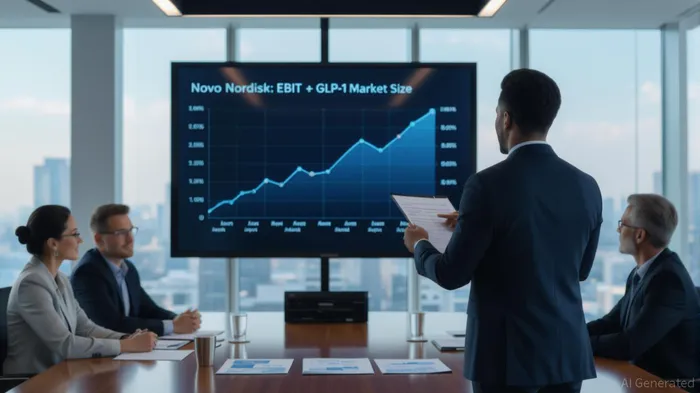
Novo Nordisk's restructuring efforts in 2025 have sparked a critical debate: Is this a calculated strategic shift to fortify its dominance in the GLP-1 market, or a sign of growing pains as competition intensifies? The Danish pharmaceutical giant has slashed 9,000 global jobs—5,000 in Denmark—aiming to generate 8 billion Danish kroner in annual savings by 2026. These savings will be reinvested into diabetes and obesity treatments, but the one-off costs of 8 billion kroner have already forced the company to revise its operating profit growth forecast downward to 4–10 percent for 2025, a stark contrast to its earlier optimism[1].
EBIT Recovery: A Balancing Act
The restructuring's immediate impact on EBIT is mixed. While NovoNVO-- Nordisk's Q1 2025 results showed a 22 percent rise in operating profit (at constant exchange rates), the broader 2025 guidance—sales growth of 13–21 percent and operating profit growth of 4–10 percent—reflects a more cautious outlook[2]. This adjustment stems from slower-than-expected adoption of Wegovy and Ozempic in the U.S., where compounded GLP-1 alternatives have eroded market share[3]. The company's Diabetes and Obesity division, however, remains a bright spot, with Obesity care sales surging 67 percent in DKK to 18.4 billion in Q1 2025[2].
Long-term EBIT projections for 2026–2027 suggest a recovery, with analysts forecasting 9.1 percent annual earnings growth and operating profit aligned with strategic goals[4]. This optimism is underpinned by Novo's 42 billion DKK, five-year investment plan, which includes expanding production capacity and advancing next-generation therapies like amycretin, a GLP-1/amylin agonist[5]. Yet, the Catalent acquisition—designed to address supply chain bottlenecks—has introduced short-term financial strain. Amortization and depreciation costs from the $16.5 billion deal have already pressured gross margins, and the company reported a significant R&D impairment in Q2 2025[6].
Competitive Positioning: Innovation vs. Imitation
The GLP-1 market is becoming a battleground. Eli Lilly's Mounjaro and Zepbound have set a new benchmark for efficacy, while oral GLP-1 candidates like orforglipron loom on the horizon[7]. Novo Nordisk's decision to terminate two obesity drug candidates—a GLP-1/GIP co-agonist and a CB1 receptor antagonist—signals a pivot toward differentiation rather than incremental improvements[8]. This strategy is risky but necessary: with Wegovy's U.S. sales faltering due to compounded alternatives and Lilly's Zepbound, Novo must innovate to retain its 51 percent market share[9].
The company's leadership transition—marked by the abrupt departure of its CEO and R&D head—adds uncertainty. New CEO Maziar Mike Doustdar faces the challenge of maintaining R&D momentum while navigating a pipeline that now prioritizes amycretin and label expansions for existing therapies[10]. Meanwhile, competitors like Boehringer Ingelheim and Viking TherapeuticsVKTX-- are advancing next-gen GLP-1s with improved tolerability and delivery methods, threatening Novo's dominance[11].
Strategic Resilience or Erosion?
Novo Nordisk's restructuring is best viewed as a strategic recalibration rather than a sign of erosion. The cost-cutting measures and R&D rationalization are defensive moves to preserve margins in a hyper-competitive landscape. By focusing on high-potential projects and expanding production capacity, the company is positioning itself to weather near-term headwinds. However, the long-term success of this strategy hinges on three factors:
1. Execution of Amycretin and Other Pipeline Candidates: If amycretin delivers on its promise of superior efficacy, Novo could regain momentum.
2. Operational Efficiency Post-Catalent: The acquisition's long-term benefits—enhanced production for Wegovy and Ozempic—must outweigh its short-term costs.
3. Adaptation to Market Access Challenges: With PBMs and employers grappling with GLP-1 costs, Novo must innovate in pricing models (e.g., direct-to-consumer options) to maintain accessibility[12].
The GLP-1 market is projected to grow at a 10.8 percent CAGR through 2034, reaching $70 billion by 2027[13]. Novo's ability to capture a significant share of this growth will depend on its agility in addressing these challenges. For now, the restructuring appears to be a calculated bet on resilience—a bet that pays off if the company's long-term vision outpaces the rapid evolution of its competitors.





Comentarios
Aún no hay comentarios