
Novo Nordisk's Aggressive Restructuring: A Strategic Reset or a Sign of Declining Dominance in the Obesity Market?
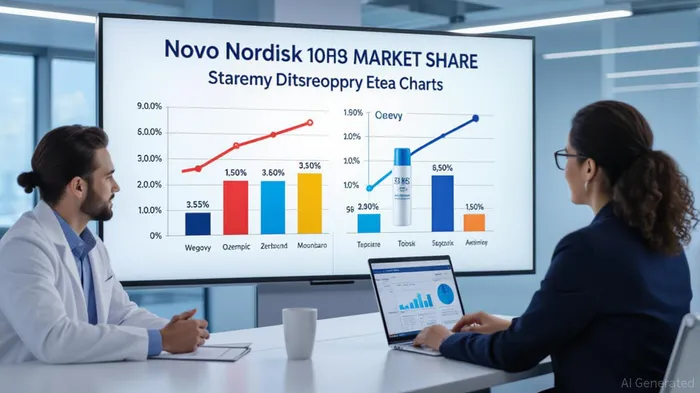
In the high-stakes arena of obesity therapeutics, NovoNVO-- Nordisk's recent restructuring efforts have sparked debate among investors: Is this a calculated strategic reset to counter intensifying competition, or a sign of waning dominance in a market increasingly dominated by Eli Lilly? The Danish pharmaceutical giant's decision to cut 9,000 jobs—11% of its global workforce—and revise its 2025 profit guidance downward[1] must be contextualized within a rapidly evolving industry landscape.
The Cost of Competition: Novo's Restructuring and Profit Downgrades
Novo Nordisk's restructuring, aimed at saving $1.25 billion annually by 2026, reflects a response to both internal and external pressures. Internally, the company faced disappointing results from its experimental CagriSema drug, which failed to meet weight-loss expectations in clinical trials[2]. Externally, Eli Lilly's Zepbound and Mounjaro have captured nearly 60% of the obesity market, with Zepbound alone accounting for two-thirds of patients using GLP-1 drugs[3]. This shift has forced Novo to revise its operating profit growth forecast from 10–16% to 4–10% for 2025[1].
The restructuring also addresses operational complexity. By freezing hiring for non-essential roles and streamlining decision-making, Novo aims to redirect resources toward core growth areas like diabetes and obesity treatments[1]. However, the one-off restructuring costs of 8 billion Danish kroner (approximately $1.3 billion) have already impacted short-term profitability[1].
Eli Lilly's Ascendancy: Market Share and Innovation
Eli Lilly's rise as a formidable competitor is underscored by its aggressive R&D and manufacturing strategies. The company's tirzepatide-based drugs, Zepbound and Mounjaro, have outperformed Novo's Wegovy and Ozempic in both weight loss efficacy and market penetration. In Q2 2025, LillyLLY-- secured 57% of the obesity market, up from 53% earlier in the year[3]. This momentum is supported by Lilly's $3 billion expansion plan for diabetes and obesity drug production[4], alongside its oral GLP-1 drug orforglipron, which showed a 12.4% average weight loss in phase 3 trials[5].
Lilly's patent strategy further solidifies its position. With 16 patents for tirzepatide and plans to extend exclusivity, the company is locking in market control while Novo NordiskNVO--, with 320 semaglutide-related patents, faces patent expiry risks for key products by 2031[4].
R&D Pipelines: A Battle for the Future
Both companies are investing heavily in next-generation therapies. Novo's pipeline includes amycretin (a GLP-1 agonist showing 13.1% weight loss in phase 1 trials) and CagriSema, which, despite mixed phase-3 results, remains a cornerstone of its obesity strategy[2]. Regulatory submissions for CagriSema are slated for early 2026, with a potential 2027 U.S. launch[5].
Eli Lilly, meanwhile, is advancing orforglipron for regulatory approval by late 2025[5] and exploring dual/triple agonists to enhance weight loss and cardiometabolic benefits[6]. The company's focus on oral formulations—a growing demand in the market—positions it to capture patients averse to injectables.
Long-Term Implications for Investors
The obesity drug market, projected to grow to $100 billion by 2030[2], presents both opportunities and risks. For Novo NordiskNVO--, the restructuring's success hinges on its ability to reinvest savings into R&D and expand patient access, particularly in emerging markets like China, where Wegovy recently gained approval[2]. However, challenges persist: compounded versions of its drugs in the U.S. and patent expirations could erode margins[1].
Eli Lilly's stronger market share and diversified pipeline suggest it is better positioned to capitalize on near-term growth. Yet, Novo's leadership in GLP-1 therapies and its strategic partnerships (e.g., with Replicate Bioscience for RNA-based treatments[7]) could enable a resurgence.
Conclusion: Strategic Reset or Decline?
Novo Nordisk's restructuring is a strategic reset—a necessary but costly move to realign resources in the face of Lilly's dominance. While the company's profit downgrades signal short-term vulnerability, its long-term prospects depend on successful R&D execution and navigating patent challenges. For investors, the key question is whether Novo can innovate fast enough to reclaim its market leadership or if Lilly's momentum will cement its position as the obesity sector's new king.







Comentarios
Aún no hay comentarios