
Novo Nordisk's 9,000-Job Cut: Strategic Restructuring or Early Sign of Declining Dominance in Obesity Market?
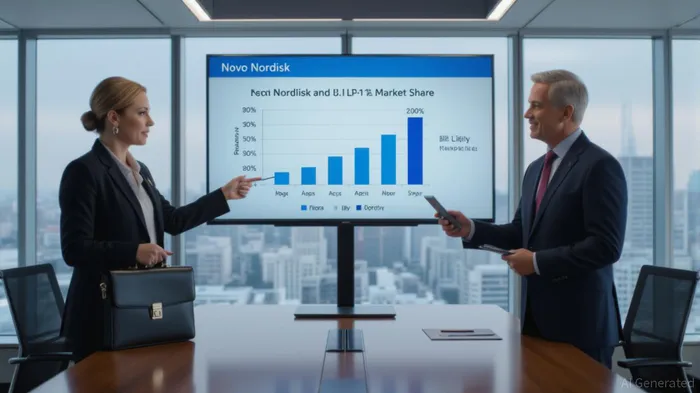
Novo Nordisk's announcement of 9,000 global job cuts—representing a $1.26 billion annual cost-saving initiative—has sparked debate about whether this reflects a proactive strategic pivot or a defensive response to eroding market dominance in the obesity drug sector. As the Danish pharmaceutical giant navigates a fiercely competitive GLP-1 landscape, investors must weigh the long-term implications of its restructuring against broader industry dynamics.
Strategic Restructuring: Cost Efficiency and Organizational Overhaul
Novo Nordisk's restructuring, led by newly appointed CEO Mike Doustdar, aims to streamline operations, accelerate decision-making, and reallocate resources to high-potential growth areas like diabetes and obesity [1]. The company emphasized that the cuts—5,000 of which are in Denmark—align with its goal to simplify its organizational structure and foster a “performance-based culture” [3]. While the one-time $1.3 billion restructuring cost will weigh on 2025 operating profits, the annual savings are expected to bolster long-term profitability. This move mirrors broader industry trends, where companies like Eli LillyLLY-- have similarly prioritized operational efficiency to fund innovation [5].
However, the scale of the cuts raises questions about their necessity. With Novo NordiskNVO-- already facing supply chain bottlenecks for Wegovy and Ozempic, the job cuts could signal a recognition of operational inefficiencies. The company's revised 2025 profit growth forecast (4–10%)—down from previous expectations—suggests that internal challenges may be outpacing the benefits of restructuring [4].
Competitive Pressures: Losing Ground to Eli Lilly
The obesity drug market has become a battleground for NovoNVO-- Nordisk and Eli LillyLLY--, with the latter gaining significant traction. By Q2 2025, Lilly's Zepbound (tirzepatide) captured 57% of the U.S. GLP-1 market, compared to Novo's 39%, driven by superior weight-loss results in clinical trials and aggressive commercialization strategies [1]. Lilly's pipeline further strengthens its position: oral GLP-1 candidate orforglipron and triple-agonist retatrutide are positioned to redefine the market, while Novo's CagriSema—despite showing 15.7% weight loss in trials—faces delays and mixed clinical data [3].
Novo's struggles are compounded by supply constraints and a delayed entry into the oral GLP-1 segment, which Lilly has already capitalized on. Analysts at MorningstarMORN-- note that Novo's market share erosion and compounded semaglutide competition have “weighed on investor confidence,” even as the company aims to capture $55 billion of a projected $200 billion GLP-1 market by 2031 [2].
R&D Pipeline and Innovation Risks
Post-restructuring, Novo Nordisk has recalibrated its R&D focus, abandoning projects like a GLP-1/GIP co-agonist and CB1 receptor blocker in favor of “differentiated programs” [3]. While this streamlines its pipeline, it also highlights a lack of near-term alternatives to Wegovy and Ozempic. The company's $42 billion, five-year R&D investment plan—equivalent to 1.7% of Denmark's GDP—underscores its commitment to innovation, but execution risks persist [4]. Leadership transitions, including the departure of former CEO Lars Fruergaard Jørgensen, have added uncertainty, with analysts cautioning about potential disruptions to long-term strategic continuity [3].
Long-Term Investment Implications
The restructuring's success hinges on Novo Nordisk's ability to balance cost discipline with innovation. While the $1.26 billion annual savings could fund future R&D or offset market share losses, the company's reliance on semaglutide-based therapies remains a vulnerability. Lilly's pipeline diversification and manufacturing expansion—bolstered by four new U.S. production sites—position it to capitalize on the obesity market's projected $100 billion growth by 2030 [5].
For Novo Nordisk, the path forward requires not only resolving supply chain issues but also accelerating next-generation therapies like CagriSema and amycretin. Analysts remain cautiously optimistic, with some arguing that the stock is undervalued given its long-term economic moat in diabetes and cardiometabolic diseases [2]. However, the job cuts and leadership shakeup suggest that Novo is playing catch-up rather than leading the market—a dynamic that could redefine its competitive standing in the coming years.
Conclusion
Novo Nordisk's 9,000-job cut is best viewed as a strategic recalibration rather than a sign of terminal decline. The restructuring addresses immediate cost pressures and operational inefficiencies, but it also underscores the company's challenges in maintaining its obesity market leadership against a more agile and innovative rival. For investors, the key question is whether Novo's R&D investments and revised organizational structure can close the gap with Lilly—or if the job cuts signal a broader struggle to adapt to a rapidly evolving therapeutic landscape.





Comentarios
Aún no hay comentarios