
November Market Rebound: AI Rally Masks Underlying Vulnerabilities
The recent market rally, while technically impressive on paper, rests on fragile foundations that merit serious scrutiny. When the Federal Reserve delivered its first rate cut in over a year and trade tensions eased in late 2025, investors greeted these developments as catalysts for a sustainable rebound. Yet this optimism overlooks critical dependencies: the same policies that fueled the upswing also inject artificial liquidity, while speculative distortions in technology sectors mask underlying valuation risks. 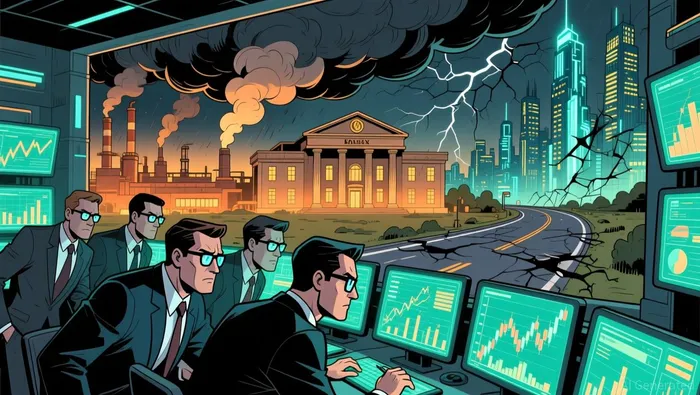 CTA strategies, for instance, notched a modest 1.9% gain year-to-date, but their performance came amid sharply higher volatility-a red flag for stability. Meanwhile, tech giants like Microsoft and Alphabet continue to dominate headlines with AI infrastructure bets, driving cloud services market caps to grow at a 14% compound annual rate between 2005–2023. Yet this growth requires relentless R&D spending, straining balance sheets while offering no guarantee of returns. The McKinsey report identifying 18 emerging "arenas of competition"-from robotics to semiconductors-further illustrates the speculative frenzy. Nvidia's $66 billion economic profit in 2024 looks extraordinary until you consider the regulatory minefield ahead: these high-growth sectors face unquantified policy risks that could quickly erode margins. The rally's sustainability isn't just questionable; it's contingent on policy tailwinds and speculative momentum that history shows rarely last without consequence.
The market's recent surge masks underlying fragility in the bull run. After speculative stocks plunged 17% from mid-October peaks, November's rebound feels more like a technical bounce than a sustainable recovery. Earnings have been the market's primary engine, with S&P 500 companies beating estimates consistently since July 2025, but this momentum now faces critical vulnerabilities. Strong AI demand-Microsoft itself reports unmet orders-doesn't erase the risk that a Fed pause in rate cuts could abruptly reverse investor euphoria, potentially triggering the kind of multiple compression that erased Nvidia's Q3 revenue growth gains. The Nasdaq trading near 35 times forward earnings looks perilously stretched against this backdrop. Historically, the S&P 500 delivers positive returns 73% of the time, but this pattern assumes stable policy and markets. The current 2025 scenario is different: projected tax cuts slashing the corporate rate to 15% remain unpassed, DOGE-inspired fiscal efficiency reforms are mired in debate, and geopolitical tensions create unpredictable headwinds. Without these policy tailwinds materializing, M&A activity could stall, leaving earnings growth unanchored. This confluence of stretched valuations, policy uncertainty, and external shocks creates a foundation where earnings quality could rapidly deteriorate under stress, turning optimism into a fragile house of cards.
Despite a robust November rebound fueled by the Federal Reserve's first rate cut in more than a year and eased trade tensions, market complacency risks clouding emerging vulnerabilities. While earnings beats and persistent AI demand underpinned optimism, late-cycle strains are surfacing-speculative stocks tumbled 17% from October peaks amid liquidity concerns, and unmet tech demand contrasts sharply with dot-com era euphoria. As institutions rotate toward regional equities and higher-quality bonds, prudent investors must monitor three operational guardrails before pivoting aggressively: a spike in 10-year Treasury yields above 4.7% following delayed December Fed cuts, Microsoft's orders/shipments ratio falling below 1.0 in early 2026 signaling AI demand cooling, and VIX sustained above 25 triggering $15B+ monthly REIT outflows. These thresholds act as early-warning systems-before sentiment shifts, liquidity tightens, or positions need defensive trimming.







Comentarios
Aún no hay comentarios