
The November CPI Miss and Its Implications for 2026 Fed Policy and Equity Sectors
The U.S. economy's November 2025 CPI report delivered a surprise that has reshaped the macroeconomic narrative for 2026. With year-over-year inflation cooling to 2.7%, well below the forecasted 3.1% according to the New York Times, the data signaled a potential turning point in the Federal Reserve's battle against inflation. This "CPI miss" has sparked a reevaluation of monetary policy and equity sector strategies, particularly in a disinflationary environment where asset rotations are accelerating.
A Fed at a Crossroads: Balancing Inflation and Growth
The Federal Reserve's December 2025 rate cut-lowering the target federal funds rate to 3.5%-3.75%-reflects its cautious optimism about the inflation trajectory. However, the decision was not unanimous; three dissenting votes highlighted internal divisions over the risks of over-tightening versus under-responding to a weakening labor market. This tension underscores the Fed's delicate balancing act: while inflation has eased from 3% in September to 2.7%, it remains above the 2% target.
Looking ahead, institutional strategists project a single rate cut in 2026, with a focus on maintaining stability in a fragile economic landscape. The Fed's policy will likely hinge on two key factors: the persistence of disinflationary pressures and the resilience of the labor market. If inflation continues to trend downward, the central bank may adopt a more accommodative stance, but it will remain wary of reigniting inflation through excessive easing as market analysis suggests. 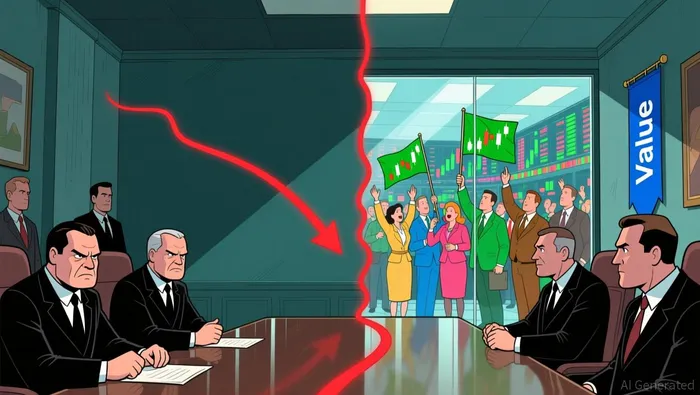
Equity Sector Rotations: From AI Hype to Value Realism
The November CPI miss has already triggered a shift in equity market dynamics. Retail investors, emboldened by the data, are aggressively rotating into high-leverage positions and growth stocks, particularly in AI infrastructure and large-cap tech firms like NVIDIA and Microsoft according to Argent Financial. This trend is mirrored in broader market indices, where the equal-weight S&P 500 has outperformed large-cap benchmarks for the first time in months, signaling a diversification of leadership.
However, this momentum-driven rotation carries risks. Margin debt among retail traders has surged, amplifying systemic vulnerabilities. For institutional investors, the focus is shifting from speculative AI bets to sectors that can monetize AI-driven efficiencies. This includes manufacturing and technology-driven industries prioritizing digital transformation and supply chain resilience according to a CPA report.
Historical precedents offer guidance. During the 1990s disinflationary period, capital flowed into U.S. assets and growth stocks, propelling the tech bubble. Similarly, post-2008, the S&P 500's 37% decline contrasted with the relative resilience of defensive sectors like Consumer Staples (-15.4%) and Utilities. These patterns suggest that in 2026, investors may increasingly favor value and small-cap stocks as the "Magnificent Seven" dominance wanes according to ProShares analysis.
Strategic Asset Rotation: Lessons from the Past
Disinflationary environments historically favor sectors with inelastic demand and operational flexibility. For example:
- Health Care and Utilities: These sectors outperformed during the 2009 financial crisis due to their essential services and stable cash flows according to investment research.
- Technology and Manufacturing: The 1990s disinflationary period saw gains in tech stocks as innovation drove efficiency according to Morgan Stanley analysis.
- Global Diversification: During dollar weakness in the 1970s, undervalued international equities and commodities thrived according to market backtesting.
For 2026, a strategic approach might involve:
1. Diversifying Beyond Tech: While AI infrastructure remains a growth driver, investors should allocate to sectors like health care and utilities, which offer downside protection.
2. Embracing Small-Cap and Value Stocks: As market leadership broadens, smaller companies with strong balance sheets may outperform.
3. Monitoring Geopolitical Risks: Manufacturers should prioritize supply chain resilience through dual-sourcing and digital transformation.
Conclusion: Navigating Uncertainty with Discipline
The November CPI miss has created a pivotal moment for investors. While the Fed's cautious easing and the allure of AI-driven growth present opportunities, the risks of leverage and over-rotation into speculative assets cannot be ignored. By drawing on historical patterns and adopting a disciplined, diversified approach, investors can position themselves to thrive in a disinflationary environment. The key lies in balancing innovation with resilience-a strategy that mirrors the Fed's own balancing act in 2026.







Comentarios
Aún no hay comentarios