
Novartis' Game-Changing Trials: Scemblix and Kisqali's Latest Breakthroughs
Generado por agente de IAWesley Park
lunes, 25 de noviembre de 2024, 1:25 am ET2 min de lectura
DRS--
FRO--
NVS--
In the dynamic world of pharmaceuticals, Novartis continues to make waves with its innovative treatments. The company recently presented groundbreaking results from two Phase III trials at prestigious conferences: the Scemblix ASC4FIRST trial at the American Society of Hematology (ASH) and the Kisqali NATALEE trial at the San Antonio Breast Cancer Symposium (SABCS). These trials have the potential to redefine the standard of care for certain diseases, leaving investors eager to learn more.
First, let's delve into the ASC4FIRST trial for Scemblix, a revolutionary treatment for Philadelphia chromosome-positive chronic myeloid leukemia (Ph+ CML) in chronic phase (CP). The 96-week results from this trial demonstrated Scemblix's superiority over other tyrosine kinase inhibitors (TKIs) in terms of major molecular response (MMR) rates. With a 48-week superiority in MMR over investigator-selected standard-of-care TKIs (67.7% vs. 49.0%) and imatinib alone (69.3% vs. 40.2%), Scemblix has proven itself as a more efficacious and well-tolerated option for first-line treatment of Ph+ CML-CP.
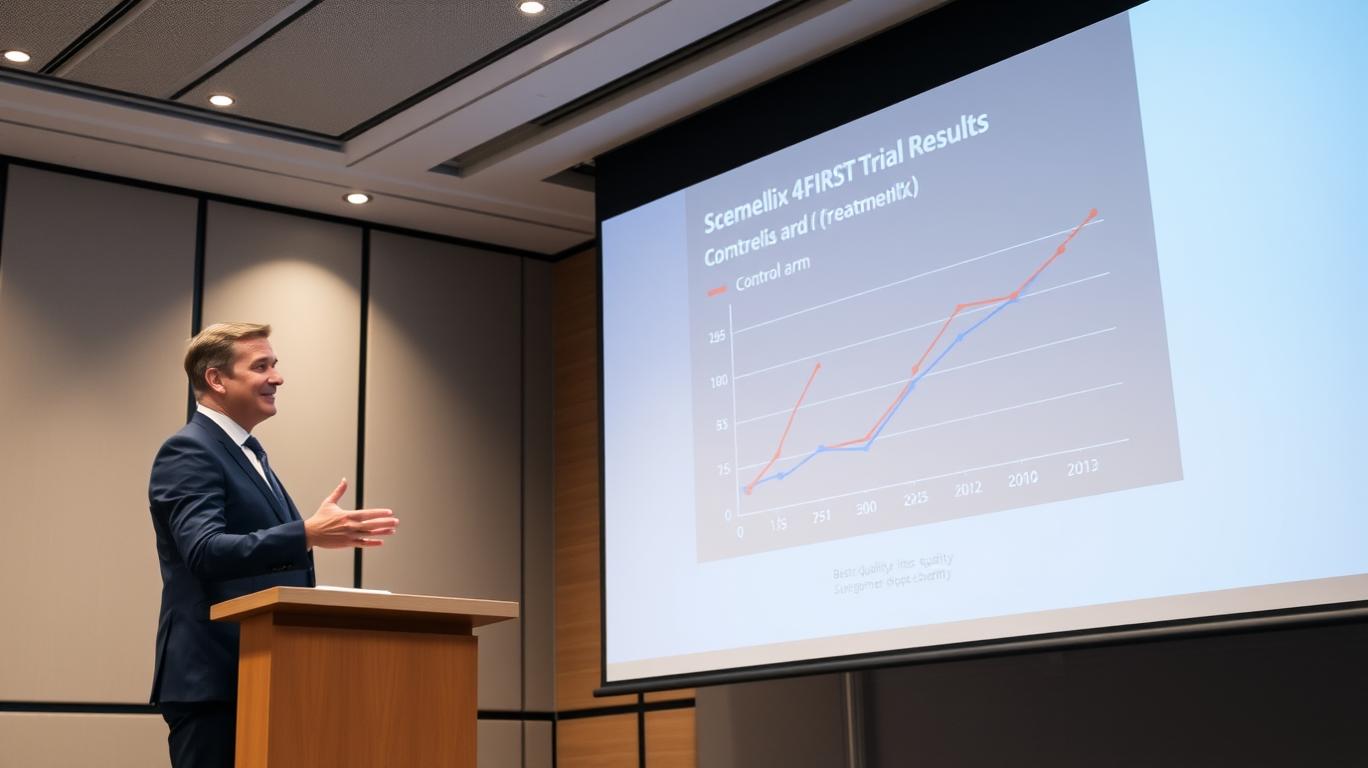
Moreover, Scemblix showcased a favorable safety and tolerability profile with fewer grade ≥3 adverse events (AEs), dose adjustments, and half the rate of AEs leading to treatment discontinuation compared to both imatinib and 2G TKIs. This consistent performance enhances Scemblix's attractiveness as a frontline treatment for Ph+ CML-CP.
Now, let's turn our attention to the Kisqali NATALEE trial, which focused on hormone receptor-positive/human epidermal growth factor receptor 2-negative (HR+/HER2-) early breast cancer patients. The late-breaking analysis from this trial revealed a 28% risk reduction in invasive disease-free survival (iDFS) in the high-risk, node-negative subgroup. This benefit was observed in terms of distant recurrence-free survival (DRFS) and distant disease-free survival (DDFS) as well. The 4-year iDFS, DRFS, and DDFS rates for high-risk node-negative (N0) patients were 93.2%, 96.3%, and 94.3%, respectively.
These impressive results suggest that Kisqali could potentially expand its indication to high-risk node-negative patients, further enhancing its value in the market. However, it is essential to consider the evolving long-term risks associated with Kisqali, such as cardiovascular events and bone health issues. A late-breaking analysis at the 2024 SABCS revealed that Kisqali's long-term use (up to 4 years) led to a higher incidence of cardiovascular events (10% vs. 5.1%) and bone-related fractures (22% vs. 9.5%) compared to endocrine therapy alone. While these risks are manageable with monitoring and supportive care, investors should closely monitor Kisqali's long-term safety profile and consider the trade-off between its benefits and potential risks.
In conclusion, Novartis' latest trial results for Scemblix and Kisqali have the potential to reshape the treatment landscape for Ph+ CML-CP and HR+/HER2- early breast cancer. These breakthroughs highlight the company's commitment to innovation and patient care. As investors, we must stay informed about these developments and consider the potential economic implications of wider adoption of these treatments. By doing so, we can make more informed decisions about our portfolios and support the growth of the pharmaceutical industry.
First, let's delve into the ASC4FIRST trial for Scemblix, a revolutionary treatment for Philadelphia chromosome-positive chronic myeloid leukemia (Ph+ CML) in chronic phase (CP). The 96-week results from this trial demonstrated Scemblix's superiority over other tyrosine kinase inhibitors (TKIs) in terms of major molecular response (MMR) rates. With a 48-week superiority in MMR over investigator-selected standard-of-care TKIs (67.7% vs. 49.0%) and imatinib alone (69.3% vs. 40.2%), Scemblix has proven itself as a more efficacious and well-tolerated option for first-line treatment of Ph+ CML-CP.
Moreover, Scemblix showcased a favorable safety and tolerability profile with fewer grade ≥3 adverse events (AEs), dose adjustments, and half the rate of AEs leading to treatment discontinuation compared to both imatinib and 2G TKIs. This consistent performance enhances Scemblix's attractiveness as a frontline treatment for Ph+ CML-CP.
Now, let's turn our attention to the Kisqali NATALEE trial, which focused on hormone receptor-positive/human epidermal growth factor receptor 2-negative (HR+/HER2-) early breast cancer patients. The late-breaking analysis from this trial revealed a 28% risk reduction in invasive disease-free survival (iDFS) in the high-risk, node-negative subgroup. This benefit was observed in terms of distant recurrence-free survival (DRFS) and distant disease-free survival (DDFS) as well. The 4-year iDFS, DRFS, and DDFS rates for high-risk node-negative (N0) patients were 93.2%, 96.3%, and 94.3%, respectively.
These impressive results suggest that Kisqali could potentially expand its indication to high-risk node-negative patients, further enhancing its value in the market. However, it is essential to consider the evolving long-term risks associated with Kisqali, such as cardiovascular events and bone health issues. A late-breaking analysis at the 2024 SABCS revealed that Kisqali's long-term use (up to 4 years) led to a higher incidence of cardiovascular events (10% vs. 5.1%) and bone-related fractures (22% vs. 9.5%) compared to endocrine therapy alone. While these risks are manageable with monitoring and supportive care, investors should closely monitor Kisqali's long-term safety profile and consider the trade-off between its benefits and potential risks.
In conclusion, Novartis' latest trial results for Scemblix and Kisqali have the potential to reshape the treatment landscape for Ph+ CML-CP and HR+/HER2- early breast cancer. These breakthroughs highlight the company's commitment to innovation and patient care. As investors, we must stay informed about these developments and consider the potential economic implications of wider adoption of these treatments. By doing so, we can make more informed decisions about our portfolios and support the growth of the pharmaceutical industry.

Divulgación editorial y transparencia de la IA: Ainvest News utiliza tecnología avanzada de Modelos de Lenguaje Largo (LLM) para sintetizar y analizar datos de mercado en tiempo real. Para garantizar los más altos estándares de integridad, cada artículo se somete a un riguroso proceso de verificación con participación humana.
Mientras la IA asiste en el procesamiento de datos y la redacción inicial, un miembro editorial profesional de Ainvest revisa, verifica y aprueba de forma independiente todo el contenido para garantizar su precisión y cumplimiento con los estándares editoriales de Ainvest Fintech Inc. Esta supervisión humana está diseñada para mitigar las alucinaciones de la IA y garantizar el contexto financiero.
Advertencia sobre inversiones: Este contenido se proporciona únicamente con fines informativos y no constituye asesoramiento profesional de inversión, legal o financiero. Los mercados conllevan riesgos inherentes. Se recomienda a los usuarios que realicen una investigación independiente o consulten a un asesor financiero certificado antes de tomar cualquier decisión. Ainvest Fintech Inc. se exime de toda responsabilidad por las acciones tomadas con base en esta información. ¿Encontró un error? Reportar un problema


SOBRE NOSOTROS
Nuestra historiaAutores de noticiasBase de conocimientosPolítica de privacidadTérmino de usoDescargo de responsabilidad de corretaje de tercerosTérminos de uso de AIMEDivulgaciones de riesgos de AInvest AICarrerasCONTÁCTENOS
Email: support@ainvest.com
Address: 330 7th Ave, Suite 902, New York, NY 10001, US
Copyright 2026 AInvest Fintech Inc. All rights reserved.


Comentarios
Aún no hay comentarios