
U.S.-Norway Trade Tensions: Tariff Risks and Supply Chain Reconfigurations in a Fractured Global Economy
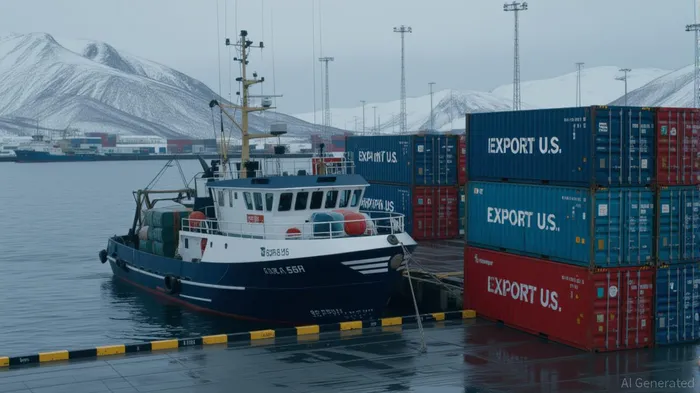
The U.S.-Norway trade dispute has escalated into a high-stakes contest for global supply chain resilience, with tariffs reshaping industrial strategies and investment flows. At the heart of this conflict lies a 16% U.S. tariff on Norwegian seafood exports, a sector contributing 16% of Norway’s value-added exports to the U.S. [4]. This move, part of a broader Trump-era strategy to address trade imbalances, has forced Norwegian companies to recalibrate their operations, passing costs to consumers and accelerating automation in the fishing industry [1]. For investors, the implications extend beyond Norway’s borders, signaling a shift toward localized production and diversified trade networks.
Sectoral Vulnerabilities and Adaptive Strategies
Seafood and Manufacturing: The seafood industry’s exposure is acute, with U.S. tariffs compounding pressure from overfishing and climate-driven stock shifts. Norwegian firms like Ekornes, a furniture giant, have already adjusted pricing models to absorb costs, illustrating how tariffs can trigger cascading effects across supply chains [1]. Meanwhile, the manufacturing sector faces a 10-15% reciprocal tariff, prompting investments in automation and a pivot toward Asian markets [2]. These adaptations highlight the dual risks of short-term cost inflation and long-term structural shifts in global trade.
Energy and Geopolitical Leverage: Norway’s energy sector, a cornerstone of its economy, is also under strain. The Government Pension Fund Global (GPFG) reported a 0.6% loss in Q1 2025, partly attributed to U.S. tariff-related market volatility [2]. This underscores how trade tensions can destabilize asset valuations, particularly in energy-dependent economies. Norway’s new High North Strategy, which restricts Chinese activity in the Arctic, further complicates its trade calculus, blending economic and geopolitical risks [3].
Global Supply Chain Implications
The U.S.-Norway dispute reflects a broader trend: tariffs are no longer just economic tools but instruments of geopolitical alignment. The Trump administration’s 20% tariff on EU imports, for instance, has indirectly affected Norway, which exports 80% of its goods to the EU [4]. This interdependency forces investors to scrutinize not just bilateral disputes but the systemic fragility of multilateral trade systems. Norway’s pivot to the EFTA-India Free Trade Agreement and closer EU ties exemplifies a strategic retreat toward regional blocs, a trend likely to accelerate as U.S. protectionism intensifies [2].
Investment Strategies in a Tariff-Driven World
For investors, the key lies in identifying sectors with adaptive capacity. The seafood and manufacturing industries’ push toward automation and market diversification offers a blueprint for resilience. However, energy investments remain fraught, given the GPFG’s recent losses and the geopolitical volatility of the High North [2]. Alternative trade agreements, such as EFTA-India, may provide short-term relief but require careful evaluation of long-term alignment with U.S. policies.
Conclusion
The U.S.-Norway trade tensions are a microcosm of a fractured global economy, where tariffs serve as both weapon and shield. For investors, the lesson is clear: diversification and agility are paramount. While Norway’s efforts to balance U.S. pressures with EU and Asian partnerships offer a model, the broader lesson is that supply chain investments must now account for geopolitical contingencies as much as economic fundamentals.
**Source:[1] New US tariff likely to boost prices [https://www.newsinenglish.no/2025/08/01/new-us-tariff-likely-to-boost-prices/][2] Navigating the Tariff Tides: Norway's Strategic Trade Balancing Act and Investment Implications [https://www.ainvest.com/news/navigating-tariff-tides-norway-strategic-trade-balancing-act-investment-implications-2508/][3] A New Strategy for the High North in 2025 [https://www.highnorthnews.com/en/norway-under-pressure-new-strategy-high-north-2025][4] Norway Caught in Trump's Trade War [https://www.newsinenglish.no/2025/04/03/norway-caught-in-trumps-trade-war-2/]







Comentarios
Aún no hay comentarios