
Norway's Housing Market Slowdown and Central Bank Policy Divergence: Assessing Investment Risks and Opportunities
The Norwegian housing market in 2023–2025 has been a study in contrasts. While nationwide house prices have risen steadily-up 4.54% year-on-year as of Q2 2025- adjusting for inflation reveals a more muted 1.49% increase. Urban hubs like Stavanger and Bergen have outpaced the national average, with price surges of 13.86% and 10.97%, respectively, driven by strong demand and constrained supply according to property data. Oslo, the capital, has seen a more modest 4.29% annual increase. These divergent trends highlight both the resilience and fragility of Norway's real estate sector, as low construction activity and high mortgage rates create headwinds for affordability and long-term stability.
Monetary Policy Divergence and Its Implications
Norges Bank's 2025 monetary policy has diverged from its global counterparts, particularly the European Central Bank (ECB) and the Federal Reserve (Fed). While the ECB and Fed have maintained a hawkish stance to combat inflation, Norges Bank has opted for cautious normalization, reducing its policy rate from 4.5% to 4% by mid-2025. This divergence reflects Norway's unique economic context: slowing disinflation, elevated domestic inflation in services and food, and a need to support a housing market constrained by supply-side bottlenecks. The central bank anticipates 1–2 additional rate cuts in 2026, with the policy rate projected to reach 3% by 2028.
This easing has significant implications for real estate and financial assets. Lower borrowing costs could stimulate demand, particularly among first-time buyers, as evidenced by the 10% reduction in down payment requirements since January 2025. However, the policy divergence also exacerbates krone depreciation pressures. Structural capital outflows-driven by Norwegian investments in U.S. equities and bonds-have weakened the krone, making Norwegian assets more attractive to foreign investors. This dynamic could offset some of the affordability challenges posed by high mortgage rates averaging 5.65% as of March 2025.
Regional Disparities and Supply Constraints
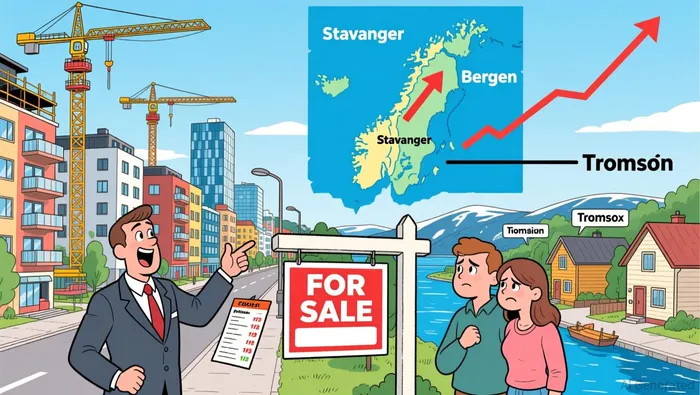
Regional disparities in price growth underscore the uneven distribution of market pressures. Stavanger and Bergen's surging prices-linked to strong demand and limited supply- contrast sharply with more modest gains in Trondheim and Tromsø. These imbalances are compounded by a construction sector in decline: dwelling completions fell by 15.4% year-on-year in H1 2025, with units under construction dropping by 9.9% according to property data. The resulting supply constraints are expected to persist, with construction activity projected to fall by over 30% in 2024–2025.
For investors, this scenario presents both risks and opportunities. High-demand urban areas with strong ESG credentials-such as energy-efficient housing or industrial logistics properties- could benefit from yield compression and enhanced cash flow stability. Conversely, secondary markets and commercial real estate developers face challenges, including high interest rates and fluctuating property values.
Financial Assets and Cross-Border Investment Trends
The interplay between monetary policy and financial assets further complicates the investment landscape. The Government Pension Fund Global (GPFG), Norway's sovereign wealth fund, has a 1.9% allocation to unlisted real estate, with returns of 2.4% in Q1 2025. Meanwhile, equities dominate the fund's portfolio at 70.6%, reflecting broader market optimism despite stretched valuations. The GPFG's focus on sustainability and ESG factors aligns with growing investor demand for responsible assets, potentially enhancing returns for Norwegian real estate with strong environmental credentials.
Cross-border investment trends also highlight Norway's appeal. Foreign ownership of real estate is permitted, albeit with restrictions on natural resources. The industrial logistics and data center sectors are particularly attractive, supported by low energy costs and government incentives. Additionally, Norway's alternative investment fund (AIF) market has grown, with assets under management reaching NOK381.7 billion by 2024, driven by foreign private equity interest.
Risks and Opportunities in a Shifting Landscape
Investors must navigate several risks. First, the housing market's reliance on low supply and high demand makes it vulnerable to sudden shifts in policy or economic conditions. Second, the krone's depreciation, while beneficial for foreign buyers, could exacerbate inflationary pressures if global trade tensions escalate. Third, commercial real estate developers face liquidity challenges, with high interest rates and reduced earnings constraining growth.
However, opportunities abound. Rate cuts in late 2025 could boost housing demand and stabilize prices, particularly in undersupplied urban markets. The krone's weaker valuation may attract capital inflows, enhancing liquidity for real estate and financial assets. Moreover, the focus on ESG and sustainable infrastructure positions Norway to capitalize on global trends toward green investing.
Conclusion
Norway's housing market and financial assets are at a crossroads. While supply constraints and high interest rates pose risks, monetary policy easing and regional price disparities create opportunities for strategic investors. The key lies in balancing exposure to high-growth urban areas with ESG-aligned assets, while hedging against currency volatility and global trade uncertainties. As Norges Bank navigates its divergent path, the interplay between policy, market dynamics, and cross-border capital flows will shape Norway's investment landscape in the coming years.







Comentarios
Aún no hay comentarios