
Northrop Grumman's Strategic Position in Defense Modernization: A Catalyst for Long-Term Shareholder Value
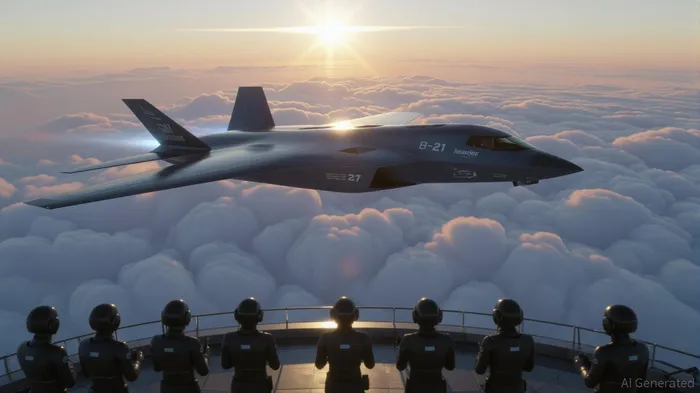
The U.S. defense sector is undergoing a transformative shift, driven by escalating global tensions, technological innovation, and a surge in federal spending. At the forefront of this evolution is Northrop Grumman CorporationNOC--, a defense contractor whose strategic investments in advanced technologies and infrastructure are positioning it to capitalize on long-term growth opportunities. While specific details on the B-21 Raider bomber program remain classified, the broader context of Northrop's competitive positioning—coupled with its financial resilience and alignment with U.S. defense priorities—paints a compelling case for its role in enhancing shareholder value through defense modernization.
Strategic Positioning in Next-Generation Defense Systems
Northrop Grumman's dominance in critical defense technologies, such as Active Electronically Scanned Array (AESA) radar systems and missile defense infrastructure, underscores its relevance in the modernization era. The company's billion-dollar investment in solid rocket motor production facilities, for instance, aligns directly with the Pentagon's Golden Dome missile defense program, which seeks to counter hypersonic and ballistic threats [1]. These capabilities not only secure Northrop's role in layered defense architectures but also create a durable competitive advantage in a market projected to expand due to rising geopolitical risks.
While the B-21 Raider's specifics remain opaque, the U.S. Air Force's emphasis on long-range strike capabilities—as evidenced by its procurement of F-35s and F-15EXs—highlights the strategic importance of stealth bombers in great power competition [4]. Northrop's legacy in stealth technology (e.g., the B-2 Spirit) and its ongoing R&D in AI-driven sensor fusion and autonomous systems suggest the B-21 will integrate these advancements to maintain air superiority. This alignment with Air Force modernization goals positions NorthropNOC-- to secure long-term contracts, even as the company navigates the absence of direct B-21 program disclosures.
Financial Resilience and Analyst Confidence
Northrop's financial performance in 2025 further reinforces its investment appeal. The company exceeded second-quarter revenue expectations, with its Sentinel program—a key initiative under the Defense Systems segment—receiving positive adjustments and contributing to a revised 2025 revenue forecast [3]. Analysts have raised price targets for the stock, citing strong execution, technological leadership, and favorable market conditions. For example, Sahm Capital notes that the Sentinel program's progress and Northrop's expertise in satellite and drone systems create a “long-term growth engine” amid rising global defense budgets [3].
However, historical backtesting of NOC's earnings beats from 2022 to 2025 reveals that while there was an average 0.9% positive return in the five trading days following a beat, the effect was not statistically significant and dissipated within 30 days. The win rate hovered around 60% initially but converged to 50%, suggesting no persistent edge. This implies that relying solely on earnings beats may not yield a robust trading strategy, and investors should consider complementary signals like guidance revisions or order-book growth.
The company's strategic flexibility is also evident in its approach to sixth-generation fighter programs. While Northrop has opted not to compete as a prime contractor for the Air Force's NGAD initiative, it remains a contender for the Navy's F/A-XX program, with a concept emphasizing stealth, AI collaboration, and extended range [4]. This pivot reflects a calculated focus on high-margin, technology-driven contracts that align with its core competencies.
Market Dynamics and Policy Tailwinds
The FY2025 defense budget of $849.8 billion and the upcoming FY2026 National Defense Authorization Act (NDAA) are critical catalysts for Northrop's growth trajectory. The NDAA is expected to prioritize cybersecurity, regional deterrence, and next-gen aircraft procurement, all areas where Northrop has established expertise [2]. Additionally, the FY2027 budget submission in early 2026 will likely solidify long-term funding for programs like the B-21, assuming continued bipartisan support for modernization.
However, the sector faces headwinds, including supply chain bottlenecks and workforce retention challenges. Northrop's emphasis on digital transformation—such as AI-driven maintenance tools and supply chain optimization—positions it to mitigate these risks while enhancing operational efficiency [4]. This proactive approach not only reduces costs but also strengthens its value proposition in an increasingly competitive defense landscape.
Conclusion: A High-Conviction Investment
Northrop Grumman's strategic alignment with U.S. defense priorities, coupled with its financial strength and technological leadership, makes it a compelling long-term investment. While the B-21 program remains shrouded in secrecy, the company's broader initiatives—ranging from Golden Dome missile defense to AI-enabled F/A-XX concepts—demonstrate a clear path to sustained growth. As defense budgets expand and modernization accelerates, Northrop's ability to leverage its R&D investments and infrastructure will likely drive robust shareholder returns.







Comentarios
Aún no hay comentarios