
Northrop Grumman's Backlog-Driven Resilience Amid Defense Crosscurrents
Northrop Grumman's Q1 2025 results underscore the duality of modern defense contracting: a robust backlog of $92.8 billion offers long-term stability, while short-term execution challenges on marquee programs like the B-21 Raider test its ability to navigate margin pressures. For investors, the question is whether the company's structural advantages—diversified defense programs, international growth, and a focus on cost discipline—can outweigh near-term turbulence. Here's why the answer leans toward cautious optimism.
The Backlog: A Fortress of Future Revenue
Northrop's $92.8 billion backlog, 60% tied to U.S. defense programs and 20% to international markets, acts as a buffer against cyclical demand fluctuations. This figure represents a 10% year-over-year increase, fueled by wins on critical programs like the Integrated Air and Missile Defense Battle Command System (IBCS) and advanced mission systems. Notably, its Q1 book-to-bill ratio of 1.45x suggests strong order momentum, with international sales surging 11%.
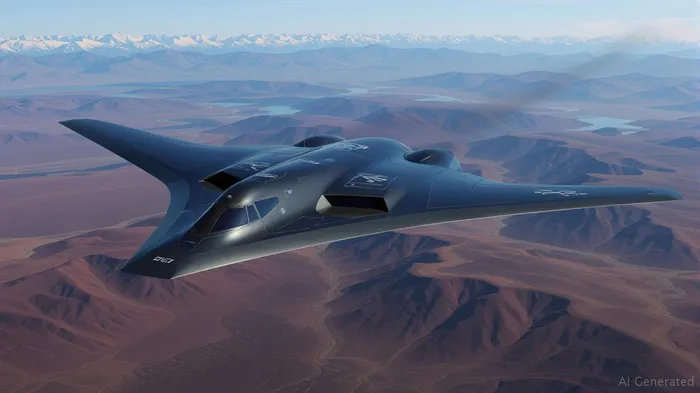
The backlog's composition matters: $56 billion is earmarked for programs with 10+ years of delivery timelines, ensuring steady revenue visibility. This contrasts sharply with peers facing shorter-term contract uncertainty. For investors, this structural advantage argues against overreacting to quarterly volatility.
The B-21 Crossroads: A Necessary Pain?
The B-21 program's $477 million Q1 loss—a one-time charge tied to manufacturing cost overruns and inflation—has dominated headlines. The hit slashed operating income by 47.5% and dragged net earnings down 62%. While painful, management framed the adjustment as a strategic pivot: reworking production processes to reduce costs in later batches.
Critically, the B-21's issues are concentrated in Northrop's Aeronautics segment, which now faces a margin outlook lowered to the “low to mid 6% range” for 2025 (down from “mid to high 9%”). Yet, this segment's challenges are partially offset by gains elsewhere: Defense Systems margins expanded, and the Space segment's sales are on track for double-digit growth.
Growth Catalysts Beyond Aeronautics
While Aeronautics stumbles, other segments are stabilizing the ship:
1. International Markets: With 20% of backlog now international, NorthropNOC-- is capitalizing on global demand for advanced systems. The IBCS program, for instance, has secured orders from Poland and Japan.
2. Digital Transformation: $200 million in savings from digitization initiatives—think AI-driven supply chain management—are already materializing. These efficiencies could counteract macroeconomic pressures like rising material costs.
3. Space Dominance: The Space segment's 10%+ sales growth is underpinned by U.S. Space Force modernization and commercial satellite contracts.
Investment Thesis: Hold for Long-Term Defense Bet
Northrop's Q2 results will be pivotal. If Aeronautics' margin trajectory improves (even modestly) and the B-21's production costs stabilize, the stock could rebound. Key metrics to watch:
- Margin recovery: Aeronautics' Q2 margin needs to avoid further declines.
- Dividend sustainability: The current $5.00 annual dividend (yield ~2.5%) is affordable, but pressure remains if free cash flow weakens.
- Backlog conversion: Ensuring that the $92.8 billion backlog translates into steady revenue without profit erosion.
Risk Factors:
- Delays in B-21 production could reignite margin concerns.
- U.S. defense budgets face political headwinds amid debt ceiling debates.
Final Take
Northrop Grumman is at a crossroads: its defense backlog and international footprint provide a sturdy foundation, but execution on the B-21 and cost discipline will determine near-term health. For investors with a 3-5 year horizon, the company's position in high-growth areas like hypersonic defense systems and space tech makes it a compelling long-term play. However, short-term traders should tread cautiously until margin pressures subside.
Rating: Hold (with a bullish bias if Q2 delivers margin stability).
Consider pairing exposure with a put option to hedge B-21-related volatility.





Comentarios
Aún no hay comentarios