
North Korea's Crypto-Fueled Threats and Regional Financial Security: Strategic Investment in Cybersecurity and Blockchain Compliance Solutions
The Scale of North Korea's Crypto-Fueled Threats
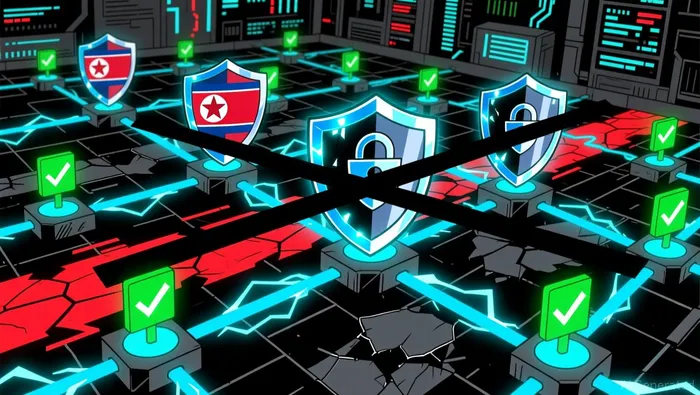
North Korean hackers have evolved from exploiting technical vulnerabilities to deploying sophisticated social engineering tactics, targeting high-net-worth individuals and manipulating them into compromising security, according to the U.S. Sanctions North Korean Bankers and Firms Tied to Crypto Laundering report. The $1.46 billion theft from Bybit in February 2025-a record in crypto history-exemplifies this shift, with stolen funds funneled through privacy tools and over-the-counter traders to obscure origins, as detailed in an Australia targets North Korean hackers and crypto networks funding WMD program article. These operations are not isolated: North Korea-linked actors have laundered over $3 billion in illicit crypto since 2017, with stolen assets directly funding weapons development, as noted in a South Korea mulls sanctioning North Korea over crypto theft report.
The geopolitical ramifications are equally severe. South Korea is considering sanctions to block DPRK-controlled wallets and restrict transactions, aligning with U.S. actions that have designated two North Korean firms for laundering $1.5 billion in illicit crypto, as reported by a South Korea Mulls North Korea Sanctions Crypto Theft 2025 article. Meanwhile, North Korea's missile tests-condemned by Germany and the UN Security Council-highlight a broader pattern of destabilization, with the regime warning of "unspecified countermeasures" against sanctions, as reported in the North Korea fires ballistic missile towards Sea of Japan DW article.
Cybersecurity and Blockchain Compliance: A Defensive Arsenal
To combat these threats, cybersecurity firms and blockchain compliance platforms are deploying cutting-edge technologies. Elliptic, for instance, uses advanced blockchain analytics to trace illicit transactions, enabling financial institutions to block North Korean-linked wallets, according to the U.S. Sanctions North Korean Bankers and Firms Tied to Crypto Laundering report. Similarly, TRM Labs has partnered with governments to monitor over-the-counter trading networks, a critical channel for laundering stolen crypto, as reported in the South Korea mulls sanctioning North Korea over crypto theft article.
The market for blockchain compliance solutions is expanding rapidly. In 2025, the healthcare payment processing sector alone is projected to grow from $20.98 billion to $24.15 billion, driven by blockchain's ability to enhance fraud detection and regulatory compliance, according to a Healthcare Payment Processing Market Report 2025 report. Meanwhile, the gold ore industry is adopting blockchain for traceability, ensuring transparency in mining operations amid global supply chain shifts, as reported in a Gold Ore Global Forecast Report 2025-2030 report. These trends reflect a broader shift: blockchain is no longer just a tool for financial innovation but a linchpin for security and compliance.
Strategic Investment Opportunities
Investors seeking to capitalize on this landscape should focus on three areas:
1. Cybersecurity Firms with Geopolitical Expertise: Companies like CrowdStrike and FireEye are expanding their threat intelligence divisions to address state-sponsored cybercrime. FireEye's recent acquisition of a North Korea-specific threat intelligence unit underscores this trend, as reported in the Australia targets North Korean hackers and crypto networks funding WMD program article.
2. Blockchain Analytics Platforms: Firms such as Chainalysis and CipherTrace are developing tools to track cross-chain transactions, a growing challenge as North Korean hackers exploit obscure blockchains, according to the U.S. Sanctions North Korean Bankers and Firms Tied to Crypto Laundering report.
3. Regulatory Compliance-as-a-Service (CaaS): The NOC as a Service market, projected to exceed $6.1 billion by 2030, is integrating blockchain to support real-time monitoring in regulated sectors like BFSI, as reported in a NOC as a Service Global Market Forecast Report 2025-2030 article.
Public-private collaboration is also critical. The U.S. Treasury's sanctions on North Korean bankers and institutions-such as Ryujong Credit Bank-demonstrate the power of combining governmental enforcement with private-sector tools, as reported in the U.S. Sanctions North Korean Bankers and Firms Tied to Crypto Laundering report. Similarly, South Korea's proposed wallet-blocking measures could create a regulatory tailwind for compliance-focused startups.
Conclusion
North Korea's crypto-fueled threats are not just a security crisis but a catalyst for innovation in cybersecurity and blockchain compliance. For investors, the stakes are clear: the market for solutions to counter these threats is expanding at an unprecedented rate, driven by both necessity and opportunity. As the U.S., South Korea, and allies intensify sanctions, the demand for advanced analytics, real-time monitoring, and decentralized ledger technologies will only grow. In this environment, strategic investments in cybersecurity and blockchain compliance are not just prudent-they are essential for safeguarding both financial systems and geopolitical stability.







Comentarios
Aún no hay comentarios