
North Korea's Crypto-Centric Cyber Threats and Their Implications for Cybersecurity and Compliance Firms
The DOJ's Crackdown on APT38: A Harbinger of Escalating Threats
In March 2025, the DOJ filed civil forfeiture complaints to seize $15.1 million in TetherUSDT-- (USDT) linked to APT38, a North Korean military hacking unit responsible for high-profile breaches at exchanges like Poloniex and CoinsPaid in 2023. Simultaneously, the DOJ secured guilty pleas from five individuals-four U.S. citizens and one Ukrainian national-who facilitated North Korean IT workers' infiltration of 136 U.S. companies by providing stolen identities and hosting company-issued laptops. These operations generated over $2.2 million for the regime while compromising the identities of 18 U.S. citizens.
The DOJ's actions highlight a broader strategy to disrupt North Korea's revenue streams, which now include over $2 billion in crypto thefts in 2025 alone, including a $1.46 billion heist from Bybit. Such incidents demonstrate the regime's ability to exploit digital vulnerabilities at scale, necessitating robust countermeasures.
The Rise of RegTech and Cybersecurity Firms as First Responders
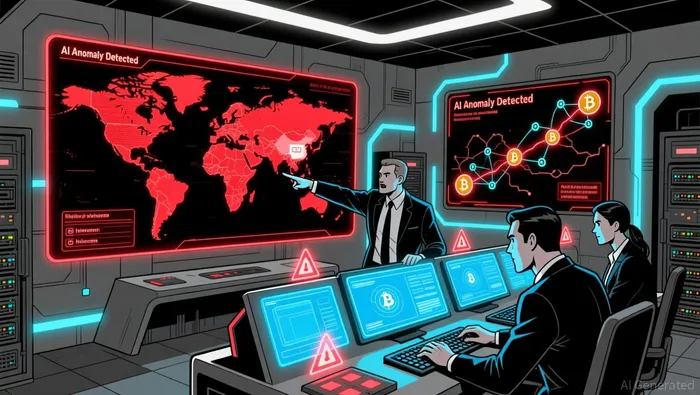
Blockchain analytics platforms like Elliptic and Chainalysis have become pivotal in countering North Korean cyber threats. Elliptic's tools, for instance, have traced over $2 billion in stolen cryptoassets in 2025, while Chainalysis identified a $1.5 billion heist from Bybit and mapped laundering networks involving intermediaries in China and the UAE. These firms employ advanced techniques such as cross-chain transaction analysis and machine learning to detect patterns indicative of sanctions evasion.
The market for such solutions is expanding rapidly. According to a report by Gartner, global enterprise cybersecurity spending is projected to reach $118.5 billion in 2025, with next-generation solutions-such as zero-trust architecture and AI-driven threat intelligence-growing at a 19.72% CAGR through 2030 according to Gartner analysis. Similarly, the RegTech sector is gaining traction as financial institutions and governments prioritize compliance automation to monitor illicit crypto flows.
Case Studies: Mitigating North Korean Cyber Threats
The DOJ's recent actions against APT38 exemplify the critical role of public-private partnerships. For example, Elliptic's collaboration with law enforcement helped identify refund addresses and obscure blockchains used by North Korean hackers to launder funds. Chainalysis's Hexagate tool, which automates high-risk transaction screening, has also been instrumental in blocking illicit deposits linked to DPRK actors.
While the provided research lacks explicit case studies of firms directly mitigating North Korean threats in the past two years, the scale of DOJ seizures and the sophistication of blockchain analytics suggest that these companies are already embedded in the frontlines of sanctions enforcement.
Investment Rationale: Long-Term Tailwinds for Cybersecurity and RegTech
The convergence of geopolitical tensions, regulatory pressures, and technological innovation is creating a fertile ground for cybersecurity and RegTech firms. Key drivers include:
1. Regulatory Enforcement: The DOJ's focus on crypto-related crime is likely to intensify, driving demand for compliance tools.
2. Technological Innovation: AI and machine learning are enabling real-time threat detection, a critical advantage against adaptive adversaries like APT38.
3. Market Expansion: The global cybersecurity market is forecasted to reach $500.7 billion by 2030, with RegTech firms benefiting from cross-sector adoption.
Investors should prioritize companies with proven expertise in blockchain forensics and sanctions compliance, such as Elliptic and Chainalysis, as well as next-gen cybersecurity firms offering zero-trust and AI-based solutions.
Conclusion
North Korea's crypto-centric cyber threats are notNOT-- merely a national security issue but a systemic risk to global financial stability. As the DOJ's actions against APT38 demonstrate, the U.S. is committed to disrupting these operations, creating a sustained demand for advanced cybersecurity and RegTech solutions. For investors, this represents a strategic opportunity to capitalize on a sector poised for exponential growth, driven by both technological innovation and geopolitical necessity.






Comentarios
Aún no hay comentarios