
North Dakota's Roughrider Coin and the Challenge to USDT's Dominance: Regulatory Innovation and Regional Crypto-Driven Monetary Sovereignty
The Rise of State-Backed Stablecoins: A New Era of Financial Innovation
The stablecoin landscape in 2025 is dominated by Tether's USDTUSDT--, which commands a 64% market share with a $157.48 billion market cap, according to the Stablecoin Industry Report: Q2 2025. However, the emergence of state-backed stablecoins like North Dakota's Roughrider Coin is beginning to disrupt this status quo. By leveraging regulatory clarity, technological innovation, and localized economic strategies, these projects are redefining the boundaries of monetary sovereignty in the digital age.
North Dakota's Roughrider Coin, set to launch in 2026, represents a bold experiment in state-level financial autonomy. Backed by the Bank of North Dakota (BND) and developed in partnership with FiservFI-- Inc., the stablecoin is pegged 1:1 to the U.S. dollar and fully collateralized by conventional financial assets, according to a North Dakota Monitor report. This initiative is not merely a technical upgrade but a strategic move to position the state as a leader in digital finance, challenging the dominance of privately issued stablecoins like USDT.
Regulatory Innovation: The Genius Act and State-Level Sovereignty
The Genius Act, enacted in July 2025, has been a game-changer for stablecoin innovation. This federal legislation established a regulatory framework that permits state-backed stablecoins to operate under a hybrid model: 80% of the rules are federally mandated, while states retain authority over the remaining 20%, as outlined in a Paul Hastings guide. For North Dakota, this means the Roughrider Coin can be issued with the confidence of federal oversight while maintaining flexibility to address local needs.
The Genius Act requires stablecoins to be fully backed by safe assets like U.S. dollars or Treasury securities and mandates monthly reserve disclosures, as noted in a Covington analysis. By adhering to these standards, the Roughrider Coin avoids the regulatory ambiguities that have plagued USDT. For instance, TetherUSDT-- has faced scrutiny over its reserve composition and delayed responses to security threats, as detailed in a Blockchain Magazine piece. In contrast, North Dakota's project benefits from pre-approved compliance, reducing legal risks for institutions and consumers alike.
This regulatory clarity is a critical differentiator. As stated by Governor Kelly Armstrong, the Roughrider Coin aims to create a "secure and efficient financial ecosystem for our citizens," as Governor Kelly Armstrong said in a CryptoTimes report, a promise that resonates in an era where trust in private stablecoins is eroding.
Technological Advantages: Speed, Security, and Scalability
While USDT operates on 13 blockchains, including EthereumETH-- and TronTRX--, its reliance on cross-chain bridges and high gas fees creates friction for users - a point highlighted by the Stablecoin Industry Report: Q2 2025. The Roughrider Coin, by contrast, is built on a dedicated blockchain optimized for speed and security, enabling instant settlements and blockchain-based audit trails, according to a CapWolf article. This design prioritizes efficiency for interbank transactions-such as loan advances and construction payments-while laying the groundwork for broader adoption in retail commerce.
Fiserv's involvement further strengthens the project's technological foundation. As a Fortune 500 fintech partner, Fiserv brings expertise in digital asset platforms, including its own stablecoin (FIUSD), ensuring robust infrastructure, as noted in a Fiserv press release. The Roughrider Coin's interoperability with other digital assets also positions it to integrate seamlessly into global financial systems, a feature USDT lacks in its current iteration, according to a TecroNet report.
Challenging USDT's Dominance: A Regional Play for Global Impact
USDT's dominance is not unassailable. Despite its 64% market share, Tether faces declining trust in DeFi ecosystems; according to the Stablecoin Industry Report: Q2 2025, USDCUSDC-- holds $7.3 billion in TVL compared to USDT's $4.9 billion. The Roughrider Coin's state-backed credibility and regulatory compliance could attract institutions wary of private stablecoins' opaque governance.
Moreover, the Roughrider Coin's focus on local economic empowerment sets it apart. By streamlining interbank transactions and reducing costs, it directly addresses inefficiencies in traditional finance. For example, the Bank of North Dakota plans to use the stablecoin for infrastructure financing and rapid money transfers, creating a blueprint for other states to follow, per a CryptoBriefing report. This regional approach mirrors Wyoming's early experiments with stablecoins, demonstrating how state-level innovation can scale into national trends, as illustrated by a OneSafe blog.
The Future of Monetary Sovereignty: From States to a Decentralized Paradigm
The Roughrider Coin is more than a stablecoin-it is a statement of regional crypto-driven monetary sovereignty. By asserting control over digital currency issuance, states like North Dakota are challenging the centralized power of private entities like Tether. This shift aligns with broader trends, including the rise of Central Bank Digital Currencies (CBDCs) and the decentralization of financial systems, as discussed in an Uncanny Faith analysis.
However, success hinges on adoption. While the Roughrider Coin will initially target institutional use cases, its long-term viability depends on consumer and merchant acceptance. Lower transaction fees and the potential for everyday commerce could drive this adoption, but competition from established players like USDT remains fierce, according to CoinLaw statistics.
Conclusion: A New Frontier in Digital Finance
North Dakota's Roughrider Coin exemplifies how regulatory innovation and technological agility can challenge the dominance of private stablecoins. By anchoring its stablecoin in federal compliance, leveraging Fiserv's infrastructure, and prioritizing local economic needs, the state is setting a precedent for a decentralized financial future.
For investors, this project signals a shift toward state-driven digital finance, where monetary sovereignty is no longer confined to central banks or private corporations. As USDT faces regulatory headwinds and scalability challenges, the Roughrider Coin-and similar initiatives-could emerge as viable alternatives, reshaping the stablecoin landscape in the years to come. 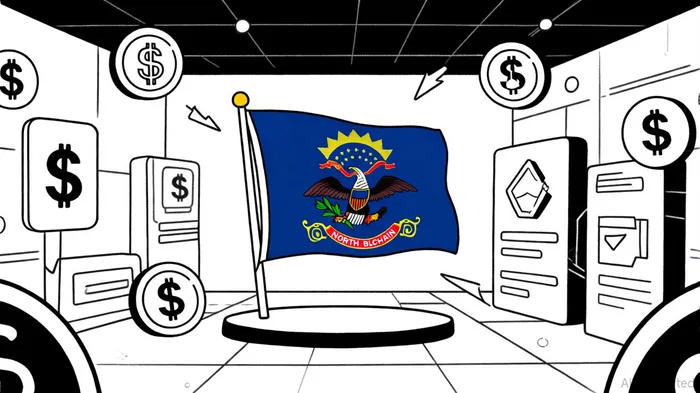





Comentarios
Aún no hay comentarios