
North American Manufacturing Reboot: Mexico's Tariff Hike and the New Supply Chain Gold Rush
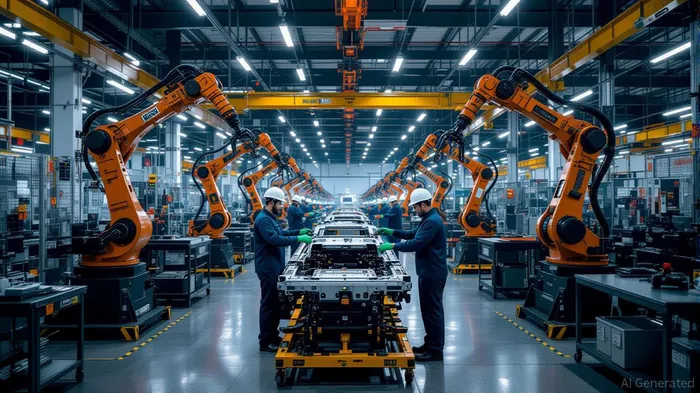
The North American supply chain is undergoing a seismic shift, and Mexico is at the center of it. With the Mexican government poised to implement a sweeping tariff hike on Chinese imports as part of its 2026 budget proposal, the ripple effects are reshaping global manufacturing strategies. This isn't just about tariffs—it's a strategic reallocation of assets, a recalibration of trade corridors, and a race to secure a competitive edge in a world where “nearshoring” isn't just a buzzword but a business imperative.
The Catalyst: Mexico's Tariff Hike and the “Fortress North America” Play
Mexico's decision to raise tariffs on Chinese imports—targeting cars, textiles, and plastics—aligns with U.S. President Donald Trump's aggressive trade agenda. By shielding domestic industries from subsidized Chinese goods, Mexico aims to bolster its manufacturing base while aligning with the U.S. and Canada under the “Fortress North America” framework. This move is a direct response to the surge in Chinese imports, which now dominate 30% of Mexico's car market, outpacing even Russia.
The stakes are high. Chinese automakers like BYD and SAIC have flooded the Mexican market with affordable, warranty-laden vehicles, but their inability to localize production (BYD's factory plans are indefinitely delayed) leaves a gap for U.S. and Mexican firms to fill. Meanwhile, the U.S. has already imposed 100% tariffs on Chinese EVs, creating a regulatory “moat” that Mexico's 20% tariffs pale in comparison to. Yet, the proposed hikes could close this gap, incentivizing companies to shift production to Mexico to avoid U.S. tariffs altogether.
The Winners: Sectors and Companies Poised for Growth
The automotive sector is leading the charge. BMW's recent announcement to produce 140,000 battery packs annually in San Luis Potosí by 2027 is a case in point. This move leverages Mexico's USMCA-compliant access to the U.S. market and its proximity to key suppliers. Similarly, StellantisSTLA-- and other automakers are expanding nearshoring operations, betting on Mexico's low labor costs and skilled workforce.
Electronics manufacturing is another hotbed. Tijuana and Guadalajara have become critical nodes for assembly, with companies like IntelINTC-- and Foxconn expanding operations to avoid U.S. tariffs on Asian imports. Mexico's engineering talent pool—120,000 graduates annually—provides a scalable workforce for high-tech production.
The medical device sector is also booming. MedtronicMDT--, Johnson & Johnson, and AbbottABT-- have established binational operations in Baja California, capitalizing on Mexico's compliance with U.S. regulatory standards and its 25% annual growth in medical device exports. Mexico now contributes 2.8% of the domestic value added to U.S. medical device exports, outpacing China and Vietnam.
The Risks: Tariff Volatility and Domestic Challenges
While the nearshoring trend is robust, risks persist. U.S. tariffs on steel, aluminum, and copper (up to 50%) could disrupt supply chains for Mexican manufacturers. Additionally, Mexico's domestic policy shifts—such as constitutional reforms under President Claudia Sheinbaum—have raised investor concerns about regulatory stability.
Moreover, China's retaliatory tariffs and geopolitical tensions could create headwinds. China's 34% tariff on U.S. goods, suspended until November 2025, and its 200% threatened tariffs on U.S. exports (agriculture, energy) add layers of uncertainty. However, Mexico's strategic position as a U.S. duty-free hub under USMCA provides a buffer.
Investment Playbook: Where to Allocate Capital
For investors, the key is to target companies and sectors that benefit from Mexico's industrial renaissance:
1. Automotive and EV Supply Chains: Look for firms expanding battery production or EV component manufacturing in Mexico. BMW's San Luis Potosí plant and Stellantis' nearshoring bets are prime examples.
2. Electronics and Semiconductor Partnerships: Companies like Intel and Foxconn, which are scaling up in Mexico, could see demand surges as U.S. tariffs on Asian imports rise.
3. Medical Device Manufacturers: Firms with binational operations in Mexico, such as Medtronic, are well-positioned to capitalize on U.S. demand.
4. Industrial Machinery and Advanced Manufacturing: Mexico's “Taruk” electric bus project (70% locally made) highlights its growing capabilities in high-tech manufacturing.
The Bottom Line: A New Era for North American Trade
Mexico's tariff hike isn't just a protectionist measure—it's a catalyst for a new era of North American integration. By aligning with U.S. trade policies and leveraging its strategic location, Mexico is becoming the linchpin of a restructured supply chain. For investors, this means opportunities in sectors that thrive on nearshoring, automation, and regional collaboration.
The question isn't whether to invest—it's where to position your capital to ride the wave. As the “Fortress North America” framework solidifies, the companies that adapt fastest will reap the rewards.





Comentarios
Aún no hay comentarios