
Nokia's Strategic Relevance in 2025: Can the Telecom Giant Reclaim Value Amid Stagnation?
In the shadow of AI-driven infrastructure and hyperconnected data centers, Nokia's 2025 trajectory hinges on a precarious balance: mitigating legacy challenges while capitalizing on a $1.2 trillion global optical networking market. The Finnish telecom titan, once synonymous with mobile phone dominance, now faces a pivotal question: Can it transform its historical missteps into a foundation for innovation in an era where optical networks and AI infrastructure define the next frontier of digital transformation?
Financial Headwinds and Currency Exposure: A Double-Edged Sword
Nokia's 2024 annual report paints a mixed picture. While the company delivered a 9% year-on-year revenue boost in Q4 (driven by Network Infrastructure and NokiaTSLA-- Technologies), its full-year net sales declined 9% in constant currency—a shortfall largely attributed to India's regulatory turbulence and a weak U.S. dollar. Currency exposure, a recurring structural challenge, cost the company an estimated €230 million in operating profit in 2025 guidance adjustments. This vulnerability contrasts starkly with the resilience of peers like EricssonERIC--, whose localized U.S. manufacturing and IP licensing models insulate it from exchange rate volatility.
Yet, Nokia's profitability metrics offer hope. A 380-basis-point operating margin expansion to 19.1% in Q4 2024—powered by cost discipline and high-margin optical networking solutions—suggests the company can navigate macroeconomic headwinds. With a net cash balance of €4.9 billion, Nokia has returned €1.4 billion to shareholders and signaled a dividend hike, signaling confidence in its capital structure.
Optical Networks and AI Infrastructure: A Strategic Pivot
Nokia's 2025 strategy is anchored in two pillars: optical networking innovation and AI-driven infrastructure. The acquisition of Infinera for €2.3 billion in 2024 marked a turning point, catapulting the company into the vanguard of high-capacity data center interconnectivity. Its WDM Optical Line System, 800Gb/s pluggables, and quantum-safe networking solutions are now staples in AI data centers, with partnerships like CoreWeaveCRWV-- and KyndrylKD-- underscoring its relevance.
The company's focus on energy efficiency is equally critical. A 70% reduction in power consumption for intra-data center connectivity solutions aligns with hyperscalers' sustainability goals, positioning Nokia to capture a growing share of the $50 billion green data center market. 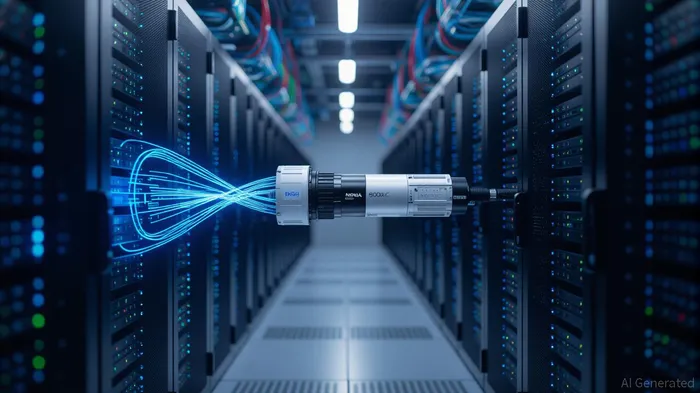
Historical Missteps: The Symbian Legacy and Platform Paralysis
Nokia's legacy is marred by strategic inflexibility. The Symbian OS fiasco—57 incompatible versions in 2009—exposed a rigid organizational structure that stifled innovation. This platform-centric delay allowed AppleAAPL-- and Google to redefine the smartphone era. While today's optical networking and AI strategies are more agile, the company still faces a structural dilemma: balancing its hardware-centric heritage with the software-defined, AI-native architectures demanded by cloud and AI workloads.
In contrast, Ericsson's cloud-native 5G solutions and Huawei's aggressive R&D (despite geopolitical risks) highlight the gapGAP-- between Nokia's hybrid model and competitors' platform-first approaches. Yet, Nokia's diversified revenue base—spanning Network Infrastructure (45% of 2024 sales), Cloud and Network Services (30%), and Optical Networks (25%)—offers a buffer against sector-specific downturns.
Untapped Opportunities: The AI-Driven Network Revolution
The coming years will test Nokia's ability to leverage AI not just as a product category but as a strategic enabler. Its Event-Driven Automation (EDA) platform, which reduces human error in data centers, and AI-powered network orchestration tools for 5G Standalone (SA) deployments, demonstrate a nascent but promising pivot. Partnerships with defense contractors (e.g., Lockheed Martin's 5G.MIL project) and web-scale clients (e.g., Nscale in the UK) further diversify its value proposition.
However, Nokia's P/E ratio of 14x (compared to Ericsson's 146x) reflects skepticism about its AI monetization potential.
Investment Thesis: Timing the Turnaround
For strategic investors, Nokia's 2025 positioning presents a paradox: a financially robust company with a €1.79 billion cash reserve and improving margins, yet trailing peers in AI-driven revenue capture. The key question is whether its recent optical networking bets can translate into sustained growth.
Risks:
- Currency and tariff headwinds could erode margins.
- Competitors like Ericsson and Huawei are faster in cloud-native innovation.
- The Infinera acquisition's integration risks remain untested.
Catalysts:
- AI data center demand surging 30% annually.
- A €2.5 billion UK AI infrastructure investment pipeline.
- 5G SA adoption accelerating, with Nokia's Open RAN expertise.
Verdict: Now is the time to consider a cautious long position in NOKIA. Its structural challenges are well-documented, but its optical networking capabilities and AI partnerships offer a path to differentiation. Investors should monitor its 2025 guidance for Q2 and Q3 as barometers of execution strength. For those with a 3–5 year horizon, Nokia's hybrid model—balancing prudence with innovation—could yield outsized returns in a sector primed for disruption.





Comentarios
Aún no hay comentarios