
Nokia's Strategic Optical Expansion: Capitalizing on 5G and Cloud Infrastructure Surge
The global demand for bandwidth is surging, driven by the proliferation of 5G networks, AI workloads, and hyperscale cloud infrastructure. At the forefront of this transformation is NokiaNOK--, which is leveraging its optical networking expertise to secure a dominant position in a market poised for exponential growth. Recent developments-from cutting-edge product launches to strategic acquisitions-underscore the company's ability to capitalize on these trends, offering compelling opportunities for investors.
Optical Networking as a Growth Engine
Nokia's Network Infrastructure segment has seen robust momentum in 2025, with optical networks emerging as a key driver. According to a Converge Digest report, the segment's Q2 2025 results highlighted a book-to-bill ratio above 1.0 in optical networks, fueled by hyperscaler demand for 800G pluggables and transport upgrades. This outperformance reflects the critical role of high-capacity optical solutions in supporting cloud providers' need for scalable, low-latency connectivity.
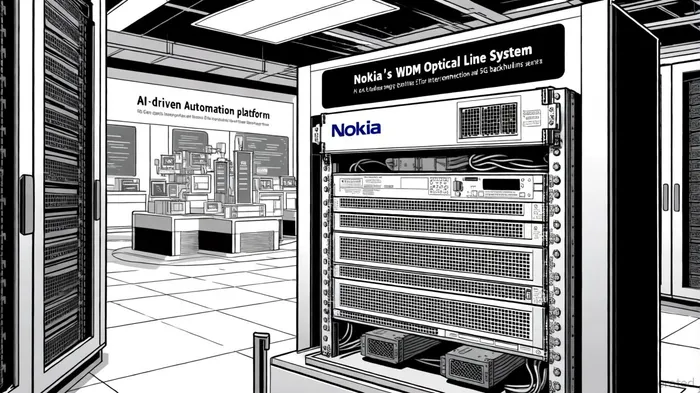
The company's recent innovations further solidify its competitive edge. At OFC50, Nokia unveiled a Wavelength Division Multiplexing (WDM) Optical Line System optimized for data center interconnection (DCI), alongside pluggable coherent optics for 400Gb/s and 800Gb/s applications, as described in a Nokia press release. These technologies address the dual challenges of bandwidth scalability and energy efficiency, which are paramount as AI-driven workloads strain existing infrastructure. For instance, Nokia's intra-data center solutions, including 1.6Tb/s connectivity, demonstrate a commitment to reducing power consumption while maintaining high-speed data transmission-a critical differentiator in an era where sustainability is a key metric for investors, according to a GlobeNewswire release.
Strategic Acquisitions and Market Positioning
Nokia's acquisition of Infinera in late 2024 has amplified its capabilities in optical transport. Industry analysts note, in a Fierce Network article, that the combined entity now ranks second in the optical transport market, with the integration of Infinera's assets accelerating Nokia's post-acquisition optical push. This move not only expands Nokia's product portfolio but also strengthens its ability to meet the surging demand for high-performance data center interconnectivity.
The strategic alignment with hyperscalers is another key factor. Hyperscalers, which require massive infrastructure to support AI and cloud services, are increasingly turning to 800G pluggables and transport upgrades. Nokia's Q2 2025 results indicate that these orders are a primary contributor to its optical networks growth, signaling strong tailwinds for the company's long-term revenue streams.
CEO Vision and Broader Strategic Priorities
Nokia's leadership, under CEO Justin Hotard, is positioning the company as a full-stack AI infrastructure provider. Hotard has emphasized that connectivity is the "critical enabler" of AI development, leveraging Nokia's Event-Driven Automation (EDA) platform and optical transport technologies to streamline network operations, as noted in a TeckNexus piece. This vision extends beyond optical networking, with Nokia securing private 5G deployments and enhancing edge computing capabilities. Such diversification reduces reliance on any single market segment while broadening the company's addressable opportunities.
Investment Implications
For investors, Nokia's strategic focus on optical networking aligns with structural trends in 5G and cloud infrastructure. The company's ability to innovate at scale-evidenced by its 800G pluggables, WDM systems, and energy-efficient solutions-positions it to capture a significant share of the AI-driven connectivity market. Additionally, the integration of Infinera's assets and the growing demand from hyperscalers suggest a durable revenue growth trajectory.
However, risks remain, including supply chain constraints and competition from rivals like Ciena and Lumentum. Yet, Nokia's first-mover advantage in 800G technology and its expanding ecosystem of partnerships with cloud providers mitigate these concerns. As AI workloads and 5G adoption accelerate, Nokia's optical infrastructure is likely to become an indispensable component of the global digital economy.







Comentarios
Aún no hay comentarios