
Nokia’s Strategic Expansion into 5G-Driven Defense Communications: A Pathway to Long-Term Growth
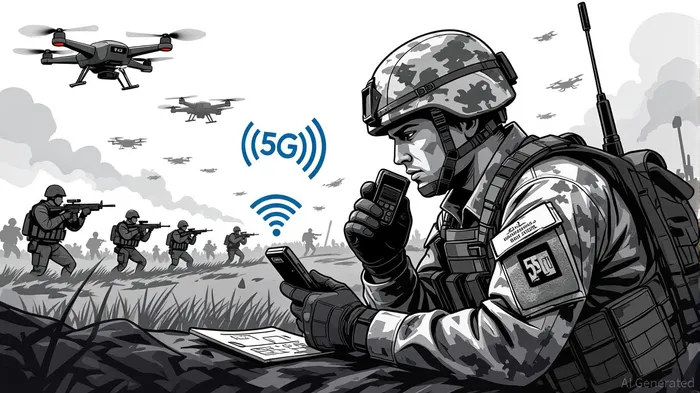
The global defense sector is undergoing a technological revolution, driven by the need for secure, high-speed, and low-latency communication systems. At the forefront of this transformation is Nokia Corporation, which has aggressively expanded its footprint in 5G-driven defense communications. With the 5G in defense market projected to grow at a blistering pace—reaching $4.24 billion by 2030 at a 21.77% CAGR [1]—Nokia’s strategic investments in military-grade 5G solutions position it as a key player in a sector poised for explosive growth.
Strategic Product Innovation and Partnerships
Nokia’s defense portfolio has evolved rapidly in recent years, with a focus on tactical 5G solutions tailored for military operations. The company’s Mission-Safe Phone, a ruggedized 5G-enabled smartphone built with 90% non-Chinese components, addresses critical security concerns in defense applications [1]. Complementing this is the Banshee 5G Tactical Radio, a portable network-in-a-backpack system that enables soldiers to deploy secure, high-capacity 5G networks in remote or hostile environments [2]. These innovations align with NATO’s recognition of 5G as a strategic enabler for multi-domain operations, as outlined in STANAG 5665 [1].
Collaborations have further solidified Nokia’s position. A notable partnership with Lockheed Martin and Verizon has produced a hybrid 5G.MIL base station, integrating Nokia’s military-grade 5G solutions into a secure, interoperable network for national defense [5]. Additionally, Nokia’s work with blackned GmbH to develop deployable tactical networks for Germany’s defense sector highlights its ability to adapt 5G technology to specific national security needs [4]. These partnerships not only diversify Nokia’s revenue streams but also validate its technical expertise in a highly specialized market.
Market Dynamics and Growth Projections
The 5G defense market is being fueled by several megatrends, including the rise of autonomous systems, real-time battlefield surveillance, and network-centric warfare. According to a report by Mordor Intelligence, the market is expected to grow from $1.58 billion in 2025 to $4.24 billion by 2030 [1], while another analysis by Roots Analysis forecasts an even steeper trajectory, reaching $12.83 billion by 2035 at a 20.07% CAGR [1]. Nokia’s focus on secure, high-bandwidth communication systems—critical for applications like drone control and AI-driven decision-making—positions it to capture a significant share of this growth [1].
Competitive Landscape and Challenges
Nokia faces stiff competition from global tech giants like Huawei, Samsung, and Ericsson, as well as defense-focused firms such as L3Harris Technologies and Raytheon [1]. However, its emphasis on secure, interoperable solutions and partnerships with established defense contractors (e.g., Lockheed Martin) provides a unique edge. For instance, Nokia’s collaboration with Motorola Solutions to create a battlefield communications hub for UK defense agencies underscores its ability to integrate into existing defense ecosystems [2].
A potential risk lies in geopolitical tensions, particularly with China’s dominance in 5G infrastructure. Nokia’s Mission-Safe Phone, which minimizes reliance on Chinese components, directly addresses this concern, aligning with NATO countries’ push for supply chain resilience [1]. However, the company must continue to innovate rapidly to stay ahead of competitors and navigate regulatory hurdles in export-controlled markets.
Investment Outlook
Nokia’s strategic alignment with the surging demand for 5G in defense, coupled with its robust product pipeline and partnerships, suggests strong long-term growth potential. The company’s recent shift toward AI-driven infrastructure—evidenced by its Network Infrastructure unit surpassing Mobile Networks in Q2 2025 revenue—further strengthens its position in the AI supercycle [2].
For investors, NokiaTSLA-- represents a compelling opportunity in a sector where security, speed, and scalability are non-negotiable. While the defense tech market is capital-intensive and competitive, Nokia’s track record in commercial 5G deployment (e.g., its multi-year RAN contract with MEO in Portugal [3]) demonstrates its ability to scale solutions across both commercial and defense domains.
Conclusion
Nokia’s expansion into 5G-driven defense communications is not just a strategic pivot—it’s a calculated bet on the future of warfare. As militaries worldwide modernize their communication systems to leverage 5G’s capabilities, Nokia’s blend of innovation, security, and collaboration positions it as a leader in a market set to balloon into the billions. For investors, the key question is not whether 5G will transform defense, but how quickly Nokia can capitalize on this inevitability.
Source:
[1] 5G In Defense Market Size & Share Analysis, [https://www.mordorintelligence.com/industry-reports/5g-in-defense-market]
[2] Nokia adds to defence portfolio as military comms rises up, [https://the-mobile-network.com/2025/09/nokia-adds-to-defence-portfolio-as-military-comms-rises-up-agenda/]
[3] Nokia and MEO sign multi-year 5G RAN contract, [https://www.nokia.com/newsroom/nokia-and-meo-sign-multi-year-5g-ran-contract/]
[4] Nokia and blackned to create next-generation deployable tactical networks for the defense sector, [https://www.nokia.com/newsroom/nokia-and-blackned-to-create-next-generation-deployable-tactical-networks-for-the-defense-sector/]
[5] Lockheed MartinLMT--, Nokia, and VerizonVZ-- Advance Defense Capabilities Through 5G.MIL Collaboration, [https://investors.lockheedmartin.com/news-releases/news-release-details/lockheed-martin-nokia-and-verizon-advance-defense-capabilities/]







Comentarios
Aún no hay comentarios