
Nokia's Share Issuance and Shareholder Value: Balancing Growth and Dilution Risk in 2025
Nokia's 2025 capital allocation strategy has become a focal point for investors, as the company navigates a delicate balance between strategic growth initiatives and shareholder value preservation. Recent developments-including a directed share issuance of 120 million shares and an aggressive buyback program-highlight the tension between funding long-term innovation and mitigating dilution risks.
Strategic Share Issuance: Fueling Incentive Programs and Operational Needs
On 2 October 2025, Nokia's Board of Directors authorized the issuance of 120 million new shares to fulfill obligations under its equity plans vesting in 2025–2027, including employee share purchase programs and long-term incentives (see the GlobeNewswire Board resolution). This move, while dilutive, aligns with the company's broader strategy to retain talent and align executive compensation with long-term performance. The shares were registered in Finland and began trading on Nasdaq Helsinki and Euronext Paris, signaling a structured approach to capital deployment.
The issuance follows a pattern of selective equity use. For instance, Nokia's 2025 Annual General Meeting sought authorization to issue up to 530 million shares, underscoring its intent to maintain financial flexibility for potential acquisitions or strategic investments, as outlined in the AGM proposals. CEO Justin Hotard has emphasized that such measures are critical to positioning NokiaNOK-- for the "AI supercycle" and expanding into high-growth areas like defense and cloud-native software, a point he made in a Justin Hotard interview.
Buybacks as a Counterbalance: Mitigating Dilution and Signaling Confidence
Simultaneously, Nokia has deployed a robust share repurchase program to offset dilution. Between November 2024 and April 2025, the company repurchased and canceled 150 million shares at an average price of €4.69, reducing unrestricted equity by €703 million (see the Q2 and half-year report). Additional repurchases in March 2025 further trimmed the share count by 4.2 million shares, according to a Yahoo Finance article. These actions, funded by Nokia's EUR 2.9 billion net cash balance and EUR 800 million first-half 2025 free cash flow (see the Q2 and half-year report), reflect a disciplined approach to capital allocation.
The buyback program's scale-authorized under a 900 million euro budget-demonstrates management's commitment to optimizing shareholder value. By retiring shares linked to prior acquisitions (e.g., Infinera Corporation) and stock-based incentives, Nokia aims to neutralize the dilutive impact of its equity programs (see the AGM proposals).
Quantifying the Net Impact: Share Count and EPS Dynamics
As of September 2025, Nokia's share count stood at 5.378 billion (companiesmarketcap). Post-buyback, this fell to 5.228 billion, but the October 2025 issuance pushed it back to 5.575 billion (see the GlobeNewswire Board resolution). While the net effect of buybacks versus new shares appears modest (a 120 million increase from the issuance offsetting prior repurchases), the EPS implications are nuanced.
Nokia's Q2 2025 EPS of $0.02 marked a 171.88% decline year-over-year (see the GlobeNewswire Board resolution), while Zacks Research cut its Q3 2025 EPS estimate to $0.07 from $0.09 (see the Q2 and half-year report). However, the company's full-year 2025 EPS is still projected at $0.34 (see the Q2 and half-year report), suggesting confidence in operational recovery. The challenge lies in whether the new shares, intended to fund growth, will generate returns sufficient to offset the dilution.
Strategic Rationale and Risk Assessment
Nokia's capital structure strategy hinges on its ability to deploy capital effectively. With a debt-to-equity ratio of 0.21 and a conservative leverage profile (see the Yahoo Finance article), the company has ample room to fund innovation without overextending. Its pivot toward cloud-native software and XaaS offerings, supported by Bell Labs research and operational streamlining, positions it to capitalize on AI-driven demand and enterprise 5G growth (see the Justin Hotard interview).
However, risks persist. The downward revision of operating profit guidance-attributed to currency fluctuations and tariffs-highlights external vulnerabilities (see the Q2 and half-year report). If the AI and defense markets underperform expectations, the dilutive costs of the 2025 issuance could outweigh its benefits.
Conclusion: A Calculated Gamble on Long-Term Value
Nokia's 2025 capital allocation strategy reflects a calculated bet on future growth. By pairing strategic share issuance with aggressive buybacks, the company seeks to balance immediate shareholder value preservation with long-term innovation. The success of this approach will depend on the execution of its AI and XaaS initiatives, as well as its ability to navigate macroeconomic headwinds. Investors must weigh the dilution risks against the potential rewards of a company poised to ride the next wave of technological disruption.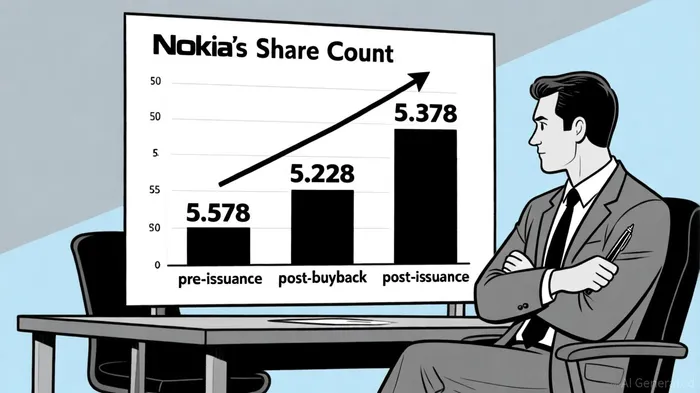







Comentarios
Aún no hay comentarios