
Nokia's Growing Role in Asia's Smart Rail Infrastructure: Strategic Partnerships as Catalysts for 5G and IoT Revenue Growth
The global shift toward smart rail infrastructure is accelerating, driven by the need for automation, sustainability, and operational efficiency. At the forefront of this transformation is NokiaNOK--, which has positioned itself as a leader in 5G and IoT solutions for railways. In Asia-a region with some of the world's most ambitious rail modernization programs-Nokia's strategic partnerships are proving to be a powerful catalyst for revenue growth. By leveraging its expertise in 5G, IoT, and the Future Railway Mobile Communication System (FRMCS), Nokia is not only addressing the technical demands of rail operators but also unlocking new revenue streams in a market projected to grow significantly over the next decade.
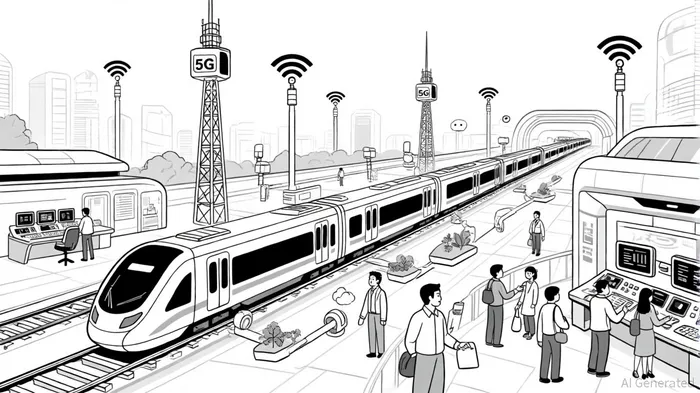
Asia's Rail Revolution: A Strategic Battleground
Asia's rail networks are undergoing a digital overhaul to meet surging demand, aging infrastructure, and sustainability goals. Countries like China, India, and Japan are investing heavily in smart rail technologies, creating a fertile ground for companies like Nokia. According to a report by Sustainability Magazine, Nokia's 5G radio solution for the 1900 MHz (n101) band is specifically designed to support FRMCS, the next-generation global standard for railway communications[2]. This technology enables mission-critical operations such as automated train control, real-time passenger information systems, and predictive maintenance, all of which are critical for Asia's rail operators.
Nokia's recent participation in the Asia Pacific Rail 2025 event in Bangkok underscored its commitment to the region[5]. The company showcased its cloud-native 5G standalone (SA) core, which allows for seamless coexistence with legacy GSM-R systems, ensuring a smooth transition to 5G without operational disruptions[3]. This capability is particularly valuable in Asia, where rail networks vary widely in technological maturity.
Strategic Partnerships: The Revenue Growth Engine
Nokia's revenue growth in Asia is being driven by targeted partnerships that align with the region's rail modernization goals.
1. India: 5G Infrastructure and Reliance Jio Collaboration
In India, Nokia has secured a major contract to supply 5G radio access network (RAN) equipment to Reliance Jio Infocomm Limited, a key player in India's telecom sector[5]. This collaboration is part of a broader strategy to build a 5G standalone network that integrates with 4G infrastructure. While the partnership is not rail-specific, it strengthens Nokia's 5G ecosystem in India, which is critical for future smart rail projects. India's National Rail Museum and other operators are already exploring 5G-based solutions for automated train operations and real-time monitoring, creating a pipeline of opportunities for Nokia[2].
2. Japan: AI-Driven Safety and IoT Integration
Japan's rail operators are leveraging Nokia's IoT and AI capabilities to enhance safety and efficiency. A notable example is Nokia's collaboration with Odakyu Electric Railway on AI-based railroad crossing safety trials[3]. Using machine learning, the project analyzes real-time video feeds to detect potential hazards, such as pedestrians or vehicles near tracks. This initiative aligns with Japan's push for "smart infrastructure," where IoT and 5G are used to create safer, more responsive rail networks. Nokia's role in this project highlights its ability to adapt its technology to regional needs, a key differentiator in Asia's fragmented market[4].
3. China: Programmable Optical Networks and 5G Standardization
While China's rail sector is dominated by state-owned enterprises, Nokia has made inroads through partnerships like its collaboration with the State Grid Corporation of China to deploy programmable optical networks[5]. Though this project focuses on the power grid, the integration of IoT for real-time monitoring and automation demonstrates Nokia's technical versatility. More importantly, Nokia's involvement in global FRMCS standardization efforts-such as its participation in the EU-funded FP2-MORANE-2 project-positions it to influence China's eventual adoption of 5G-based rail systems[4].
The Financial Implications: A $1.2 Billion Opportunity
The global market for FRMCS-ready private 5G networks is projected to reach $1.2 billion by 2027, according to World Today Journal[4]. Nokia's early mover advantage in Asia-coupled with its partnerships in India, Japan, and China-places it in a strong position to capture a significant share of this market. The company's cloud-native 5G SA core, modular deployment options, and proven track record in GSM-R transitions (e.g., with ProRail in the Netherlands[3]) further reduce the risk for rail operators, making Nokia an attractive partner.
Conclusion: A Win-Win for Nokia and Asia's Rail Sector
Nokia's strategic partnerships in Asia are more than just technical collaborations-they are revenue accelerators. By tailoring its 5G and IoT solutions to the unique needs of China, India, and Japan, Nokia is not only driving digital transformation in rail but also securing long-term contracts in a high-growth sector. As Asia's rail operators race to adopt FRMCS and automate their networks, Nokia's ecosystem of partnerships, proven technology, and regional engagement will likely translate into robust revenue growth. For investors, this represents a compelling opportunity to bet on a company that's building the rails of the future.





Comentarios
Aún no hay comentarios