
Nokia and blackned Lead the Digital Battlefield Revolution – Why Investors Should Deploy Now
The modern battlefield is no longer defined by physical terrain alone. In the post-digital battlefield era, where connectivity is as vital as ammunition, a new paradigm is emerging: software-defined defense. This shift has positioned NokiaNOK-- (NOK) at the forefront of a $22.75 billion tactical communications market, thanks to its partnership with blackned GmbH—a subsidiary of Rheinmetall—to develop next-generation deployable networks. This alliance isn't just about technology; it's about reshaping how militaries fight, communicate, and dominate in an era of hyperconnected warfare. Here's why investors must act now.
The Tactical Network Revolution: Where 5G Meets Battlesuite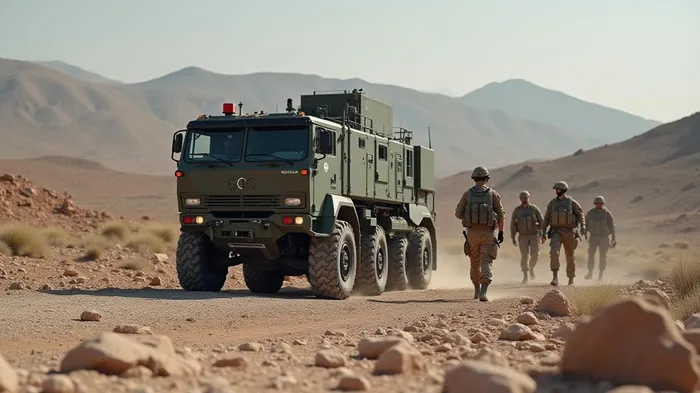
Nokia's collaboration with blackned combines its industry-leading 5G infrastructure with blackned's defense-grade software (RIDUX middleware and XONITOR management systems). The result? A scalable, interoperable platform designed to power Rheinmetall's Battlesuite, a NATO-aligned digital ecosystem that unifies land, air, and naval forces. This integration addresses a critical gap: interoperability. Modern militaries demand systems that can “plug and play” across allied forces—a requirement NATO member states are aggressively funding.
The technical brilliance lies in the deployable networks themselves. These systems are mobile, self-powered, and capable of delivering high-speed, low-latency communication in any environment—from the Arctic to urban warfare zones. By leveraging Nokia's 5G and blackned's software, the partnership ensures:
- Real-time situational awareness via AI-driven data analytics.
- Cyber-resilience through advanced encryption and anti-jamming protocols.
- Adaptability for both German defense needs and export to NATO allies.
This is not incremental innovation—it's a generational leap in military comms, and the market is ready to pay for it.
Why Germany's Defense Spending Surge Matters
Germany's defense budget has skyrocketed, reaching $88.5 billion in 2024—a 28% annual jump—and it's poised to grow further. The Bundestag's historic 2024 vote to exempt defense spending from debt limits has unlocked a €500 billion infrastructure fund, with a clear focus on modernizing systems like tactical networks. This isn't just about Germany; it's a regional trend. NATO's European members are collectively investing over $693 billion annually on defense, with interoperability mandates pushing militaries to adopt standardized solutions like Battlesuite.
Nokia's partnership directly aligns with these priorities. The company's 5G technology has already been tested in NATO exercises (e.g., Norway's Joint Viking 2025), proving its ability to enhance situational awareness and cross-unit coordination. With Rheinmetall's global reach and blackned's software expertise, this platform is primed for export dominance in a market projected to hit $30.73 billion by 2029.
The Market Opportunity: A Gold Mine for Early Adopters
The tactical communications sector is booming, driven by:
1. NATO's Interoperability Mandate: All 32 members are upgrading systems to work seamlessly—a requirement Nokia's software-defined networks fulfill.
2. AI and 5G Integration: militaries are moving beyond basic comms to data-driven decision-making, which Nokia's 5G backbone enables.
3. Geopolitical Tensions: Russia's aggression and China's naval expansion are accelerating defense budgets worldwide.
Nokia's edge? It's already embedded in the supply chain. Its partnership with blackned and Rheinmetall gives it a first-mover advantage in a market where contracts are multi-decade and high-margin. Consider this:
- Germany's Bundeswehr is targeting 380 Panther KF51 tanks—each requiring advanced comms systems.
- NATO's 2023 spending saw 18 member states meet the 2% GDP target, with Poland and Sweden now exceeding 3%.
Risks? Yes. But the Upside Outweighs Them
Critics cite semiconductor shortages and bureaucratic delays in defense procurement. True—but Nokia's scale and partnerships (e.g., its “co-existence network element” for PON services) mitigate supply chain risks. Meanwhile, the German government's €62.6 billion order backlog for Rheinmetall signals urgency, not hesitation.
Conclusion: Deploy Now—Before the Battlefield Does
Nokia's pivot to defense tech isn't a side hustle—it's a $22.75 billion growth engine. With Germany's modernization pipeline, NATO's interoperability demands, and the scalability of its Battlesuite platform, this partnership is a once-in-a-decade opportunity.
Investors should treat this as a strategic buy, with a price target reflecting Nokia's expanding role in a sector primed for exponential growth. The battlefield is digital—and Nokia is its kingmaker.
Act now. The next phase of warfare starts today.





Comentarios
Aún no hay comentarios