
Nokia's 5G Industrial Transformation Opportunity in Rail Infrastructure: Strategic Value and Long-Term Growth Implications
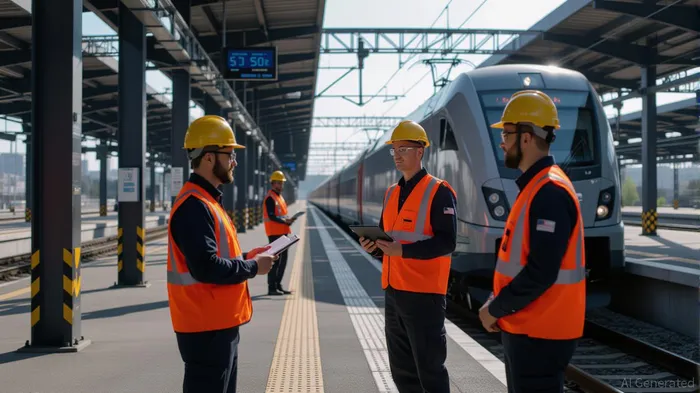
The industrial Internet of Things (IoT) is reshaping global infrastructure, and nowhere is this transformation more critical than in rail systems. As governments and private operators seek to modernize aging networks, 5G technology has emerged as a linchpin for enabling automation, safety, and sustainability. NokiaNOK--, a long-standing player in telecommunications, is positioning itself at the forefront of this shift with its 5G-based solutions for rail infrastructure. The company's strategic bets in this sector could not only redefine its role in industrial IoT but also signal broader implications for the telecommunications infrastructure stock market.
Strategic Positioning: Nokia's 5G Rail Solutions as a Catalyst for Industrial IoT
Nokia's recent launch of a commercial 5G platform for digital railway operations underscores its ambition to lead the transition to the Future Railway Mobile Communication System (FRMCS) [1]. This system replaces the legacy GSM-R standard, which has underpinned rail communications for decades but lacks the capacity and flexibility required for next-generation applications. Nokia's solution includes the industry's first commercial 5G radio operating in the 1900 MHz (n101) band, paired with a cloud-native 5G standalone core optimized for rail environments [3].
The platform's capabilities extend beyond basic connectivity. By enabling automated train operations, real-time passenger information systems, and mission-critical voice and data services, Nokia's 5G infrastructure supports a vision of railways that are safer, more efficient, and environmentally sustainable [4]. For instance, predictive maintenance powered by IoT sensors and 5G connectivity can reduce downtime and operational costs, while smart energy management systems align with global decarbonization goals [1].
Nokia's approach also emphasizes interoperability and scalability. The company's AirScale portfolio is designed to comply with international standards and cybersecurity requirements, ensuring seamless integration across borders and rail operators [3]. This is particularly significant in Europe, where the EU-funded FP2-MORANE-2 project is testing digital rail solutions to harmonize cross-border operations [1]. By aligning with regulatory frameworks and industry needs, Nokia is securing a first-mover advantage in a market poised for rapid expansion.
Market Growth and Financial Implications
The financial case for Nokia's 5G rail initiatives is bolstered by robust market growth projections. According to a report by Future Market Insights, the global 5G infrastructure market is expected to surge from USD 14.0 billion in 2025 to USD 574.4 billion by 2035, with a compound annual growth rate (CAGR) of 45.0% [1]. This exponential growth is driven by the adoption of private 5G networks in industrial sectors, including rail, where ultra-reliable low-latency communication (URLLC) and network slicing are critical for mission-critical applications.
Specifically, the FRMCS market is gaining traction. Cumulative spending on FRMCS-ready 5G and LTE networks for railways is projected to reach $1.2 billion between 2024 and 2027 [2]. This figure highlights the urgency of modernization efforts, as rail operators seek to avoid the high costs of maintaining aging GSM-R systems. Nokia's early commercialization of 5G rail solutions positions it to capture a significant share of this spending, particularly as its technology is already being tested in Europe—a region that accounts for a substantial portion of global rail infrastructure investment.
However, the company's broader financial health remains a concern. In July 2025, Nokia slashed its profit forecast by 16%, citing a €300 million combined impact from U.S. dollar weakness and trade tariffs, with tariffs alone costing between €50 million and €80 million [1]. These headwinds underscore the challenges of operating in a globalized supply chain, where macroeconomic volatility can erode margins. For investors, the question becomes whether Nokia's rail initiatives can offset these pressures by generating recurring revenue from long-term infrastructure contracts.
Historical data from 2022 to 2025 reveals a nuanced pattern in Nokia's stock performance following earnings misses. Over six such events, the stock demonstrated an average cumulative return of approximately +6% 21 trading days post-announcement, outperforming the S&P 500 (proxy) by nearly 6.4 percentage points. While short-term (1–5 day) reactions were muted, statistically significant outperformance emerged after the third week, with the strongest positive drift observed between days 21–29. This suggests that market participants may have overreacted to near-term disappointments, only to reassess Nokia's long-term strategic value in the medium term.
Competitive Landscape and Strategic Differentiation
While Nokia is a leader in digital railway innovation, it faces competition from rivals such as EricssonERIC-- and Huawei, both of which are also developing 5G solutions for industrial applications. However, Nokia's early commercialization of a 5G radio tailored for rail operations gives it a distinct edge [3]. Unlike general-purpose 5G infrastructure, Nokia's offerings are engineered to meet the unique demands of railways, including high mobility, stringent safety standards, and the need for cross-border interoperability.
Experts in the digital railway sector have highlighted Nokia's role in advancing smart rail maintenance and communication systems [4]. This differentiation is critical in a market where reliability and compliance are non-negotiable. Moreover, Nokia's participation in EU-funded projects like FP2-MORANE-2 enhances its credibility and provides a testing ground for scaling its solutions across Europe.
Challenges and Risks
Despite its strategic advantages, Nokia's 5G rail transformation is not without risks. The transition from GSM-R to FRMCS is a complex, multi-year process that requires coordination among regulators, operators, and technology providers. Delays in standardization or deployment could slow adoption. Additionally, the company's recent profit cuts highlight vulnerabilities in its financial model, particularly as it navigates currency fluctuations and geopolitical trade tensions.
For investors, the key is to balance these risks against the long-term potential of industrial IoT. Nokia's rail solutions are part of a broader trend where 5G is becoming the backbone of critical infrastructure. If the company can scale its offerings beyond Europe and demonstrate cost efficiencies, it could reinvigorate its growth trajectory.
Conclusion: A Strategic Bet on the Future of Connectivity
Nokia's 5G rail initiatives represent more than a product launch—they are a strategic pivot toward industrial IoT, a sector expected to drive the next wave of innovation in telecommunications. By aligning with the FRMCS transition and leveraging its expertise in network infrastructure, Nokia is positioning itself to benefit from a market that could expand by over 40 times in the next decade.
For telecommunications infrastructure stocks, this signals a broader opportunity. As industries increasingly rely on 5G for automation and data-driven operations, companies that can deliver tailored solutions—like Nokia's rail platform—will likely outperform in a sector otherwise characterized by commoditization. However, investors must remain vigilant about macroeconomic risks and competitive dynamics.





Comentarios
Aún no hay comentarios