
Nokia's 5G Expansion in Emerging Markets: Strategic Value in Latin America
Strategic Partnerships and Market Penetration
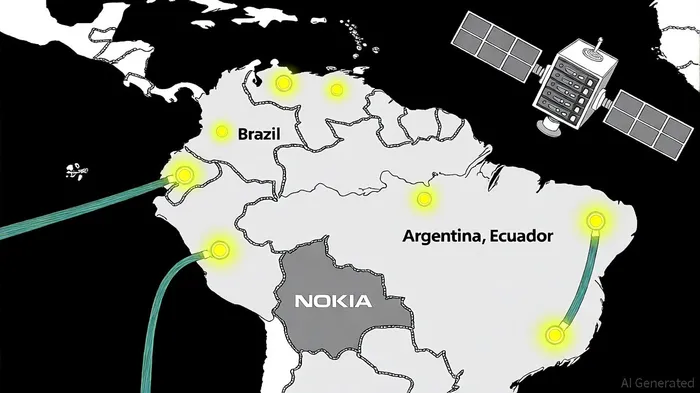
Nokia's recent collaborations in Latin America underscore its commitment to capturing a significant share of the region's 5G infrastructure market. In 2025, the company partnered with TIM Brasil to expand 5G coverage across 15 states, leveraging its AirScale portfolio and MantaRay Network Management system to enhance connectivity and drive enterprise digitalization. This partnership aligns with Brazil's ambitious goal to achieve nationwide 5G coverage by 2029, a market projected to reach 179 million subscribers by 2030, according to a GlobeNewswire report.
Similarly, Nokia's 2023 alliance with Telefónica focuses on deploying private wireless networks for industries such as mining, energy, and manufacturing. These partnerships highlight Nokia's dual strategy: expanding public 5G networks while addressing the growing demand for industry-specific connectivity solutions. In Argentina, Nokia secured a landmark 5G contract with Claro Argentina in 2024, becoming the sole supplier for the country's initial 5G rollout, according to an ABI Research report. The deployment of its AirScale portfolio in major cities positions Nokia to capitalize on Argentina's digital transformation agenda.
A pivotal development in 2025 was Nokia's partnership with Ecuador's Corporación Nacional de Telecomunicaciones E.P. (CNT E.P.) to launch the country's first commercial 5G network. This project, utilizing Nokia's AirScale and IP routing solutions, delivers speeds up to 1.5 Gbps and ultra-low latency, supporting digital transformation in healthcare, education, and transportation, as reported in a Yahoo Finance article. The initiative aligns with Ecuador's national broadband strategy, aiming to expand high-speed connectivity nationwide by mid-2026.
Market Growth and Economic Impact
The Latin American 5G enterprise market is projected to grow at a compound annual growth rate (CAGR) of 29.9% from 2025 to 2030, reaching $1.2 billion in revenue by 2030, according to a Grand View Research forecast. This growth is driven by hybrid networks, which accounted for 4.4% of the global 5G enterprise market in 2024. The expansion of 5G is also catalyzing edge computing infrastructure, particularly in Brazil, Mexico, and Chile. For instance, Mexico's Telcel already serves 10 million 5G subscribers, with 6.6 million in 125 cities as of 2024 (per the GlobeNewswire analysis cited above).
Nokia's involvement in these markets is not merely transactional; it is fostering localized ecosystems. By supplying energy-efficient solutions tailored to dynamic wireless environments, Nokia supports Latin American operators in reducing operational costs while meeting sustainability goals, as noted in the Yahoo Finance coverage of the Ecuador project. This aligns with the region's increasing investments in AI-ready data centers, led by operators like Scala Data Centers and Elea Data Centers (see the GlobeNewswire report cited earlier).
Competitive Positioning and Geopolitical Context
Nokia's expansion in Latin America occurs amid fierce competition from Huawei, Ericsson, and local vendors. In Q2 2025, Huawei overtook Nokia as the second-largest RAN vendor outside China, leveraging its cost-effective solutions and strong presence in emerging markets, according to a Light Reading article. However, Nokia's partnerships with Western operators-such as Vodafone and Rakuten Mobile-demonstrate its ability to navigate geopolitical tensions, particularly the U.S.-China tech war, which has created opportunities for Western vendors in Latin America (as noted in the ABI Research analysis referenced earlier).
Ericsson, the global RAN market leader, has focused on markets where Huawei is excluded, such as the U.S. and India, as described in a Light Reading article. In contrast, Nokia's strategy in Latin America emphasizes collaboration with both global and local stakeholders. For example, its Ecuador project involves close coordination with the government, ensuring alignment with national digital goals, which helps mitigate risks associated with regulatory shifts and enhances long-term contract stability (see the Yahoo Finance coverage referenced above).
Long-Term Strategic Value
Nokia's 5G partnerships in Latin America offer significant long-term value. First, the region's projected 5G growth-driven by urbanization, industrial digitization, and edge computing-provides a durable revenue stream. Second, Nokia's focus on hybrid networks and private wireless solutions positions it to benefit from the shift toward industry-specific applications, such as smart manufacturing and autonomous logistics. Third, the geopolitical realignment following the U.S.-China tech war has created a vacuum in Latin America, which Nokia is filling through strategic alliances with Western operators and governments (as discussed in the ABI Research report cited earlier).
However, challenges persist. Huawei's dominance in the RAN market outside China remains a hurdle, and regulatory uncertainties in countries like Brazil could delay infrastructure projects. Nonetheless, Nokia's emphasis on localized, energy-efficient solutions and its alignment with national digital agendas provide a competitive edge.
Conclusion
Nokia's 5G expansion in Latin America reflects a calculated, long-term strategy to capitalize on the region's digital transformation. By securing high-impact partnerships with operators like TIM Brasil, Claro Argentina, and CNT E.P., Nokia is not only expanding its market share but also fostering ecosystems that align with global trends in edge computing and AI. While competition from Huawei and Ericsson is intense, Nokia's ability to navigate geopolitical dynamics and deliver tailored solutions positions it as a key player in Latin America's 5G future. For investors, this represents a compelling opportunity in a market with substantial growth potential.





Comentarios
Aún no hay comentarios