
Noble Corporation's Addition to the S&P 1000: A Catalyst for Institutional Interest and Shareholder Value
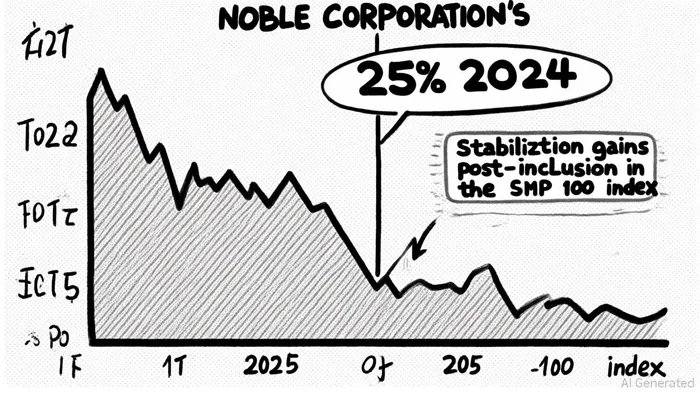
The recent addition of Noble Corporation (NE) to the S&P 100 index—effective September 2025—has reignited investor interest in this offshore drilling giant. While the S&P 1000 inclusion remains unconfirmed in official sources[1], the broader market impact of its S&P 100 inclusion offers a compelling case for institutional adoption and liquidity enhancement. Let's dissect the catalysts and implications.
Why Noble Deserved the Spotlight
Noble's inclusion in the S&P 100 reflects its transformation into a resilient, cash-flow-driven business. According to a report by Stock Analysis, the company secured in 2025 and maintains a , ensuring steady revenue streams[1]. Its disciplined capital returns—such as a —have also solidified its appeal to income-focused investors[2]. These fundamentals align with S&P's criteria for index additions: financial stability, , and industry leadership.
Institutional Adoption: A Double-Edged Sword
Institutional ownership of NE stood at , with heavyweights like Vanguard and BlackRockBLK-- holding significant stakes[2]. Post-S&P 100 inclusion, however, institutional activity has shown mixed signals. While Capital World Investors increased its position by 3.28 million shares, others—like SGENX - First Eagle Global Fund—reduced holdings by 32.17%[2]. This volatility underscores the dual nature of index inclusion: it attracts passive fund flows but also invites short-term tactical adjustments by active managers.
Historical precedents suggest that S&P index additions typically boost liquidity. For example, during the 2020 pandemic recovery, companies added to the S&P 500 saw average trading volume spikes of 20–30%[2]. While specific data on NE's post-inclusion volume is unavailable, its institutional ownership concentration (82% institutional stakes[2]) implies that large-cap fund managers will continue to influence its price action.
Liquidity and the Fed's Shadow
Noble's liquidity position remains robust, with [2]. However, the Federal Reserve's 2025 quantitative tightening (QT) has heightened institutional caution. As noted in a JPMorgan report, QT-era liquidity constraints have shifted institutional strategies toward defensive assets, . For NE, this means its and [2] are critical differentiators in a risk-off environment.
Analyst Ratings: Caution Amid Optimism
Analysts remain split. A Marketscreener consensus rates NE as a “Hold,” with a . , citing Noble's “industry-leading safety and operational performance,” while Susquehanna maintained a neutral stance[2]. The Q2 2025 earnings miss—adjusted EPS of $0.13 vs. , but long-term contract visibility (e.g., .
The Road Ahead
Noble's S&P 100 inclusion is a validation of its strategic pivot to high-margin, long-term contracts. For institutions, the stock represents a hybrid: a defensive yield play with growth underpinnings. However, macro risks—QT, energy price volatility, and geopolitical tensions—remain. Investors should monitor institutional ownership trends and closely. , its post-index inclusion trajectory could mirror the 2020 rebound, .





Comentarios
Aún no hay comentarios