
Nissan's Revamped ProPilot and Its Strategic Implications for Autonomous Driving
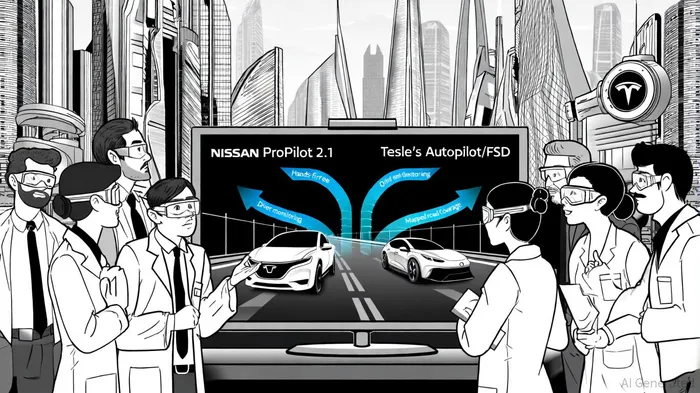
The autonomous driving landscape in 2025 is defined by rapid innovation and fierce competition, with Nissan's ProPilot 2.1 and Tesla's Autopilot/FSD emerging as two of the most prominent players in the L2+ ADAS segment. As automakers race to refine semi-autonomous systems, investors must evaluate how Nissan's strategic positioning—rooted in cautious, driver-assisted innovation—compares to Tesla's bold, software-driven approach. This analysis explores Nissan's ProPilot 2.1, its technical and market advantages, and its implications for the broader autonomous driving investment landscape.
ProPilot 2.1: A Cautious Leap into Hands-Free Driving
Nissan's ProPilot 2.1 represents a significant evolution in its driver-assistance technology, offering hands-free driving on pre-mapped highways and integrating advanced hardware such as HD maps, 10 sonar sensors, and infrared cameras for driver monitoring[1]. Available on 2025 models like the Rogue SL, ArmadaAACI--, and Infiniti QX80, the system allows drivers to remove their hands from the wheel on approximately 115,000 miles of mapped roads in the U.S. and Canada[2]. Key features include lane centering, adaptive cruise control, and automated lane-change suggestions, though the driver must confirm maneuvers manually[3].
A critical differentiator is ProPilot 2.1's emphasis on driver attentiveness. The system employs an infrared camera to track eye movement, ensuring the driver remains engaged—a feature absent in Tesla's Autopilot[4]. This approach aligns with Nissan's conservative strategy, prioritizing safety over full autonomy. Additionally, ProPilot 2.1 integrates GoogleGOOGL-- Maps for real-time traffic updates and personalized navigation, enhancing user experience[5].
Tesla's FSD: Aggressive Automation with Mixed Reception
Tesla's Full Self-Driving (FSD) system, in contrast, has long been a market leader, offering broader functionality such as traffic light recognition, city street navigation, and automated parking[6]. With over 1.2 million active FSD subscriptions globally as of Q3 2025, Tesla's software-as-a-service model generates recurring revenue while maintaining a first-mover advantage[7]. The system's camera-only architecture, however, has drawn scrutiny for inconsistent performance in adverse conditions, and its lack of robust driver monitoring has raised safety concerns[8].
Despite these challenges, Tesla's FSD remains a dominant force, supported by frequent over-the-air updates and a 46% U.S. EV market share in Q2 2025[9]. However, regulatory hurdles in Europe and public skepticism about driver complacency have tempered its growth[10].
Strategic Positioning: Nissan's Niche vs. Tesla's Ambition
Nissan's ProPilot 2.1 occupies a distinct niche in the L2+ market. By focusing on highway driving and integrating partnerships with Google, Nissan has created a user-friendly system that appeals to safety-conscious consumers. Its mapped road coverage, though smaller than GM's Super Cruise (750,000 miles), is expanding via over-the-air updates[11]. The system's affordability—offered as part of a $3,200 technology package in the 2025 Rogue—also positions it as a cost-effective alternative to Tesla's $8,000 FSD purchase or $99/month subscription[12].
Tesla, meanwhile, continues to push the boundaries of autonomy, aiming for Level 3 capabilities with its FSD v13 update. However, its aggressive roadmap faces headwinds, including regulatory delays and competition from Chinese EV manufacturers like BYD, which are rapidly scaling ADAS adoption[13].
Market Share and Investment Implications
While TeslaTSLA-- dominates the EV and ADAS markets, Nissan's ProPilot 2.1 is gaining traction among consumers seeking a balanced approach to automation. Consumer Reports has ranked ProPilot 2.0 above Tesla's Autopilot, citing superior lane centering and driver monitoring[14]. This suggests that Nissan's cautious, safety-first strategy may resonate with a broader audience as regulatory scrutiny of autonomous systems intensifies.
For investors, the key lies in diversification. Tesla's FSD offers high-growth potential but carries regulatory and technical risks. Nissan's ProPilot 2.1, with its focus on incremental innovation and partnerships, presents a more stable, albeit slower, path to market penetration. The global ADAS market, projected to grow at a 23.27% CAGR through 2030[15], will likely reward companies that balance innovation with safety and affordability.
Conclusion
Nissan's ProPilot 2.1 underscores the automaker's commitment to refining L2+ capabilities while navigating the complexities of autonomous driving. Though it trails Tesla in ambition and market share, its emphasis on driver monitoring, affordability, and partnerships positions it as a credible competitor in the L2+ segment. For investors, the strategic implications are clear: a diversified portfolio that includes both Tesla's disruptive potential and Nissan's measured innovation may best capture the opportunities—and mitigate the risks—of the evolving ADAS landscape.





Comentarios
Aún no hay comentarios