
NioCorp's Q3 2025 Results: Strategic Resilience in a Volatile Rare Earth Landscape
NioCorp Developments Ltd. (NYSE: NB) has navigated a turbulent Q3 2025 with a mix of financial strain and strategic progress, reflecting the broader volatility of the rare earth materials industry. The company reported a record cash balance of $162.8 million as of September 30, 2025, but this was offset by a net loss of $42.7 million, or $0.53 per share, compared to $2.1 million in the same period in 2024, according to the company's preliminary unaudited results. The loss was driven by non-cash charges of $32.1 million tied to share price fluctuations and $6.8 million in expenditures for the Elk Creek Project, the results show. While these figures underscore operational challenges, they also highlight NioCorp's aggressive capital allocation to advance its critical minerals project in southeast Nebraska-a move that aligns with U.S. national security priorities and growing demand for EV and clean energy technologies.
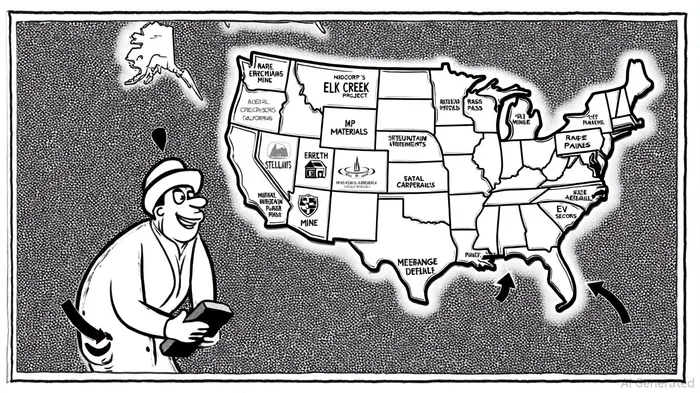
Strategic Positioning Amid Industry Volatility
The rare earth sector in 2025 is defined by geopolitical fragility and shifting supply dynamics. China's dominance-accounting for 63% of global rare earth element (REE) mining and 90% of processing-has intensified concerns over supply chain concentration, as detailed in a Streetwise Reports article. Recent export restrictions on seven REEs in April 2025, according to a TradeCloud analysis, and border closures affecting Myanmar imports, according to Fastmarkets, have further destabilized markets. Against this backdrop, NioCorp's vertically integrated Elk Creek Project has emerged as a strategic asset. The project, which is shovel-ready with permits in place, targets niobium, scandium, titanium, and magnetic rare earths like neodymium and dysprosium-materials critical for EV motors, wind turbines, and defense systems, as outlined in a NioCorp press release.
The U.S. government has elevated niobium, dysprosium, and terbium to the top 10 most critical minerals for national security, amplifying NioCorp's relevance. The company's CEO, Mark A. Smith, has emphasized that niobium's strategic value is underscored by its 100% import dependency in the U.S., with potential GDP losses if access is disrupted. This alignment with federal priorities has already yielded tangible support: the project has received a $10 million grant from the U.S. Department of Defense and has entered discussions with the Export-Import Bank for $800 million in low-cost financing, according to a CruxInvestor report.
Capital Raising and Partnership Progress
To fund the $1.2 billion construction cost of Elk Creek, NioCorpNB-- executed three equity offerings in Q3 2025, raising $155 million in gross proceeds, the company said. While these raises diluted existing shareholders, they provided critical liquidity to advance pre-construction activities, including land acquisition and engineering design, according to a Construction Owners press release. The company has also secured binding offtake agreements for 50% of its niobium output with Thyssenkrupp and 12 tonnes of scandium annually with Traxys USA. Most notably, a term sheet with Stellantis for a 10-year rare earth offtake agreement-pending project financing-positions NioCorp to supply neodymium-praseodymium oxide, dysprosium oxide, and terbium oxide for EV electrification, per a Stellantis term sheet.
These partnerships contrast with the broader industry's reliance on government bailouts. For instance, MP Materials, a key competitor, has secured a $400 million Pentagon investment and a $500 million Apple deal, according to Stockwave Insights, while Lynas Rare Earths in Australia has leveraged U.S. defense funding for refining capacity. NioCorp's approach, however, emphasizes private-sector collaboration and project-specific financing, which could offer long-term flexibility but also exposes it to market volatility.
Competitive Challenges and Opportunities
Despite its strategic advantages, NioCorp faces headwinds. The rare earth sector is grappling with price declines in 2024, which has pressured margins, and the company's adjusted net loss of $8.3 million in Q3 2025-up from $1.4 million in 2024-reflects ongoing cost pressures. Competitors like MP Materials, with its fully integrated supply chain and government-backed price floors, have a clearer path to profitability. NioCorp's reliance on external financing for Elk Creek's remaining $1.2 billion cost also introduces execution risk, particularly if rare earth prices stagnate or geopolitical tensions ease.
Yet, the company's focus on niobium and scandium-materials with limited global producers-offers a unique value proposition. Scandium, for example, is critical for high-strength aluminum alloys used in aerospace and defense, sectors less sensitive to cyclical demand swings. Additionally, NioCorp's project is one of only two in the U.S. with permits for rare earth processing, a capability that could become increasingly valuable as China's export controls tighten.
Conclusion: A High-Stakes Bet on Supply Chain Resilience
NioCorp's Q3 2025 results encapsulate the dual-edged nature of its strategy: significant financial losses paired with strategic progress in a sector where geopolitical tailwinds outweigh near-term profitability. The company's alignment with U.S. critical mineral priorities and its shovel-ready Elk Creek Project position it to benefit from long-term supply chain diversification efforts. However, its ability to secure remaining financing and execute on offtake agreements will determine whether it becomes a cornerstone of the non-Chinese rare earth ecosystem or a casualty of sector volatility. For investors, the key question is whether NioCorp can leverage its strategic assets to outpace competitors reliant on government largesse-a bet that hinges on both market conditions and the pace of global decarbonization.





Comentarios
Aún no hay comentarios