
How NIO's Battery Swap Network Is Reshaping EV Retail and Driving Customer Acquisition
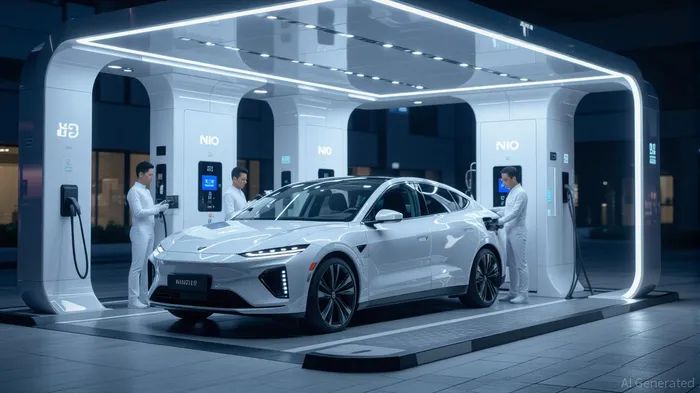
In the fiercely competitive electric vehicle (EV) market, Inc. (NIO) has carved out a unique niche by redefining retail strategy and customer acquisition through its battery-swap infrastructure. While most automakers rely on traditional charging networks and price wars, NIO's “Battery as a Service” (BaaS) model and expansive Power Swap Stations have created a defensible moat in a crowded industry. This approach not only addresses key pain points for EV buyers—such as range anxiety and long charging times—but also fosters loyalty through a community-driven retail experience.
The Battery Swap Network: A Game-Changer for EV Retail
NIO's Power Swap Stations are more than just infrastructure; they are a strategic lever for customer retention and market differentiation. As of June 2025, the company operates 3,405 battery swap stations in China, with 1,000 along highways connecting 550 major cities. These stations have enabled 80 million cumulative swaps, with an average of 97,000 daily transactions in Q2 2025. The convenience of swapping a depleted battery for a fully charged one in under three minutes has proven critical for long-distance travel, particularly during peak holiday periods. For instance, one station recorded 150 swaps in a single day during the 2024 Labor Day holiday, showcasing the scalability of the model.
The model further amplifies this advantage. By decoupling battery ownership from vehicle purchase, NIONIO-- reduces upfront costs by up to 10% for buyers. Customers can lease batteries on a subscription basis or opt for different battery capacities based on their usage patterns. This flexibility has driven adoption among both urban commuters and long-haul drivers, with 60% of new sales attributed to referrals from existing customers. The company's data also highlights economic benefits: battery swaps have saved users an estimated RMB 20.9 billion ($2.9 billion) in energy costs compared to gasoline vehicles, reinforcing the value proposition.
Retail Strategy: Beyond the Showroom
NIO's retail model diverges sharply from conventional dealership formats. The company's “NIO Houses”—multifunctional showrooms in urban centers—serve as community hubs, co-working spaces, and social venues. These locations are designed to foster brand loyalty and word-of-mouth marketing, with 187 NIO Houses operational globally by June 2025. The integration of digital tools, such as the NIO App, further enhances the customer experience. The app allows users to book swaps, manage subscriptions, and access a range of services, including remote diagnostics and branded merchandise. This ecosystem has driven a 50% penetration rate for NIO Life products among vehicle owners, with an average annual spend of $300 per customer.
The company's digital-first approach is equally impactful. The NIO App has become a one-stop platform for e-commerce, social networking, and vehicle management, creating a sticky user experience. This digital infrastructure not only streamlines operations but also provides NIO with valuable data to refine its offerings and target new markets.
Defensibility in a Crowded Market
NIO's battery-swap network is a formidable barrier to entry for competitors. While TeslaTSLA-- (TSLA) and others focus on fast-charging infrastructure, NIO's swap stations offer a faster, more scalable solution. The company's partnerships with for Choco-Swap technology and ShellSHEL-- for EV infrastructure further solidify its lead. Additionally, NIO's modular, expandable station design—patented in late 2024—enables rapid capacity increases without new construction, reducing capital expenditures.
Internationally, NIO is replicating its success in Europe, with 60 swap stations across five countries and plans to expand to 1,000 by 2025. Despite slower progress in Q2 2025 (adding only 384 new stations against a target of 1,800–2,000), the company is addressing bottlenecks through regional partnerships and operational efficiency measures. For example, collaborations in 15 Chinese provinces have reduced deployment costs, while larger “hub” stations in high-demand areas aim to boost throughput.
Challenges and the Road Ahead
NIO's ambitious expansion faces headwinds. The company must accelerate station deployment to meet its 2025 targets, requiring an average of 54–62 new stations per week in the second half of the year. Internationally, European operations remain under-resourced, with only five active employees in the Power division. However, NIO's leadership changes—such as Stanley Qu overseeing infrastructure and Fei Shen leading the Onvo sub-brand—signal a focus on streamlining operations and innovation.
The introduction of fifth-generation swap stations in 2025, compatible with the sub-brand, also positions NIO to capture mass-market segments. With Firefly's new models leveraging CATL's Choco-Swap technology, the company is poised to expand its reach beyond premium buyers.
Investment Implications
NIO's non-traditional retail strategy and battery-swap infrastructure present a compelling long-term investment opportunity. While short-term execution risks exist—such as meeting expansion targets—the company's defensible moat, high customer retention, and innovative ecosystem create a strong foundation for growth. Investors should monitor key metrics, including:
- Swap station deployment rates and regional expansion progress.
- Customer acquisition costs and referral rates, which highlight the effectiveness of NIO's community-driven model.
- BaaS subscription growth, which could become a recurring revenue stream.
For those with a 3–5 year horizon, NIO's ability to scale its network and diversify into new markets—particularly in Europe—could drive significant shareholder value. However, investors should balance optimism with caution, as the EV sector remains highly competitive and capital-intensive.
In conclusion, NIO's battery-swap network is not just a technological innovation but a strategic reimagining of EV retail. By addressing customer pain points, fostering loyalty, and leveraging digital tools, the company has positioned itself as a leader in a market where differentiation is key. For investors seeking exposure to the EV revolution, NIO's unique approach offers a compelling case for long-term growth.





Comentarios
Aún no hay comentarios