
Nintendo Switch 2 Delays and Borderlands 4: A Tectonic Shift in Gaming Sector Valuations?
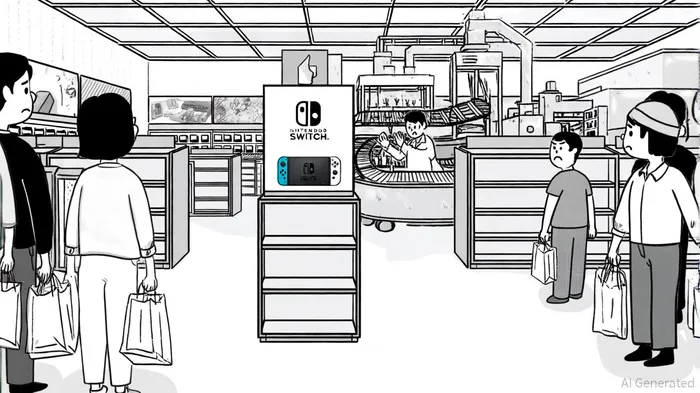
The Nintendo Switch 2's delayed pre-orders and the indefinite postponement of Borderlands 4 on the platform have ignited a firestorm of uncertainty in the gaming sector. These events, while seemingly isolated, expose a broader vulnerability in the industry's risk-reward calculus. For investors, the interplay between hardware bottlenecks and software monetization challenges is reshaping valuations in ways that demand closer scrutiny.
Hardware Delays: Tariffs, Production, and the Cost of Entry
Nintendo's decision to delay U.S. pre-orders for the Switch 2 until after assessing Trump-era tariffs has created a ripple effect. The console, priced at $449.99—nearly double its predecessor—faces a 46% tariff on Vietnamese imports and similar hurdles from Chinese manufacturing hubs[1]. This has forced Nintendo to navigate a precarious balancing act: absorb costs to maintain the price point or risk alienating price-sensitive consumers. According to a report by CNBC, the company's production capacity struggles have already led to global shortages, with 6 million units shipped in the first month of the June 2025 launch[2]. Analysts at TechPowerUp predict these shortages could persist until spring 2026 due to ongoing parts shortages[3].
The hardware delays are not merely logistical. They signal a fundamental tension between Nintendo's premium pricing strategy and the economic realities of global trade. As stated by Nintendo President Shuntaro Furukawa, the company is “focused on increasing production and delivering a device that justifies its higher price point”[4]. Yet, with tariffs pushing costs upward and supply chain bottlenecks persisting, the Switch 2's profitability remains a question mark.
Software Monetization: Borderlands 4 as a Case Study
The indefinite delay of Borderlands 4 on the Switch 2 underscores the fragility of third-party software ecosystems. Gearbox Software cited “additional development and polish time” as the reason for the delay, but the root cause lies in the Switch 2's hardware limitations and the game's performance issues on other platforms[5]. According to IGN, early hands-on reports highlighted subpar performance on the Switch 2, including low frame rates and input lag[6]. Gearbox's CEO, Randy Pitchford, has defended the game's optimization challenges, but this has done little to quell investor concerns.
The delay's financial implications are twofold. First, it disrupts revenue streams for both Gearbox and Nintendo. Digital pre-orders for the Switch 2 version were canceled, with refunds issued starting September 26[7]. Second, it raises questions about the Switch 2's viability as a platform for high-end third-party titles. As noted by Gamerant, the lack of development kits for the Switch 2 has already delayed other projects, including Warframe[8]. This scarcity of hardware for developers exacerbates the risk of a weak launch library, which could deter consumers and investors alike.
Investor Sentiment: A Stock Market Whiplash
The gaming sector's stock valuations have been particularly sensitive to these developments. Nintendo's stock, which hit an all-time high of $24.44 in early August 2025, dipped to $21.50 by late September following the Borderlands 4 delay announcement[9]. Analysts at Newzoo attribute this volatility to “heightened uncertainty around the Switch 2's ability to sustain long-term demand”[10]. Meanwhile, Gearbox's parent company, 2K, has seen its shares underperform, with investors wary of the Borderlands franchise's reputation for technical shortcomings.
The broader market context is equally telling. The 2024 console hardware slump—marked by a 25% drop in U.S. spending on PlayStation, Xbox, and Switch devices—has left investors with a lingering skepticism about hardware cycles[11]. The Switch 2's delayed pre-orders and the Borderlands 4 fiasco have only deepened this skepticism. As one analyst put it, “The sector is now pricing in a 'wait-and-see' approach, with valuations reflecting a premium only for companies with diversified revenue streams”[12].
Risk-Reward Rebalance: What's Next for Investors?
The cascading effects of hardware and software delays are forcing a recalibration of risk-reward profiles. For Nintendo, the Switch 2's success hinges on its ability to mitigate supply chain risks and attract third-party developers. The company's commitment to producing 15 million units by March 2026[13] is a positive signal, but it remains to be seen whether this will offset the reputational damage from pre-order delays and shortages.
For Gearbox and other third-party developers, the Borderlands 4 delay highlights the perils of overambitious launch windows. The game's performance issues on PC and consoles have already eroded consumer trust, and the lack of a clear release date for the Switch 2 version adds to the uncertainty. As Forbes notes, “Investors are now factoring in a higher discount rate for games with cross-platform ambitions, given the Switch 2's hardware constraints”[14].
Conclusion: A Sector at a Crossroads
The Nintendo Switch 2 and Borderlands 4 saga is more than a case study in mismanagement—it is a microcosm of the gaming sector's evolving challenges. Hardware delays, exacerbated by geopolitical tariffs and supply chain fragility, are colliding with software monetization hurdles, creating a perfect storm for investor caution. While the long-term growth of the gaming industry remains intact, the path to recovery will require nimble strategies from both hardware manufacturers and software developers. For investors, the lesson is clear: in an era of interconnected risks, the gaming sector's valuations will be judged not just by the quality of its products, but by its ability to navigate the turbulence of global markets.







Comentarios
Aún no hay comentarios