
Nintendo's Strategic Reinvention: Why the Switch 2 Success Signals Long-Term Value for Investors
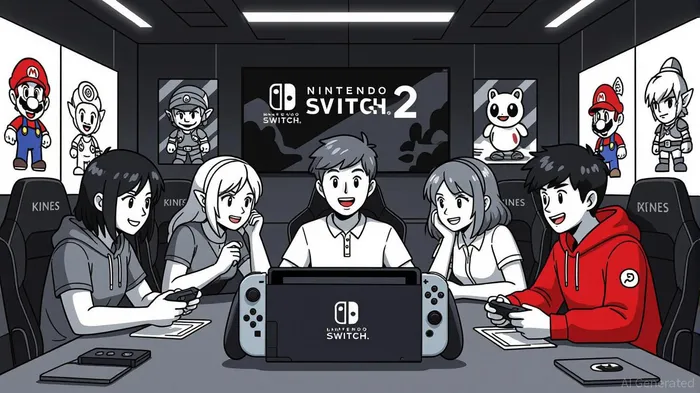
In the ever-evolving gaming landscape, Nintendo has once again proven its mettle with the record-breaking launch of the Switch 2. The console, which debuted on June 5, 2025, has sold over 7 million units globally in just seven weeks, making it the fastest-selling console in history [1]. This achievement is not merely a product of hardware innovation but a testament to Nintendo’s strategic reinvention—a blend of capital-efficient innovation, enduring brand loyalty, and a masterclass in monetizing intellectual property (IP). For investors, the Switch 2’s success signals a company that has not only adapted to market demands but has redefined them.
Capital-Efficient Innovation: Hardware as a Gateway to High-Margin Software
Nintendo’s business model hinges on a flywheel effect: hardware drives software sales, which in turn reinforce brand loyalty and justify future hardware investments. The Switch 2 exemplifies this. While its hardware—featuring a 7.9-inch LCD screen, 4K support, and enhanced Joy-Con 2 controllers—has drawn praise, the real profit engine lies in software. First-party titles like Mario Kart World and The Legend of Zelda: Tears of the Kingdom have sold millions, with Mario Kart World achieving a 96.7% attachment rate among Switch 2 owners [5].
This software-centric strategy is capital-efficient. Nintendo’s software segment operates at gross margins of approximately 65%, dwarfing the 30% margins of its hardware business [1]. By contrast, competitors like MicrosoftMSFT-- and SonySONY-- rely heavily on hardware sales, which operate at lower margins and require significant upfront investment in manufacturing and cloud infrastructure. Microsoft’s Game Pass subscription model and Sony’s focus on PlayStation 5 exclusives are undeniably successful, but they lack the recurring revenue and high-margin leverage Nintendo extracts from its IPs [3].
Monetizing IPs Beyond the Screen: Films, Parks, and Global Reach
Nintendo’s ability to stretch its IPs across mediums is a key differentiator. The Super Mario Bros. Movie, for instance, became the second-highest-grossing film of 2023, generating a “halo effect” that boosted Mario-related game sales [4]. Similarly, Nintendo’s foray into theme parks—though still nascent—shows promise, with properties like Mario and Pokémon offering untapped monetization potential. This diversification reduces reliance on cyclical hardware cycles and creates cross-promotional synergies.
Financially, this strategy pays off. In fiscal year 2024, Nintendo reported $12.2 billion in revenue, with operating profit rising 25% year-over-year to ¥580 billion [2]. While Sony and Microsoft posted higher overall revenues ($29.8 billion and $25.1 billion, respectively), Nintendo’s profit margins and return on invested capital (ROIC) outpace both, reflecting its asset-light model [2].
Brand Loyalty: The Unseen Engine of Growth
Nintendo’s success is underpinned by a fanbase that is as loyal as it is global. The Switch 2’s launch saw U.S. sales outpace the original Switch’s 2017 performance by 75% [2], while Japan—Nintendo’s home market—accounted for 1.27 million units in Q1 2025 [5]. This loyalty stems from decades of nurturing iconic franchises and a “game-first” design philosophy that prioritizes playability over raw power. Backward compatibility with the original Switch’s library further cements this ecosystem, ensuring that new hardware adoption is met with minimal friction.
Critics may point to the Switch 2’s $449.99 price tag and shorter battery life as drawbacks [5], but these concerns are overshadowed by the console’s performance and the emotional equity Nintendo has built. In an era of economic uncertainty, consumers are willing to pay a premium for brands that deliver nostalgia and innovation—a dynamic Nintendo has mastered.
Contrasting Models: Asset-Light vs. Tech-Driven
While Sony and Microsoft bet on hardware scale and cloud infrastructure, Nintendo’s asset-light approach minimizes risk and maximizes flexibility. Sony’s PlayStation 5, for example, has sold 65 million units, but its reliance on physical hardware and exclusive titles creates vulnerability during supply chain disruptions or shifts in consumer preferences [2]. Microsoft’s $68.7 billion acquisition of Activision Blizzard added IP depth but also increased debt and operational complexity [2]. Nintendo, by contrast, leverages existing IPs to drive growth without the need for costly acquisitions or infrastructure overhauls.
The Investment Case: A Must-Owning Play
For investors, Nintendo represents a rare combination of defensiveness and growth potential. Its capital-efficient model, high-margin software business, and diversified IP monetization create a moat that rivals struggle to match. The Switch 2’s projected 15 million unit sales by March 2026 [5] suggest this momentum is far from peaking. Meanwhile, Nintendo’s forays into films, theme parks, and potential metaverse integrations open new revenue streams.
Source:
[1] Nintendo Switch 2: The Fastest Selling Console Ever With ... [https://www.superbcrew.com/nintendo-switch-2-the-fastest-selling-console-ever-with-over-5-million-units-sold-in-its-first-month/]
[2] Nintendo Switch 2 Has Sold 2 Million Units in the U.S., 75% Ahead of the Switch 1's Pace [https://www.ign.com/articles/nintendo-switch-2-has-sold-2-million-units-in-the-us-75-ahead-of-the-switch-1s-pace]
[3] Microsoft Stock Analysis 2025: The Next Great Growth Story? [https://www.prospiausa.com/post/microsoft-stock-analysis-2025-the-next-great-growth-story]
[4] Nintendo Deep Dive - by Samir Soriano [https://samirdivesdeep.substack.com/p/nintendo-deep-dive]
[5] Nintendo Quarterly Revenue More Than Doubles ... [https://stocktwits.com/news-articles/markets/equity/nintendo-quarterly-revenue-more-than-doubles-powered-by-smashing-switch-2-sales/chr3t3ARdbT]





Comentarios
Aún no hay comentarios